
CIE iGCSE Co-Ordinated Science C4.2 Hydrogen–oxygen fuel cells Exam Style Questions Paper 4
Question
Most-appropriate topic codes (Cambridge IGCSE Co-ordinated Sciences 0654):
• Topic C4.2 — Hydrogen-oxygen fuel cells
• Topic C10.2 — Air quality and climate
▶️ Answer/Explanation
(a)(i) water
The only product formed in a hydrogen-oxygen fuel cell is water, making it an environmentally friendly energy source.
(a)(ii) loss of electrons (from hydrogen)
Oxidation is defined as the loss of electrons. At the anode, hydrogen atoms lose electrons to form protons, so they are oxidised.
(b)
Any three from:
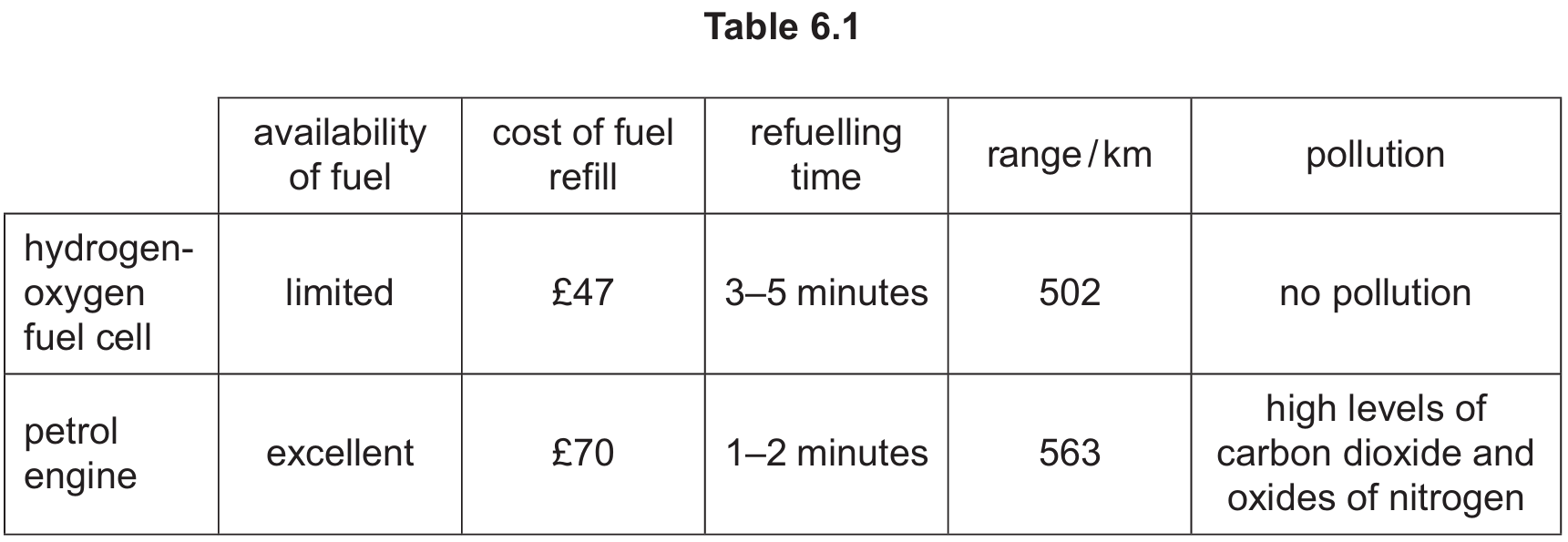
Hydrogen-oxygen fuel cell:
- cheaper (than petrol) to refill
- short refuelling time
- good range
- no pollution
OR
Petrol engine:
- high availability / excellent availability
- quicker refuelling
- longer range (than hydrogen-oxygen)
The most suitable fuel depends on the criteria prioritised. Hydrogen-oxygen fuel cells produce no pollution but have limited availability, while petrol engines have excellent availability and slightly longer range but produce harmful emissions.
(c)(i) acid rain / respiratory problems
Oxides of nitrogen dissolve in rainwater to form acid rain, which damages buildings, soil, and aquatic ecosystems. They also irritate the respiratory system.
(c)(ii) nitrogen reacts with oxygen ; at high temperature (inside a car engine)
The high temperatures and pressures in car engines cause atmospheric nitrogen and oxygen to react, forming nitrogen oxides.
(c)(iii) 2CO + 2NO → 2CO₂ + N₂
In catalytic converters, carbon monoxide reduces nitrogen oxides, producing harmless carbon dioxide and nitrogen gas. This prevents toxic gases from being released into the atmosphere.