Home / iGCSE / Coordinated Sciences / C5.1 Exothermic and endothermic reactions Paper 2

CIE iGCSE Co-Ordinated Science C5.1 Exothermic and endothermic reactions Exam Style Questions Paper 2

Question

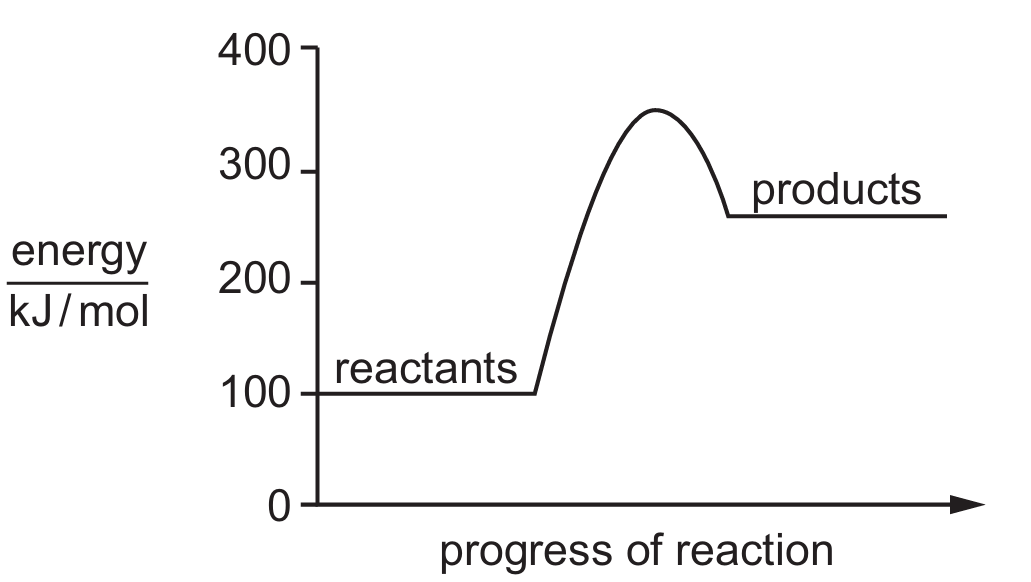
A reaction pathway diagram for a reaction is shown.

What is the value of the activation energy for this reaction?

A. 100 kJ/mol
B. 150 kJ/mol
C. 250 kJ/mol
D. 350 kJ/mol

▶️ Answer/Explanation
Activation energy is the energy difference between the reactants and the highest point (transition state). Reactants at 100 kJ, peak at 350 kJ, so activation energy = 350 – 100 = 250 kJ/mol. Answer C.
Answer: (C)

Question

Magnesium reacts with dilute hydrochloric acid.

During the reaction, the reaction mixture becomes warm.

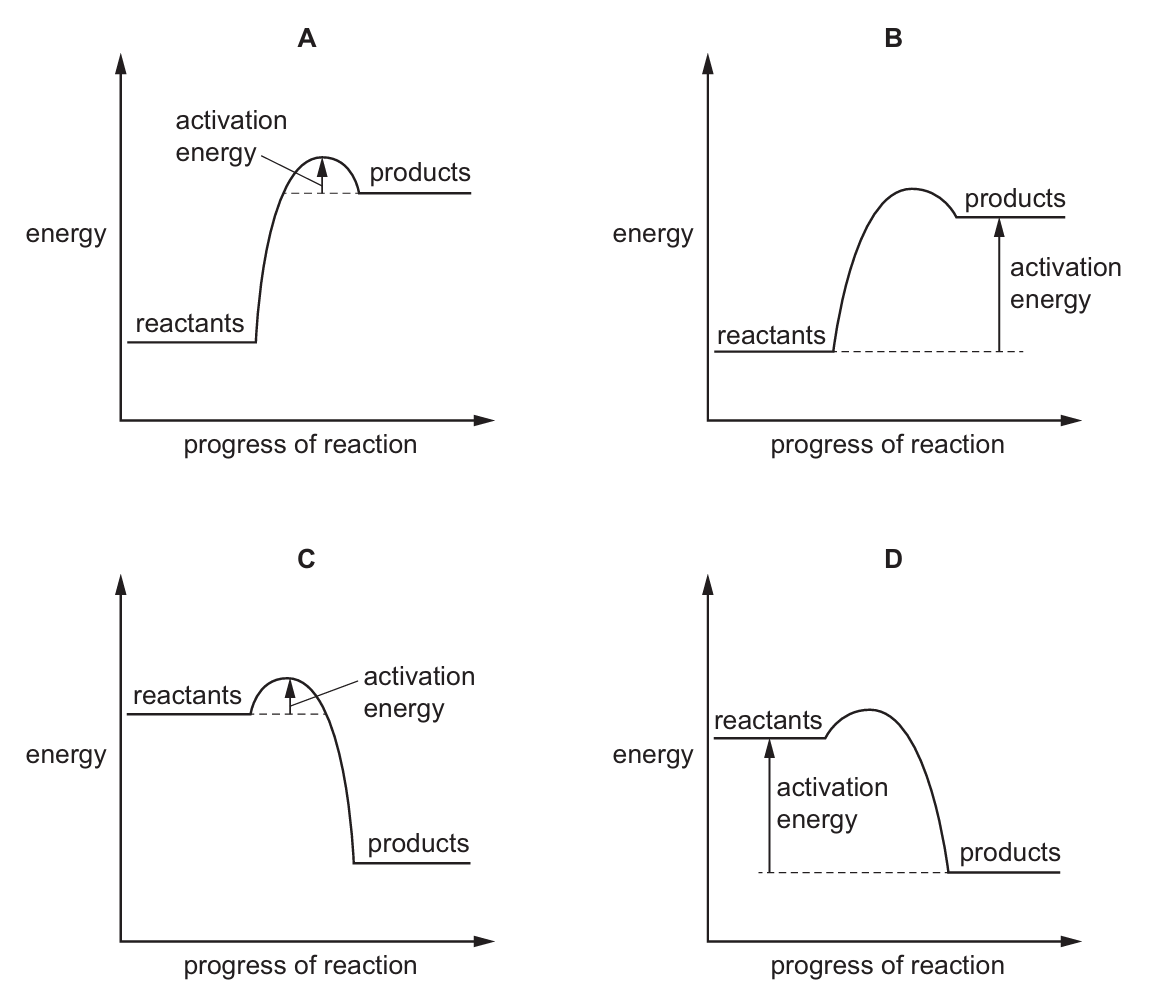
What is the reaction pathway diagram for this reaction?

▶️ Answer/Explanation
The reaction mixture becomes warm, indicating that the reaction is exothermic (releases thermal energy to the surroundings). In an exothermic reaction, the products have less energy than the reactants, so the energy level of products is lower on the diagram. The activation energy is the energy barrier shown as the peak. Therefore, diagram C correctly shows reactants at a higher energy level than products with the activation energy peak, representing an exothermic reaction. Diagrams A and B show endothermic reactions (products higher energy), and diagram D incorrectly shows products lower than reactants but without the correct labelling of activation energy.
Answer: (C)

Question

When magnesium reacts with dilute hydrochloric acid, the temperature of the mixture increases.

Which statement about this reaction is correct?

A. It is endothermic as thermal energy is taken in from the surroundings.
B. It is endothermic as thermal energy is transferred to the surroundings.
C. It is exothermic as thermal energy is taken in from the surroundings.
D. It is exothermic as thermal energy is transferred to the surroundings.

▶️ Answer/Explanation
The temperature of the mixture increases, which means the reaction releases thermal energy to the surroundings. This is characteristic of an exothermic reaction. In an exothermic reaction, thermal energy is transferred from the reacting chemicals to the surroundings, causing the temperature to rise. Endothermic reactions absorb energy and cause the temperature to decrease.
Answer: (D)

Question

When a match burns, heat and light energy are produced.

Which row describes the type of change and the type of reaction taking place?

▶️ Answer/Explanation
Burning (combustion) is a chemical change because new substances (\(\text{CO}_2\) and \(\text{H}_2\text{O}\)) are formed and the reaction is irreversible — the original match cannot be restored.
It is also an exothermic reaction because energy (heat and light) is released to the surroundings; therefore the correct row is B (chemical change, exothermic).
Answer: (B)

Question

The temperature of solution Q is 21 °C. The temperature of solution P is 24 °C.

The two solutions are mixed. The temperature of the mixture is 31 °C.

Which statement is correct?

A. An endothermic reaction occurs and the reacting chemicals gain energy.
B. An endothermic reaction occurs and the reacting chemicals lose energy.
C. An exothermic reaction occurs and the reacting chemicals gain energy.
D. An exothermic reaction occurs and the reacting chemicals lose energy.

▶️ Answer/Explanation
Both starting solutions were cooler (21 °C and 24 °C) than the resulting mixture (31 °C), so the surroundings gained thermal energy.
A temperature rise means the reaction released energy to the surroundings, which is the definition of an exothermic reaction.
In an exothermic reaction, it is the reacting chemicals that lose energy (as it is transferred out to the surroundings).
Answer: (D)
Scroll to Top