Home / iGCSE / Coordinated Sciences / C2.7 Metallic bonding Paper 2

CIE iGCSE Co-Ordinated Science C6.2 Rate of reaction Exam Style Questions Paper 2

Question

Calcium carbonate and dilute hydrochloric acid react together in a beaker.

When the reaction mixture is heated, the rate of the reaction increases.

Which statements explain this observation?

  1. The frequency of particle collisions increases.
  2. More colliding particles have energy greater than the activation energy.
  3. The gas pressure in the beaker increases.
  4. The activation energy decreases.

A. 1 and 2
B. 1 and 3
C. 2 and 4
D. 3 and 4

▶️ Answer/Explanation
Heating increases the kinetic energy of particles, causing them to move faster. This results in more frequent collisions between reactant particles (statement 1). Additionally, a greater proportion of collisions have sufficient energy to exceed the activation energy, meaning more collisions are successful (statement 2). Statement 3 is incorrect because gas pressure increase is an effect of heating, not a reason for the rate increase. Statement 4 is incorrect because activation energy is a constant for a given reaction and does not change with temperature (only a catalyst can lower activation energy). Therefore, statements 1 and 2 correctly explain the observation.
Answer: (A)

Question

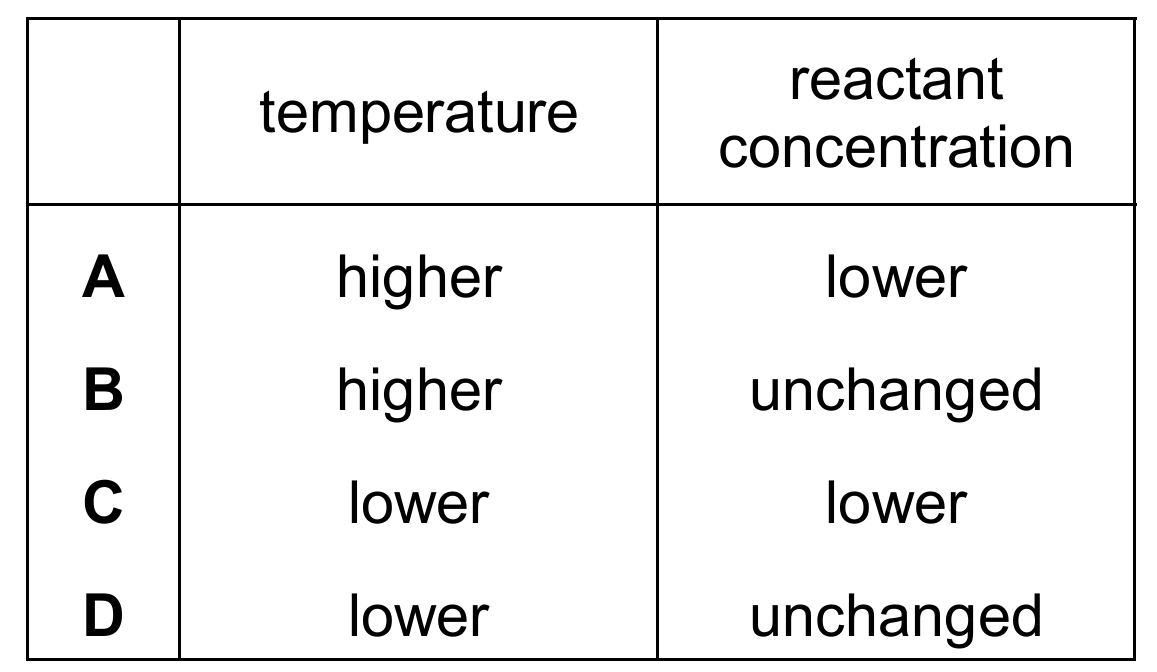
Which change to the conditions of a reaction can produce the same number of successful collisions between reacting particles per second?

▶️ Answer/Explanation
For the same number of successful collisions per second to occur, an increase in temperature (which increases collision frequency and energy) can be balanced by a decrease in reactant concentration (which reduces the number of particles available to collide). This way, the overall rate of successful collisions remains unchanged. Increasing temperature while keeping concentration unchanged would increase the rate, while decreasing both would decrease it further.
Answer: (A)

Question

The rate of reaction between calcium carbonate and dilute hydrochloric acid is determined either by measuring the change in gas volume per unit time or by measuring the change in mass per unit time.

Which piece of apparatus must be used for both methods?

A. a balance
B. a gas syringe
C. a stop-clock
D. a thermometer

▶️ Answer/Explanation
Both “per unit time” methods require the measurement to be tracked against time, so a stop-clock is always needed to time the readings.
A gas syringe is only needed for the gas volume method, and a balance is only needed for the mass-loss method.
A thermometer is not required for either method, since neither tracks temperature.
Answer: (C)

Question

Sulfuric acid is manufactured by the Contact process.

One of the reactions in this process converts sulfur dioxide to sulfur trioxide.

Which statements about the conditions for this reaction are correct?

  1. A nickel catalyst is used.
  2. A pressure of about 1–2 atmospheres is used.
  3. A temperature of about 450 °C is used.

A. 1, 2 and 3
B. 1 and 2 only
C. 1 and 3 only
D. 2 and 3 only

▶️ Answer/Explanation
The Contact process actually uses a vanadium(V) oxide catalyst, not nickel, so statement 1 is incorrect.
A pressure of about 1–2 atmospheres and a temperature of about 450 °C are the correct standard conditions used, so statements 2 and 3 are correct.
This makes the combination of statements 2 and 3 the accurate description of the conditions.
Answer: (D)

Question

Which change decreases the frequency of collisions between reactant particles?

A. increasing the concentration of reactant solutions
B. increasing the pressure on gaseous reactants
C. increasing the temperature of the reaction mixture
D. using larger pieces of a solid reactant

▶️ Answer/Explanation
Using larger pieces of a solid reactant reduces the exposed surface area for a given mass.
A smaller surface area means fewer particles are available for collisions, decreasing collision frequency and reaction rate.
All the other options increase collision frequency by increasing particle concentration or energy.
Answer: (D)
Scroll to Top