Home / iGCSE / Coordinated Sciences / C6.3 Redox Paper 2

CIE iGCSE Co-Ordinated Science C6.3 Redox Exam Style Questions Paper 2

Question

Which statements about oxidation and reduction are correct?

  1. Oxidation is the gain of oxygen.
  2. Oxidation is the loss of oxygen.
  3. Reduction is the gain of oxygen.
  4. Reduction is the loss of oxygen.

A. 1 and 3
B. 1 and 4
C. 2 and 3
D. 2 and 4

▶️ Answer/Explanation
Oxidation is defined as the gain of oxygen (statement 1), while reduction is defined as the loss of oxygen (statement 4). Statement 2 incorrectly describes oxidation as loss of oxygen, and statement 3 incorrectly describes reduction as gain of oxygen. Therefore, the correct statements are 1 and 4.
Answer: (B)

Question

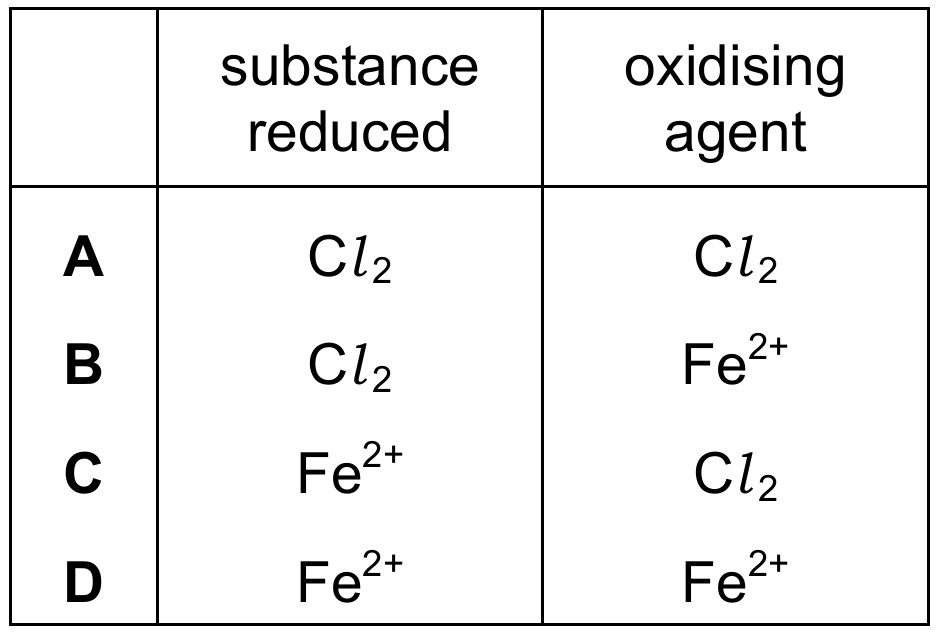
The ionic equation for the reaction between iron(II) chloride and chlorine is shown.

\(2\text{Fe}^{2+} + \text{Cl}_2 \rightarrow 2\text{Fe}^{3+} + 2\text{Cl}^-\)

Which row shows the substance that is reduced and the oxidising agent?

▶️ Answer/Explanation
\(\text{Fe}^{2+}\) loses an electron to become \(\text{Fe}^{3+}\), so iron is oxidised.
\(\text{Cl}_2\) gains electrons to become \(\text{Cl}^-\), so chlorine is the substance reduced.
Since \(\text{Cl}_2\) accepts electrons from iron, causing iron’s oxidation, chlorine is also the oxidising agent.
Answer: (A)

Question

Iron displaces copper ions from its aqueous salts.

An equation for this reaction is shown.

\(Fe + Cu^{2+} \rightarrow Fe^{2+} + Cu\)

What is the reducing agent in this reaction?

A. \(Cu\)
B. \(Cu^{2+}\)
C. \(Fe\)
D. \(Fe^{2+}\)

Most-appropriate topic codes (Cambridge IGCSE Co-ordinated Sciences 0654):

Topic C6.3: Redox — Identify oxidising and reducing agents in electron-transfer reactions.
▶️ Answer/Explanation
Iron (Fe) loses electrons to form \(Fe^{2+}\), so iron is oxidised.
A substance that is oxidised (loses electrons) is the reducing agent, since it causes another species to be reduced.
Here, Fe reduces \(Cu^{2+}\) to Cu, so Fe is the reducing agent.
Answer: (C)

Question

In which equation is the underlined zinc an oxidising agent?

A. Zn + Cl2 → ZnCl2
B. Zn + 2H+ → Zn2+ + H2
C. Zn2+ + Mg → Zn + Mg2+
D. 2Zn + O2 → 2ZnO

▶️ Answer/Explanation
An oxidising agent is a species that is itself reduced while causing another species to be oxidised.
In \(Zn^{2+} + Mg \rightarrow Zn + Mg^{2+}\), the zinc ion gains electrons to become zinc metal — it is reduced — while magnesium is oxidised.
In all the other equations, zinc itself loses electrons (is oxidised), meaning it acts as the reducing agent, not the oxidising agent.
Answer: (C)

Question

The equation for the reaction of iron(III) oxide and aluminium is shown.

\[ 2\text{Al} + \text{Fe}_2\text{O}_3 \rightarrow \text{Al}_2\text{O}_3 + 2\text{Fe} \]

Which statements about this reaction are correct?

  1. Iron(III) ions are reduced.
  2. O atoms gain electrons.
  3. \(\text{Fe}_2\text{O}_3\) is a reducing agent.
  4. Al atoms lose electrons.

A. 1 and 2
B. 1 and 4
C. 2 and 3
D. 3 and 4

▶️ Answer/Explanation
Aluminium atoms lose electrons (are oxidised) to form \(\text{Al}^{3+}\) ions, so statement 4 is correct.
Iron(III) ions, \(\text{Fe}^{3+}\), gain electrons to become neutral iron atoms, meaning they are reduced, so statement 1 is correct.
Oxide ions, \(\text{O}^{2-}\), lose electrons to become oxygen atoms bound in \(\text{Al}_2\text{O}_3\) rather than gaining electrons, and since \(\text{Fe}_2\text{O}_3\) is itself reduced, it acts as the oxidising agent, not the reducing agent — so statements 2 and 3 are both incorrect.
Answer: (B)
Scroll to Top