Home / iGCSE / Coordinated Sciences / C7.1 The characteristic properties of acids and bases Paper 2

CIE iGCSE Co-Ordinated Science C7.1 The characteristic properties of acids and bases Exam Style Questions Paper 2

Question

The word equation shown is incomplete.

acid + alkali → X + water

What is X?

A. base
B. carbon dioxide
C. hydrogen
D. salt

▶️ Answer/Explanation
The reaction between an acid and an alkali is a neutralisation reaction. In this reaction, the acid neutralises the alkali to produce a salt and water. Therefore, X represents the salt formed. The specific salt produced depends on the particular acid and alkali used in the reaction. Option A is incorrect because the alkali itself is a base, and the acid is already a reactant.
Answer: (D)

Question

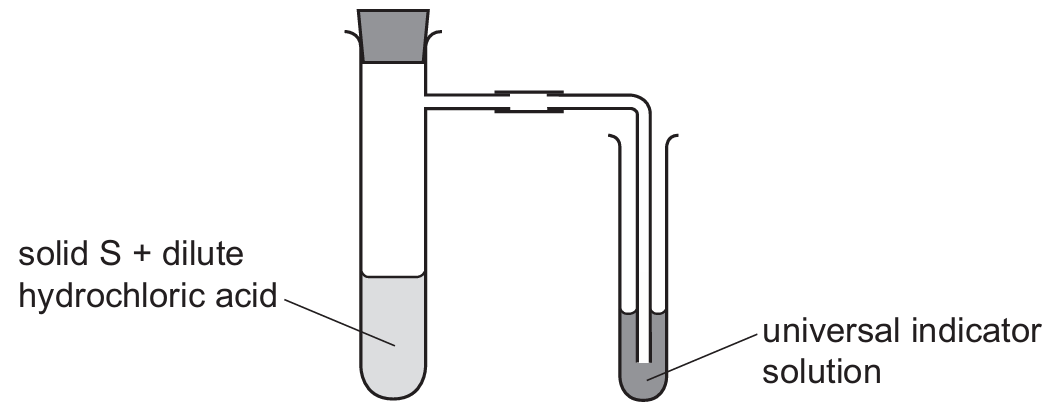
Solid S is added to dilute hydrochloric acid in the apparatus shown.

The universal indicator solution shows the pH decreases.

What is solid S?

A. zinc
B. zinc carbonate
C. zinc hydroxide
D. zinc oxide

▶️ Answer/Explanation
The pH of the indicator solution decreasing shows that carbon dioxide gas is being produced and dissolving in it, forming carbonic acid.
Only a reaction between hydrochloric acid and a carbonate releases \(CO_2\) gas as a product.
Zinc carbonate is the solid that reacts with the acid to release \(CO_2\).
Answer: (B)

Question

Which statements about neutralisation are correct?

  1. Acids and bases produce water when they neutralise each other.
  2. During neutralisation, bases transfer protons to acids.
  3. Neutral solutions turn universal indicator green.
  4. During neutralisation, acids transfer hydroxide ions to bases.

A. \(1\) and \(3\)  
B. \(1\) and \(4\)  
C. \(2\) and \(3\)  
D. \(2\) and \(4\)

▶️ Answer/Explanation
Neutralisation follows \(H^+ + OH^- \rightarrow H_2O\), confirming statement \(1\).
A neutral solution has \(pH = 7\), which turns universal indicator green, confirming statement \(3\); statements \(2\) and \(4\) wrongly reverse the direction of ion/proton transfer.
Answer: (A)

Question

Why do farmers add limestone to soil?

A. It acts as a fertiliser.
B. It adds nitrogen to the soil.
C. It decreases the pH of the soil.
D. It increases the pH of the soil.

▶️ Answer/Explanation
Limestone, calcium carbonate, is a base that neutralises excess acidity commonly found in soil.
Neutralising acid raises the pH of the soil towards neutral, making it more suitable for growing crops.
Limestone contains no nitrogen and does not directly supply plant nutrients, so it does not act as a fertiliser.
Answer: (D)

Question

Which substance changes the colour of damp red litmus?

A. \(CO_2\)
B. \(Cl_2\)
C. \(H_2\)
D. \(SO_2\)

▶️ Answer/Explanation
Chlorine gas dissolves in the moisture on damp litmus paper and acts as a bleaching agent.
This bleaching action turns the damp red litmus white, rather than simply changing its colour due to acidity.
\(CO_2\) and \(SO_2\) are acidic gases but only turn blue litmus red, not red litmus, and \(H_2\) has no effect on litmus.
Answer: (B)
Scroll to Top