Home / iGCSE / Coordinated Sciences / C7.2 Oxides Paper 1 |IITIAN ACADEMY

CIE iGCSE Co-Ordinated Science C7.2 Oxides Exam Style Questions Paper 1

Question

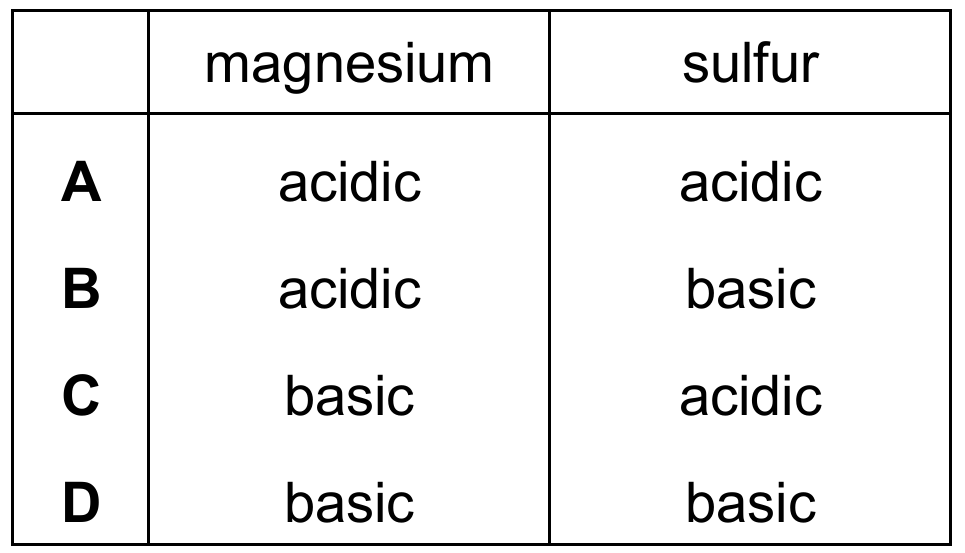
Which row shows the types of oxide formed by magnesium and sulfur?

▶️ Answer/Explanation

Oxides can be classified as acidic or basic based on the metallic or non-metallic character of the element forming the oxide:

  • Metals form basic oxides. These oxides react with acids to form a salt and water (neutralisation). For example, magnesium oxide (MgO) is a basic oxide.
  • Non-metals form acidic oxides. These oxides react with bases to form a salt and water. For example, sulfur dioxide (SO\(_2\)) and sulfur trioxide (SO\(_3\)) are acidic oxides.

Magnesium is a metal, so it forms a basic oxide. Sulfur is a non-metal, so it forms an acidic oxide. Therefore, magnesium = basic and sulfur = acidic, which matches row C.

Answer: (C)

Question

Four different oxides are listed.

  1. calcium oxide
  2. lithium oxide
  3. nitrogen oxide
  4. phosphorus oxide

Which oxides are acidic oxides?

A. 1 and 2
B. 1 and 3
C. 2 and 4
D. 3 and 4

▶️ Answer/Explanation
Calcium and lithium are metals, and metal oxides are generally basic, so calcium oxide and lithium oxide are basic, not acidic.
Nitrogen and phosphorus are non-metals, and non-metal oxides are generally acidic.
So the acidic oxides are nitrogen oxide and phosphorus oxide, which are oxides 3 and 4.
Answer: (D)

Question

Which substance is a basic oxide?

A. calcium oxide
B. carbon dioxide
C. nitrogen dioxide
D. sulfur dioxide

▶️ Answer/Explanation
Basic oxides are formed by metals; calcium oxide is the oxide of the metal calcium.
Carbon dioxide, nitrogen dioxide, and sulfur dioxide are all oxides of non-metals, making them acidic oxides.
Calcium oxide reacts with acids to form a salt and water, confirming its basic character.
Answer: (A)

Question

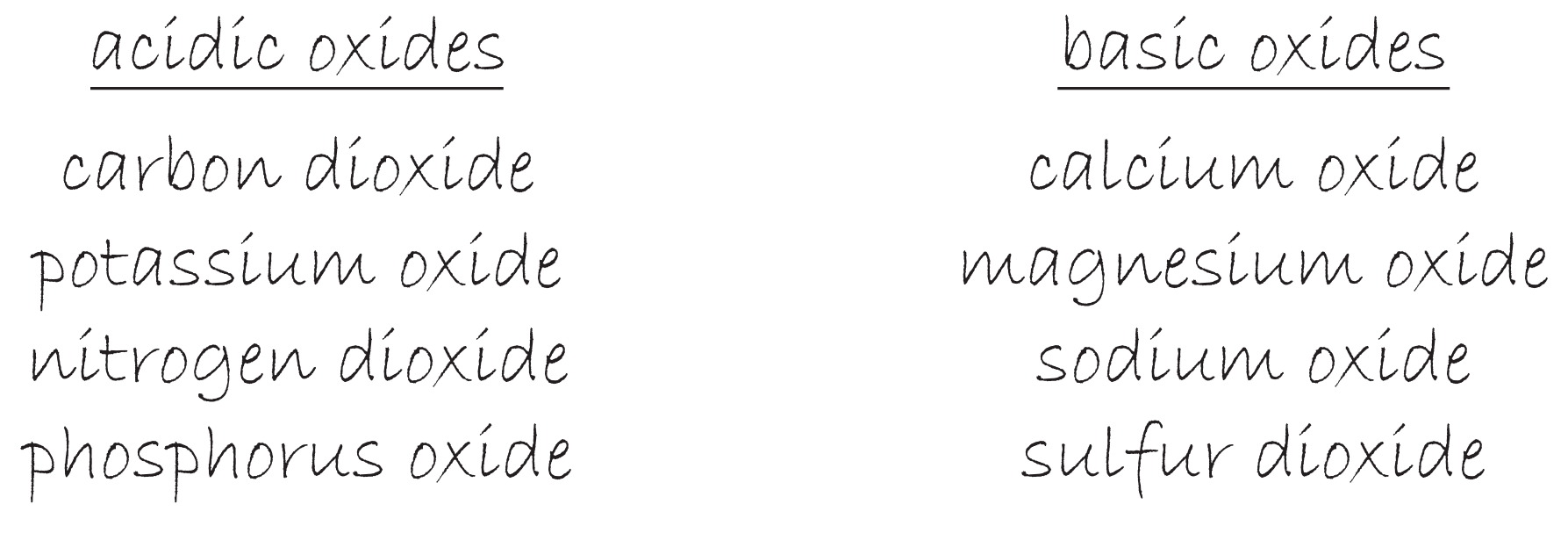
A student makes lists of acidic oxides and basic oxides.

Which oxides are not in the correct list?

A. carbon dioxide and sodium oxide
B. potassium oxide and sulfur dioxide
C. nitrogen dioxide and sulfur dioxide
D. potassium oxide and calcium oxide

▶️ Answer/Explanation
Potassium is a metal, so potassium oxide is a basic oxide, not an acidic oxide as listed.
Sulfur dioxide is a non-metal oxide, so it is an acidic oxide, not a basic oxide as listed.
Carbon dioxide is correctly acidic and sodium oxide is correctly basic, so only potassium oxide and sulfur dioxide are misplaced.
Answer: (B)

Question 

Which substance is classified as an acidic oxide?
(A calcium oxide
(B) carbon dioxide
(C) lithium oxide
(D) sodium oxide

▶️Answer/Explanation

Ans: B

Scroll to Top