
CIE iGCSE Co-Ordinated Science C7.2 Oxides Exam Style Questions Paper 4
Question
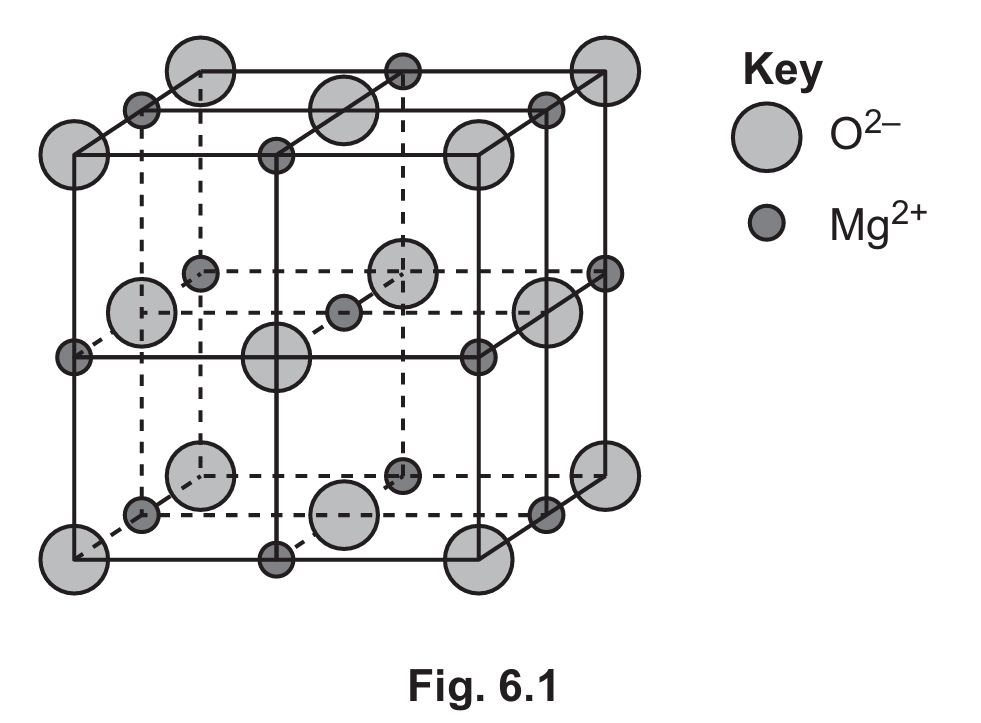
Classify magnesium oxide.
Explain your answer.
Determine the electronic configuration of a magnesium atom.
Describe the similarity and the difference between the three isotopes.
The boiling point is 102 °C.
Describe how the student knows that the sea water is not pure water.
Most-appropriate topic codes (Cambridge IGCSE Co-ordinated Sciences 0654):
• Topic C2.4 — Ions and ionic bonds (Part (a))
• Topic C7.2 — Oxides (Part (b))
• Topic C2.2 — Atomic structure and the Periodic Table (Part (c))
• Topic C2.3 — Isotopes (Part (d))
• Topic C3.2 — Relative masses of atoms and molecules / C3.3 — The mole and the Avogadro constant (Part (e))
• Topic C10.1 — Water (Part (f))
▶️ Answer/Explanation
(a) Formula = MgO.
The diagram shows equal numbers of Mg²⁺ and O²⁻ ions in a 1:1 ratio. The charges balance (+2 and -2), so the formula is MgO.
(b) Classification: Basic oxide.
Explanation: Magnesium is a metal. Metal oxides react with acids to form salts and water. Magnesium oxide is a basic oxide because it neutralises acids.
(c) Electronic configuration = 2.8.2.
Magnesium has 12 protons/electrons. The first shell holds 2, the second holds 8, and the remaining 2 electrons go into the third shell.
(d) Similarity: Same number of protons (atomic number = 12).
Difference: Different number of neutrons / different mass numbers (24, 25, 26).
(e) Calculation:
\(M_r\) of MgSO₄ = 26 + 32 + (4 × 16) = 122
\(\text{moles} = \frac{\text{mass}}{M_r} = \frac{3.05}{122} = 0.025\text{ mol}\)
Note: The \(^{26}\text{Mg}\) isotope has mass number 26, so the relative atomic mass used for Mg is 26 in this calculation.
(f) Pure water boils at 100°C at standard atmospheric pressure.
The sea water sample boils at 102°C, which is higher than 100°C. This elevation in boiling point indicates the presence of dissolved impurities (salts), so the water is not pure.
Question
Topic codes:
• Topic C2.2 — Atomic structure and the Periodic Table (Part (a) & (b))
• Topic C2.3 — Isotopes (Part (c))
• Topic C7.2 — Oxides (Part (d))
• Topic C10.2 — Air quality and climate / Global warming (Part (e))
• Topic C3.3 — The mole and the Avogadro constant (Part (f))
▶️ Answer/Explanation
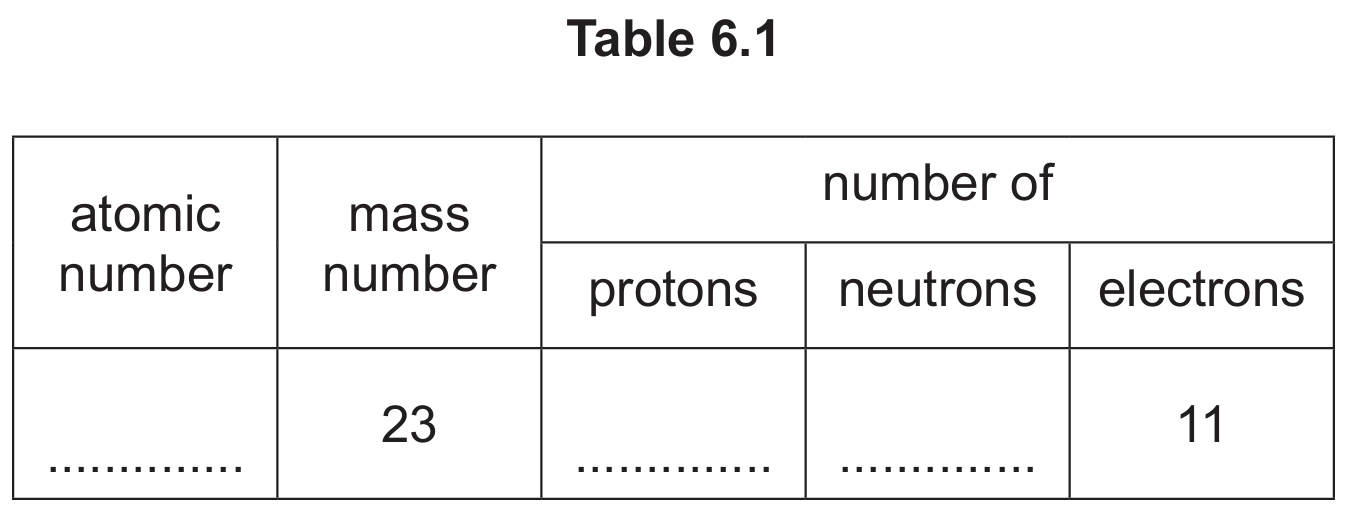
(a) Complete Table 6.1:
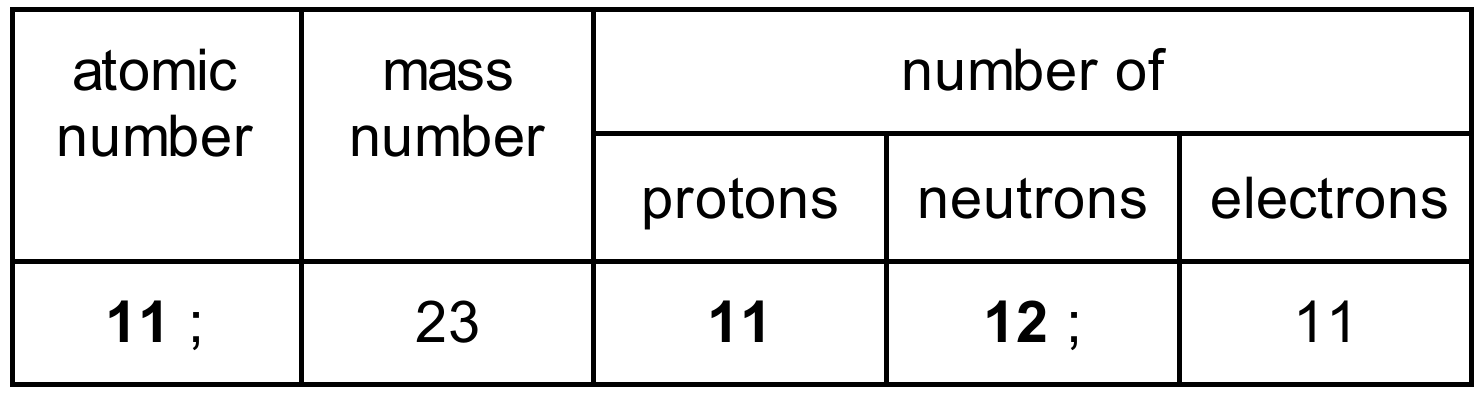
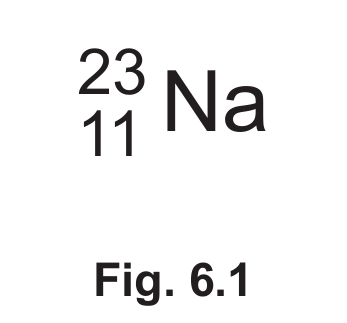
Sodium has 11 protons (atomic number = 11), 11 electrons (neutral atom), and 23 − 11 = 12 neutrons.
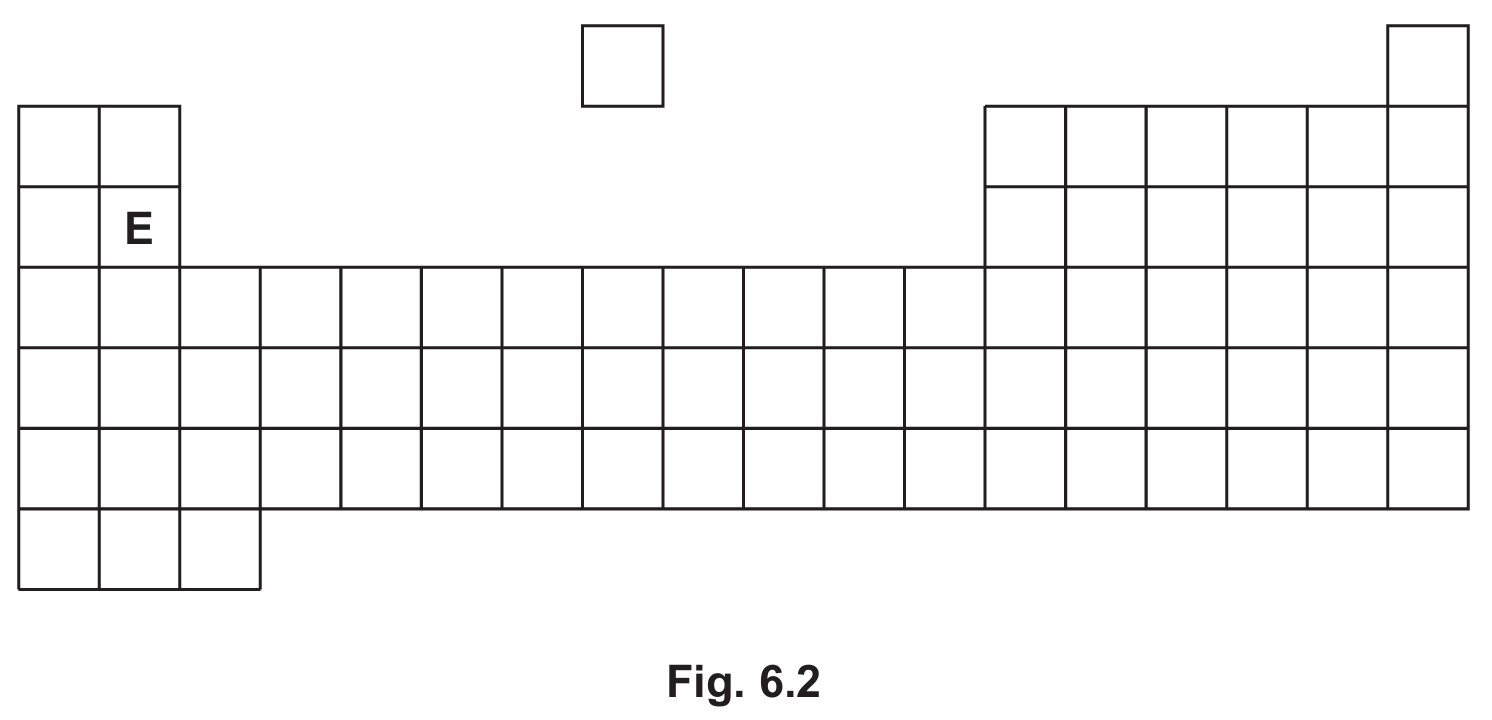
(b) ☑ 2.8.2
Element E is in Period 3 (three electron shells) and Group II (two outer-shell electrons). Therefore, the electronic configuration is 2,8,2.
(c) Isotopes of carbon have the same chemical properties because they have the same number of electrons / the same electronic configuration. Chemical properties depend on the number and arrangement of electrons in the atom.
(d) Acidic oxide — carbon dioxide is an acidic oxide because it reacts with bases to form salts and water.
(e) Energy from the Sun reaches the Earth’s surface. Some energy is reflected back into space. Most of the energy is absorbed by the Earth’s surface, causing an increase in temperature. The warm Earth emits energy. Some of this emitted energy is then absorbed by greenhouse gases. When this energy is re-emitted, it can be transferred back to the Earth’s surface.
(f) \(M_r\) of CO₂ = 12 + (2 × 16) = 44
Moles of CO₂ = 11000 ÷ 44 = 250 mol
Volume of CO₂ = 250 × 24 = 6000 dm³