Home / iGCSE / Coordinated Sciences / C8.2 Group I properties Paper 1 |IITIAN ACADEMY

CIE iGCSE Co-Ordinated Science C8.2 Group I properties Exam Style Questions Paper 1

Question

Sodium is below lithium in Group I of the Periodic Table.

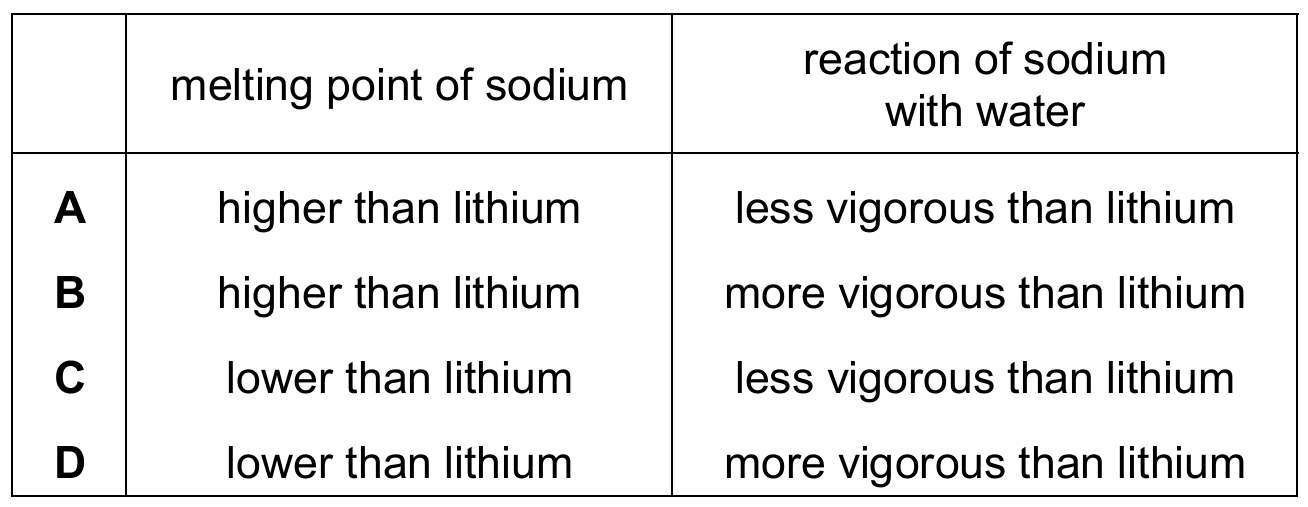
Which row describes the properties of sodium in comparison with lithium?

▶️ Answer/Explanation

Group I elements (alkali metals) show trends as you go down the group. Sodium is below lithium, so we compare sodium’s properties to lithium’s:

  • Melting point: As you go down Group I, the melting point decreases. This is because the metallic bonding becomes weaker as the atoms get larger and the delocalised electrons are further from the positive nuclei. Therefore, sodium has a lower melting point than lithium.
  • Reaction with water: As you go down Group I, the reactivity with water increases. This is because the outer-shell electron is held less strongly and is more easily lost as the atoms get larger (more electron shells, more shielding). Therefore, sodium reacts more vigorously with water than lithium.

Thus, sodium has a lower melting point and reacts more vigorously with water compared to lithium. This matches row D.

Answer: (D)

Question

The element rubidium is in Group I of the Periodic Table.

It burns in oxygen to form an oxide.

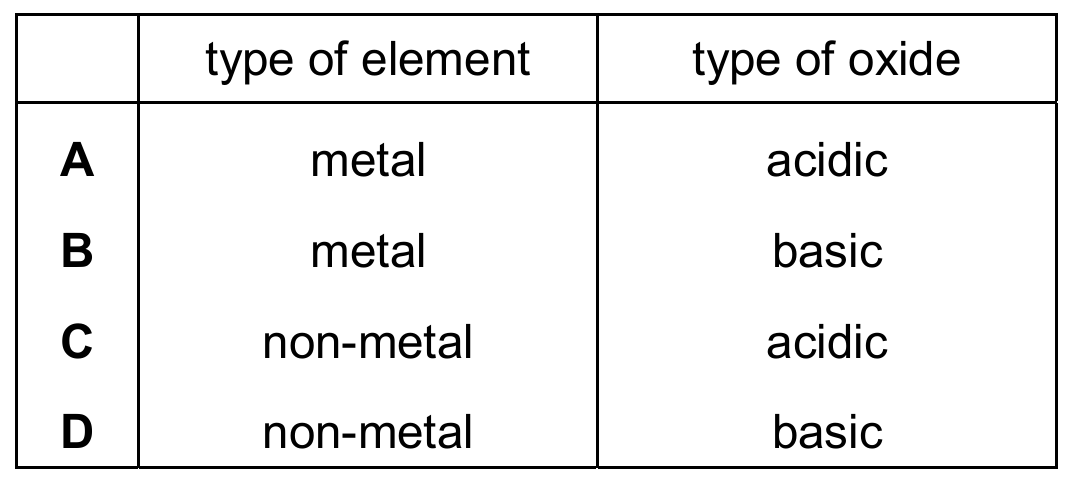
Which row describes rubidium and its oxide?

▶️ Answer/Explanation
Rubidium is in Group I, so it is a metal. Metals generally form basic oxides (e.g. \(\mathrm{Rb_2O}\)) that react with acids to produce salt and water. Non‑metals form acidic oxides. Therefore, the correct row is metal and basic.
Answer: (B)

Question

Potassium is in Group I of the Periodic Table.

Which statement about potassium is correct?

A. It is a relatively hard metal.
B. It is less dense than lithium.
C. It has a higher melting point than sodium.
D. It reacts more vigorously with water than sodium.

▶️ Answer/Explanation
Group I metals are soft, not hard, and become more reactive going down the group as the outer electron is further from the nucleus and more easily lost.
Density and melting point generally decrease down the group, so potassium is denser than lithium and has a lower melting point than sodium (not higher).
Since potassium is below sodium in Group I, it reacts more vigorously with water than sodium does.
Answer: (D)

Question

The elements in Group I of the Periodic Table are metals.

What are the trends as the group is descended?

A. decrease in melting point and less reactive with water
B. decrease in melting point and more reactive with water
C. increase in melting point and less reactive with water
D. increase in melting point and more reactive with water

▶️ Answer/Explanation
Going down Group I, the melting points of the metals decrease.
Going down the group, the outer electron is further from the nucleus and more easily lost, so reactivity with water increases.
Row B correctly shows a decrease in melting point together with an increase in reactivity with water.
Answer: (B)

Question

Potassium reacts with water.

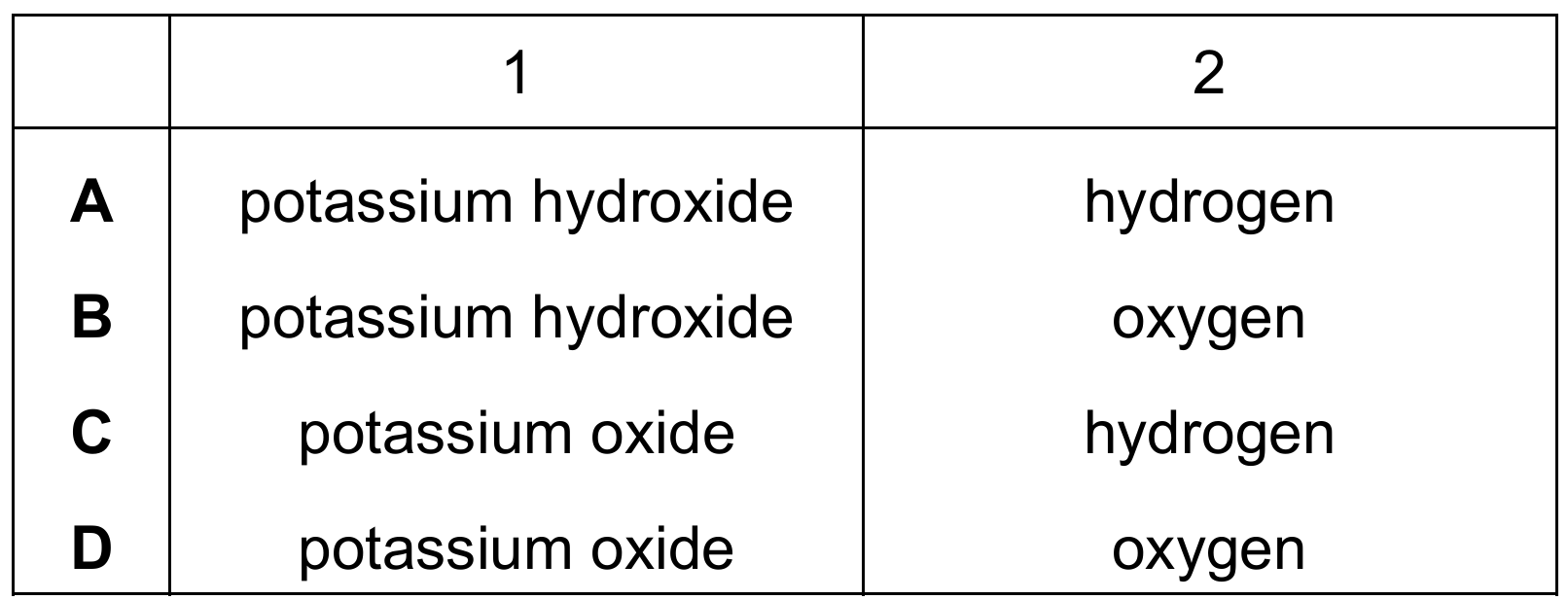
potassium + water → ……1…… + ……2……

Which words complete the equation?

▶️ Answer/Explanation
Group I alkali metals react vigorously with cold water to form a metal hydroxide and hydrogen gas.
The word equation is \( \text{potassium} + \text{water} \rightarrow \text{potassium hydroxide} + \text{hydrogen} \).
Potassium oxide and oxygen are not the products of this reaction.
Answer: (A)
Scroll to Top