Home / iGCSE / Coordinated Sciences / C8.2 Group I properties Paper 2

CIE iGCSE Co-Ordinated Science C8.2 Group I properties Exam Style Questions Paper 2

Question

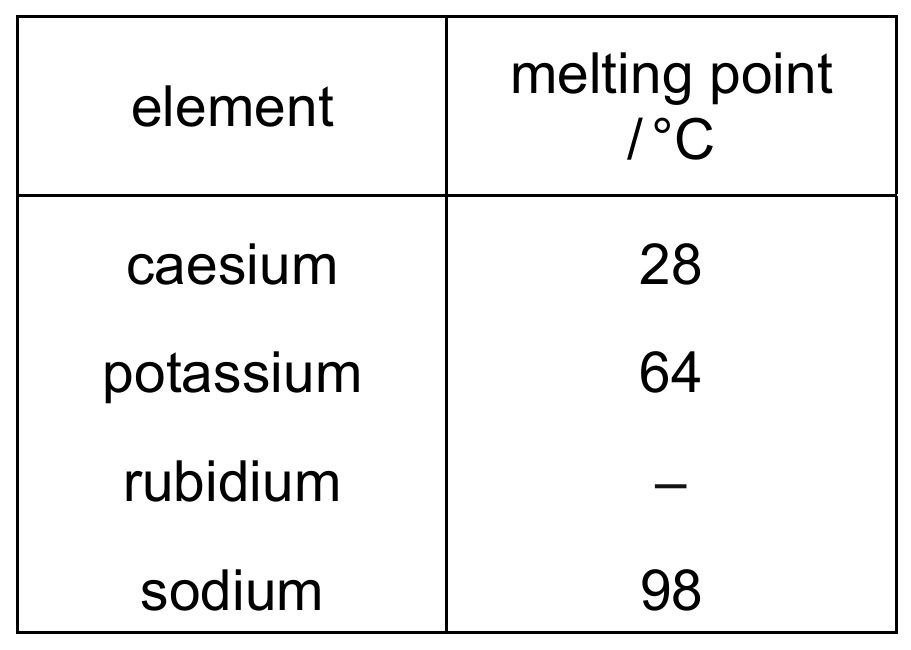
The melting points of some Group I metals are shown.

What is the melting point of rubidium?

A. 20 °C
B. 40 °C
C. 80 °C
D. 100 °C

▶️ Answer/Explanation
In Group I, melting points decrease as we go down the group. From the given data, sodium melts at 98°C, potassium at 64°C, and caesium at 28°C. Rubidium sits between potassium and caesium, so its melting point should be between 28°C and 64°C. Among the options, 40°C is the only value that fits this range. 20°C is below caesium’s melting point, 80°C and 100°C are above potassium’s melting point, which would contradict the trend.
Answer: (B)

Question

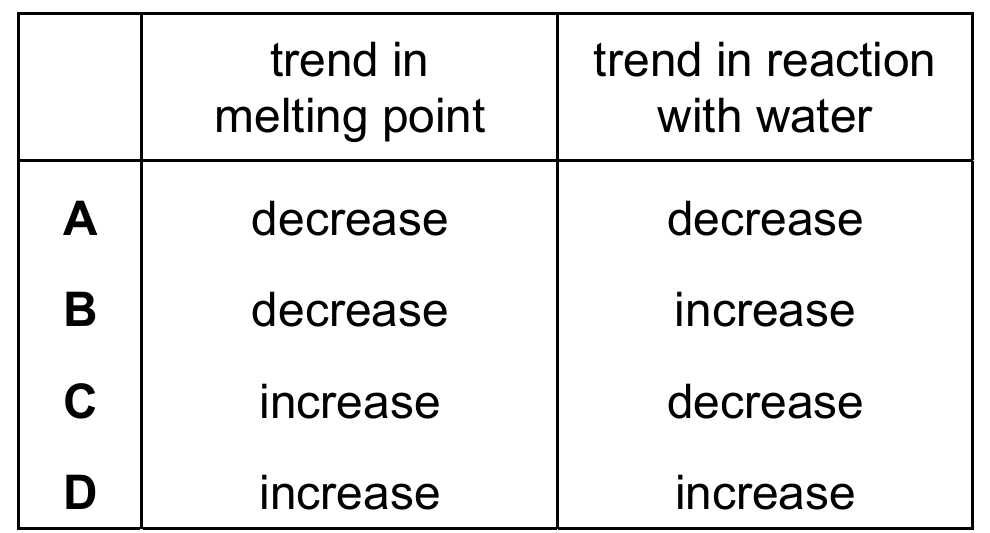
Which row describes the trends shown by the Group I elements lithium to potassium?

▶️ Answer/Explanation
Down Group I (from lithium to potassium), the melting point decreases as metallic bonding weakens due to larger atomic size. Reactivity with water increases because the outer electron is more easily lost as atomic radius increases and ionization energy decreases.
Answer: (B)

Question

The elements in Group I of the Periodic Table are metals.

What are the trends as the group is descended?

A. decrease in melting point and less reactive with water
B. decrease in melting point and more reactive with water
C. increase in melting point and less reactive with water
D. increase in melting point and more reactive with water

▶️ Answer/Explanation
Going down Group I, the outer electron is further from the nucleus and more easily lost, so reactivity with water increases.
Melting points decrease down the group as the metallic bonding gets weaker with increasing atomic size.
Answer: (B)

Question

Which row about the trends in the elements going down Group I of the Periodic Table is correct?

▶️ Answer/Explanation
Going down Group I, the outer electron is further from the nucleus and more easily lost, so reactivity increases.
At the same time, the metallic bonding becomes weaker as atoms get larger, so melting point decreases down the group.
Answer: (C)

Question

All Group I metal compounds and all Group II metal chlorides are soluble in water.
All Group II metal carbonates and barium sulfate are insoluble.
Which method is used to prepare barium sulfate using barium carbonate?
(A)  direct combination of solid barium carbonate and dilute sulfuric acid
(B)  reaction of solid barium carbonate and hydrogen chloride gas, followed by reaction with dilute sulfuric acid
(C)  reaction of aqueous barium carbonate with dilute hydrochloric acid, followed by reaction with aqueous sodium sulfate
(D)  reaction of solid barium carbonate with dilute hydrochloric acid, followed by reaction with aqueous sodium sulfate

▶️Answer/Explanation

Ans: D

Scroll to Top