
CIE iGCSE Co-Ordinated Science C8.2 Group I properties Exam Style Questions Paper 3
Question
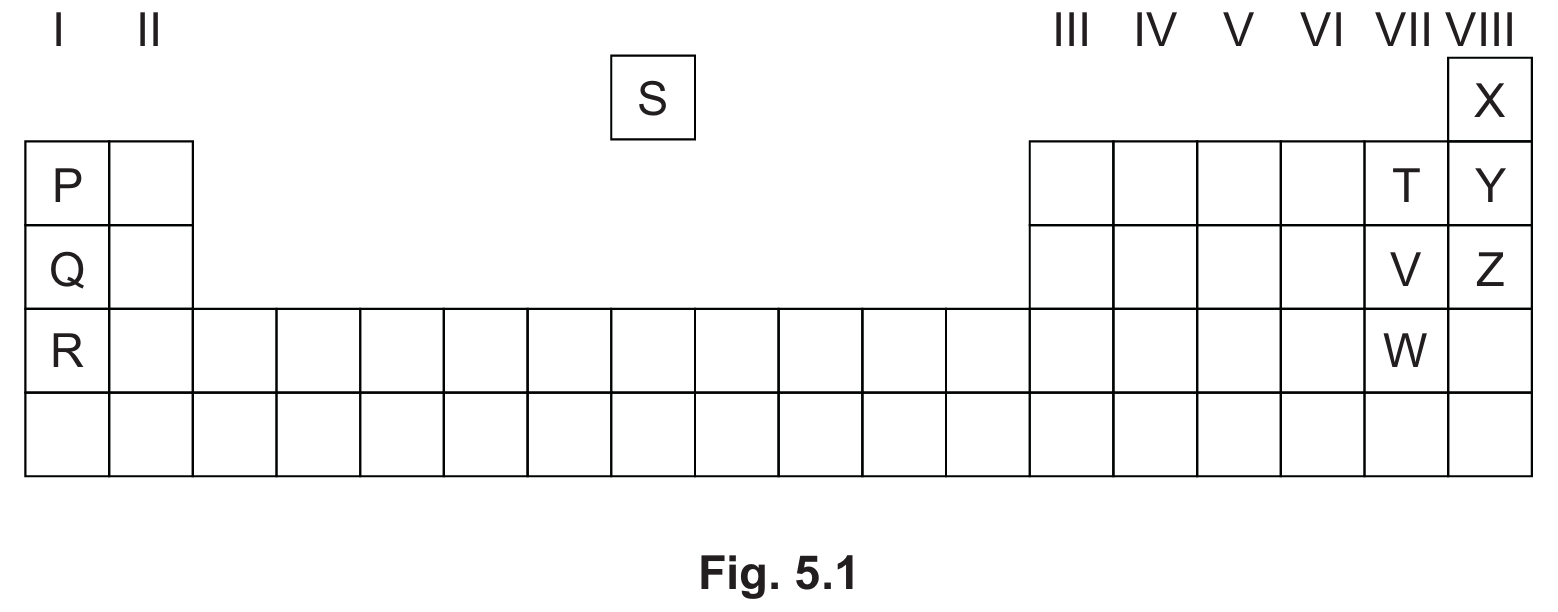
Most-appropriate topic codes (Cambridge IGCSE Co-ordinated Sciences 0654):
• Topic C2.2 — Atomic structure and the Periodic Table (Part (a))
• Topic C8.1 — Arrangement of elements (Part (b)(i) & (b)(ii))
• Topic C8.2 — Group I properties (Part (b)(iii) & (b)(v))
• Topic C8.3 — Group VII properties (Part (b)(vi))
• Topic C8.5 — Noble gases (Part (b)(iv))
▶️ Answer/Explanation
(a)
The elements are listed in order of their proton / atomic number.
Moving from left to right across the Periodic Table, the elements become less metallic.
These metals form coloured compounds and are known as the transition elements.
As you move across a period, the increasing number of outer-shell electrons makes it progressively harder for atoms to lose electrons and behave as metals. Transition elements sit in the central block of the Periodic Table and are characterised by variable oxidation states, catalytic behaviour, and the formation of coloured ions and compounds.
(b)(i)
S, T, or V
S represents hydrogen (Group I, Period 1), which exists as the diatomic molecule $\text{H}_2$ at room temperature. T and V are halogens (Group VII) which also exist as diatomic molecules — fluorine ($\text{F}_2$) and chlorine ($\text{Cl}_2$) respectively — and are gases at room temperature. Any one of these three letters is a correct answer.
(b)(ii)
P, Q, or R
P, Q, and R are all metals located in Group I (alkali metals), and metals are solids at room temperature. They represent lithium, sodium, and potassium respectively, all of which have melting points well above room temperature. Any one of these three letters is a correct answer.
(b)(iii)
P, Q, or R
Alkali metals occupy Group I of the Periodic Table, excluding hydrogen (S, Period 1) which is a non-metal. P (lithium, Period 2), Q (sodium, Period 3), and R (potassium, Period 4) are all alkali metals with one outer-shell electron, making them highly reactive. Any one of these three letters is a correct answer.
(b)(iv)
X, Y, or Z
Noble gases are found in Group VIII (Group 0) of the Periodic Table and have a completely full outer electron shell. X represents helium (Period 1), Y represents neon (Period 2), and Z represents argon (Period 3) — all of which are monatomic, colourless, and extremely unreactive gases at room temperature. Any one of these three letters is a correct answer.
(b)(v)
R
Reactivity of alkali metals increases down Group I as the outer electron is further from the nucleus and more easily lost. Among the Group I metals shown, R sits lowest in the group (Period 4 — potassium) and is therefore the most reactive metal in Fig. 5.1.
(b)(vi)
T
Reactivity of halogens decreases down Group VII as each successive element has a greater atomic radius, making it harder to attract an additional electron. T sits higher in the group (Period 2 — fluorine) than V (Period 3 — chlorine), making T the most reactive halogen shown in Fig. 5.1.
Question
Most-appropriate topic codes (Cambridge IGCSE Co-ordinated Sciences 0654):
• Topic C9.6 — Extraction of metals (Part (a)(i))
• Topic C8.2 — Group I properties (Part (a)(ii))
• Topic C9.1 — Properties of metals (Part (a)(iii))
• Topic C4.1 — Electrolysis (Part (a)(iv))
• Topic C7.1 — Characteristic properties of acids (Parts (b)(i), (b)(ii), (b)(iii))
• Topic C9.4 — Reactivity series (Part (b)(iii))
▶️ Answer/Explanation
(a)(i) aluminium
Bauxite is the main ore of aluminium. Aluminium is extracted from bauxite by electrolysis because it is a reactive metal.
(a)(ii) sodium
Sodium is an alkali metal found in Group I of the Periodic Table. The other alkali metals include lithium and potassium.
(a)(iii) iron
Steel is an alloy made primarily of iron with small amounts of carbon and other elements such as chromium and nickel.
(a)(iv) platinum
Platinum is used as an inert electrode in electrolysis because it is unreactive and does not participate in the reaction.
(b)(i) magnesium chloride / hydrogen
The products of the reaction between magnesium and hydrochloric acid are magnesium chloride (a salt) and hydrogen gas.
(b)(ii) effect on rate of reaction: increases
Explanation: The concentration of the acid has doubled from \(36.5 \, \text{g/dm}^3\) to \(73.0 \, \text{g/dm}^3\). Increasing the concentration means there are more reactant particles per unit volume. This leads to a higher frequency of successful collisions between magnesium atoms and hydrogen ions, thereby increasing the rate of reaction.
(b)(iii) calcium / sodium / potassium
Calcium, sodium and potassium are all more reactive than magnesium in the reactivity series. These metals react more vigorously with dilute acids and water compared to magnesium.