Home / iGCSE / Coordinated Sciences / C8.3 Group VII properties Paper 2

CIE iGCSE Co-Ordinated Science C8.3 Group VII properties Exam Style Questions Paper 2

Question

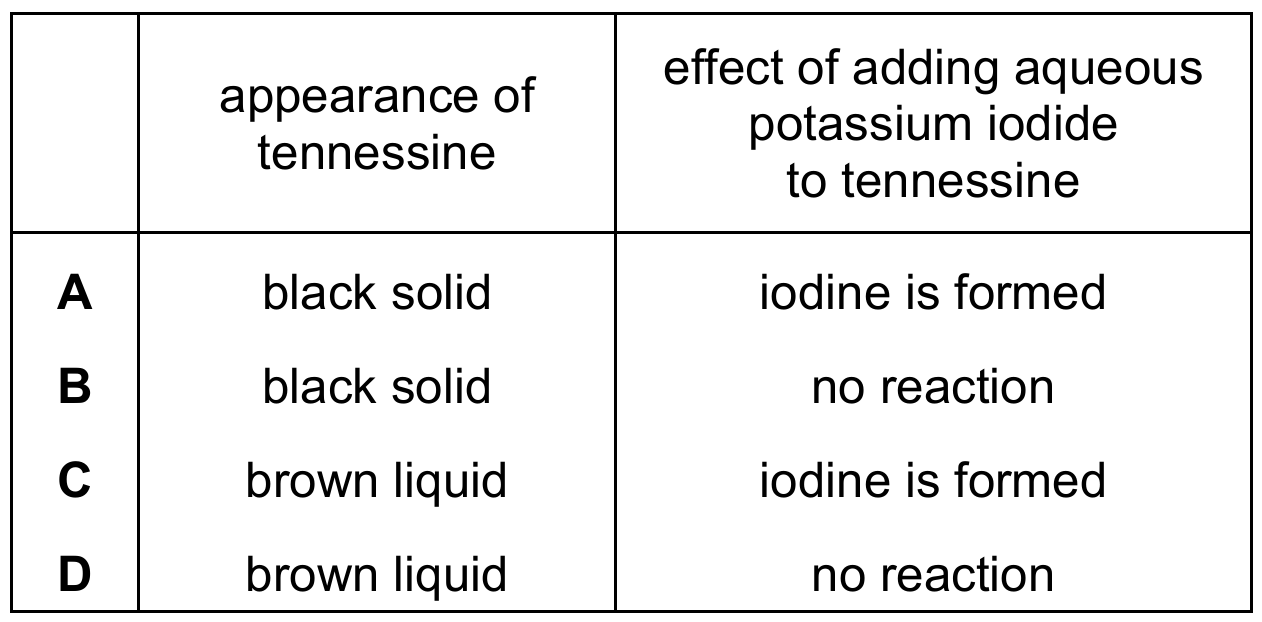
Tennessine is a newly discovered halogen and is below astatine in Group VII of the Periodic Table.

Which row predicts the appearance of tennessine and the effect of adding aqueous potassium iodide?

▶️ Answer/Explanation
Going down Group VII the halogens get darker in colour (F is pale yellow, Cl is yellow-green, Br is red-brown, I is grey/black) so tennessine, below astatine, would be expected to be very dark (black/solid).
Reactivity decreases down the group, so tennessine is less reactive than iodine and cannot displace iodide ions from potassium iodide solution — no reaction occurs, matching row B.
Answer: (B)

Question

Which statements about the halogens are correct?

  1. They are diatomic metals.
  2. Their atoms have seven outer-shell electrons.
  3. Going down the group, they change from solid to liquid to gas.
  4. Going down the group, they become darker in colour.

A. 1 and 2
B. 1 and 3
C. 2 and 4
D. 3 and 4

▶️ Answer/Explanation
Halogens are diatomic non-metals, not metals, so statement 1 is incorrect.
Their atoms have seven outer-shell electrons, so statement 2 is correct.
Going down the group they change from gas to liquid to solid (not solid to liquid to gas), so statement 3 is incorrect.
Going down the group they get darker in colour, so statement 4 is correct.
Answer: (C)

Question

Which statement about the halogens is not correct?

A. Iodine has a darker colour than chlorine.
B. They all exist as diatomic molecules.
C. They are all gases at room temperature.
D. They are all non-metals.

▶️ Answer/Explanation
Going down Group VII, the halogens change physical state at room temperature: chlorine is a gas, bromine is a liquid, and iodine is a solid, so they are not all gases.
All halogens do exist as diatomic molecules (e.g. \(\text{Cl}_2\), \( \text{I}_2\) and are classed as non-metals, and their colour does get darker going down the group (chlorine pale green, iodine dark grey/purple), so statements A, B and D are all true.
Since the question asks which statement is not correct, the false statement about them all being gases is the answer.
Answer: (C)

Question

Which statement about the elements in Group VII of the Periodic Table is correct?

A. Chlorine is more reactive than bromine.
B. The colour of the elements becomes darker up the group.
C. The melting point of the elements decreases down the group.
D. The reactivity of the elements increases down the group.

▶️ Answer/Explanation
In Group VII (halogens), reactivity decreases down the group. Chlorine is above bromine, so it is more reactive. Colours become darker down the group, melting points increase down the group.
Answer: (A)

Question

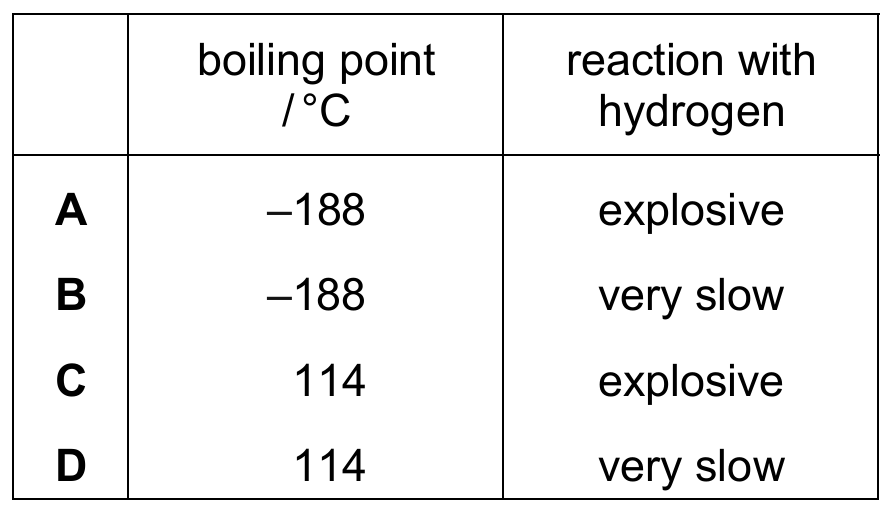
Bromine has a boiling point of \(59^\circ\text{C}\). It reacts with hydrogen rapidly.

Iodine has a boiling point of \(184^\circ\text{C}\). It reacts with hydrogen slowly.

Which row about fluorine is correct?

▶️ Answer/Explanation
Fluorine is above chlorine in Group VII, so it has a lower boiling point (around -188°C) and is more reactive. Reactivity decreases down the group, so fluorine reacts explosively with hydrogen, more rapidly than chlorine, bromine, or iodine.
Answer: (A)
Scroll to Top