
CIE iGCSE Co-Ordinated Science C8.4 Transition elements Exam Style Questions Paper 4
Question
The student uses a flame test.
State what the student observes if the compound contains potassium.
Iron(II) sulfate contains iron(II) ions, \(Fe^{2+}\).
Sodium hydroxide solution is used to test for iron(II) ions.
The iron(II) ions react with \(OH^-\) ions from the sodium hydroxide solution. A precipitate of iron(II) hydroxide, \(Fe(OH)_2\), is made.
The proton number (atomic number) of magnesium is 12.
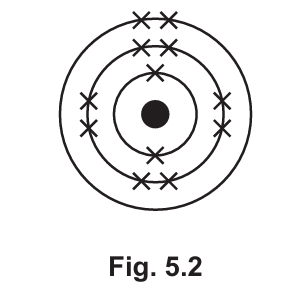
The proton number (atomic number) of oxygen is 8.
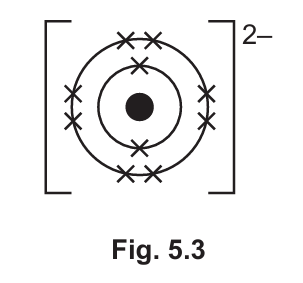
Fig. 5.3 shows the electronic structure of an oxide ion.
Most-appropriate topic codes (Cambridge IGCSE Co-ordinated Sciences 0654):
• Topic C8.2 — Group I properties (Part a)
• Topic C8.4 — Transition elements (Part b)
• Topic C2.4 — Ionic bonding (Parts c, d)
▶️ Answer/Explanation
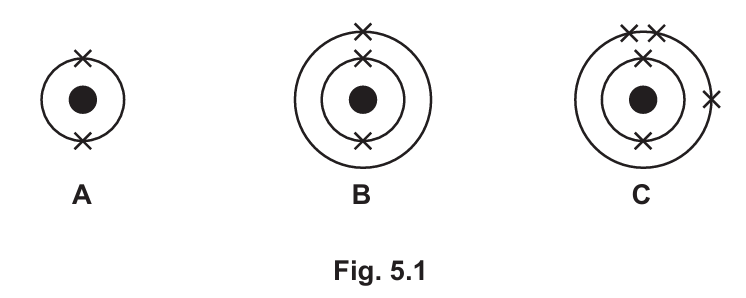
(a)(i) B
Group I metals have exactly one electron in their outermost shell.
Diagram B shows this arrangement (2, 1), matching a Group I element such as lithium.
(a)(ii) Lilac (purple) flame
Potassium compounds give a characteristic lilac flame when heated in a flame test.
This is used to confirm the presence of potassium ions in a compound.
(b)(i) Green
Iron(II) hydroxide, \(Fe(OH)_2\), forms as a green precipitate.
This distinguishes it from iron(III) hydroxide, which is reddish-brown.
(b)(ii) \(Fe^{2+}(aq) + 2OH^{-}(aq) \rightarrow Fe(OH)_2(s)\)
One iron(II) ion combines with two hydroxide ions.
Charges balance: \(2+\) and \(2 \times (1-) = 2-\), giving a neutral solid product.
(c)(i) 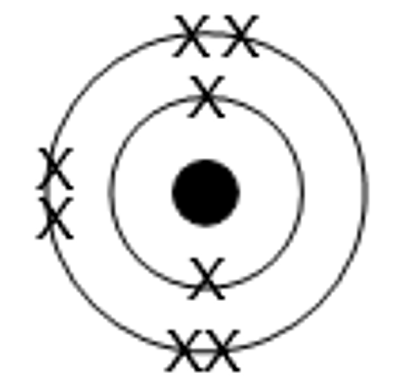
Oxygen has atomic number 8, so it has 8 electrons.
These are arranged as 2 electrons in the first shell and 6 electrons in the second (outer) shell.
(c)(ii) 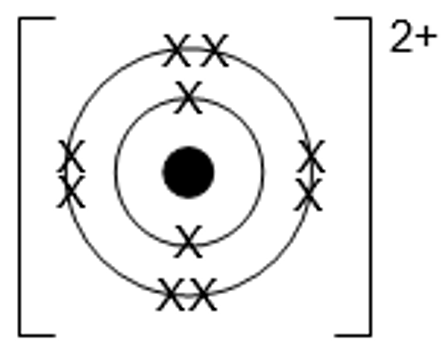
Magnesium atom (2,8,2) loses its 2 outer electrons to form \(Mg^{2+}\).
The resulting ion has the electronic structure 2,8, shown with a 2+ charge on the bracket.
(c)(iii) Strong ionic bonds require a lot of energy to break
There is a strong electrostatic attraction between the oppositely charged \(Mg^{2+}\) and \(O^{2-}\) ions.
A large amount of energy is needed to overcome this strong ionic bonding, giving magnesium oxide a high melting point.
(d) \(K_2O\)
Charges must balance: \(K^+\) and \(O^{2-}\).
Two \(K^+\) ions (total charge 2+) balance one \(O^{2-}\) ion, giving the formula \(K_2O\).
Question
Copper is a transition metal. Transition metals form coloured compounds.
(a) Write down two other properties of transition metals that are not properties of all metals.
▶️Answer/Explanation
1. High density
2. Act as catalysts
Additional properties:
– Variable oxidation states
– Form complex ions
– High melting points (except mercury)
Example: Copper has density 8.96 g/cm³ (vs 2.7 for aluminum) and copper(II) sulfate is blue
(b) Copper carbonate, CuCO3, reacts with dilute hydrochloric acid, HCl.
Copper chloride, CuCl2, is made.
CuCO3 + 2HCl → CuCl2 + H2O + CO2
(i) Copper chloride contains copper ions, Cu2+, and chloride ions, Cl–. Describe the test and its positive result for chloride ions.
▶️Answer/Explanation
Test: Add nitric acid followed by silver nitrate solution
Result: White precipitate forms
Chemical equation:
Ag+(aq) + Cl–(aq) → AgCl(s)↓
Note: Nitric acid is added first to remove carbonate impurities that would also give precipitate
(ii) In an experiment, 4.0 g of copper carbonate reacts with excess dilute hydrochloric acid.
Calculate the maximum mass of copper chloride that can be made. [Ar; C, 12; Cl, 35.5; Cu, 64; O, 16]
▶️Answer/Explanation
4.4 g
Calculation:
1. Calculate molar masses:
– CuCO3 = 64 + 12 + (3×16) = 124 g/mol
– CuCl2 = 64 + (2×35.5) = 135 g/mol
2. Moles of CuCO3 = 4.0 g ÷ 124 g/mol = 0.03226 mol
3. 1:1 mole ratio → 0.03226 mol CuCl2 produced
4. Mass = 0.03226 mol × 135 g/mol = 4.354 g → 4.4 g (2 sig figs)
(iii) In another experiment, 8.8 g of carbon dioxide gas is made. Calculate the volume of carbon dioxide gas in cm3 at 25°C.
The molar gas volume at 25°C is 24 dm3.
[Ar; C, 12; O, 16]
▶️Answer/Explanation
4800 cm3
Calculation steps:
1. Molar mass CO2 = 12 + (2×16) = 44 g/mol
2. Moles of CO2 = 8.8 g ÷ 44 g/mol = 0.2 mol
3. Volume at 25°C = 0.2 mol × 24 dm3/mol = 4.8 dm3
4. Convert to cm3: 4.8 × 1000 = 4800 cm3
Key points:
– 1 dm3 = 1000 cm3
– Temperature must be in Kelvin for exact calculations (25°C = 298K)
(c) Explain why copper is a conductor of electricity. Use ideas about metallic bonding.
▶️Answer/Explanation
1. Copper has delocalized electrons that can move freely through the metal lattice
2. These mobile electrons carry charge when potential difference is applied
Metallic bonding details:
– Cu atoms form a “sea of electrons”
– Outer shell electrons (4s1 in copper) become delocalized
– Applied voltage causes net electron flow