
CIE iGCSE Co-Ordinated Science C8.5 Noble gases Exam Style Questions Paper 3
Question
Most-appropriate topic codes (Cambridge IGCSE Co-ordinated Sciences 0654):
• Topic C2.2 — Atomic structure and the Periodic Table (Part (a))
• Topic C8.1 — Arrangement of elements (Part (b)(i) & (b)(ii))
• Topic C8.2 — Group I properties (Part (b)(iii) & (b)(v))
• Topic C8.3 — Group VII properties (Part (b)(vi))
• Topic C8.5 — Noble gases (Part (b)(iv))
▶️ Answer/Explanation
(a)
The elements are listed in order of their proton / atomic number.
Moving from left to right across the Periodic Table, the elements become less metallic.
These metals form coloured compounds and are known as the transition elements.
As you move across a period, the increasing number of outer-shell electrons makes it progressively harder for atoms to lose electrons and behave as metals. Transition elements sit in the central block of the Periodic Table and are characterised by variable oxidation states, catalytic behaviour, and the formation of coloured ions and compounds.
(b)(i)
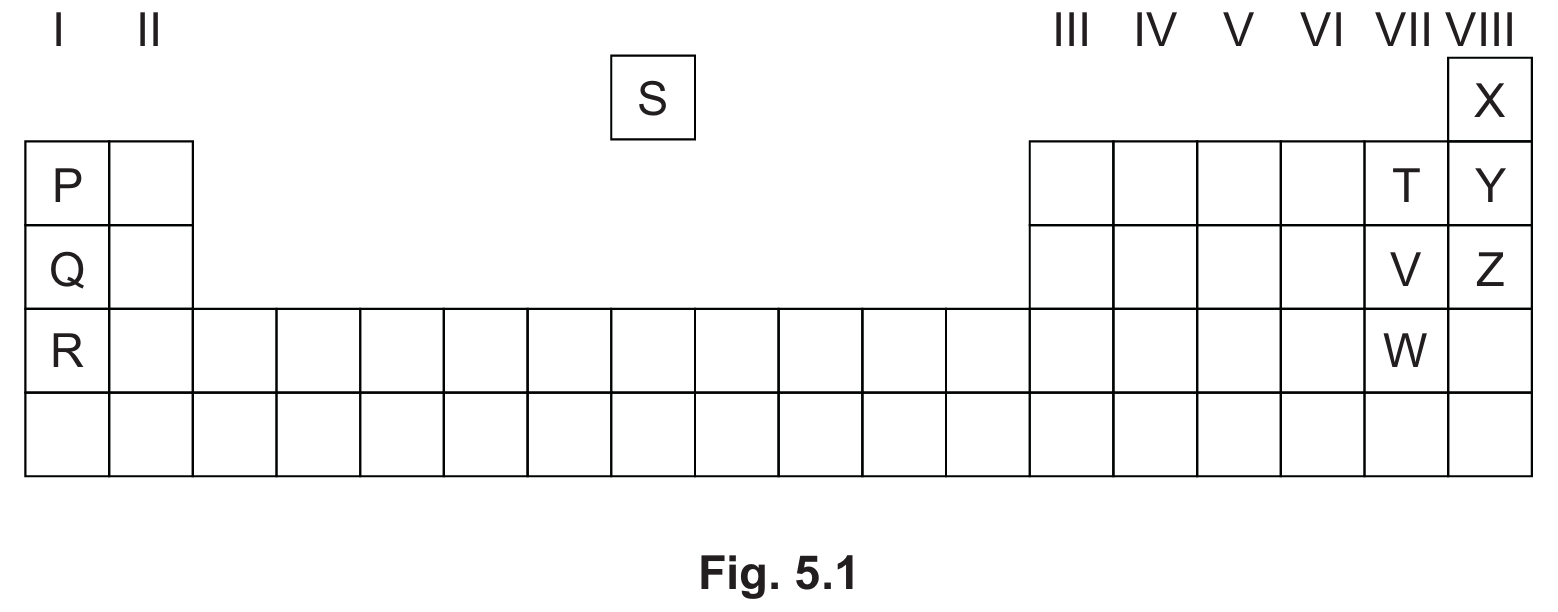
S, T, or V
S represents hydrogen (Group I, Period 1), which exists as the diatomic molecule $\text{H}_2$ at room temperature. T and V are halogens (Group VII) which also exist as diatomic molecules — fluorine ($\text{F}_2$) and chlorine ($\text{Cl}_2$) respectively — and are gases at room temperature. Any one of these three letters is a correct answer.
(b)(ii)
P, Q, or R
P, Q, and R are all metals located in Group I (alkali metals), and metals are solids at room temperature. They represent lithium, sodium, and potassium respectively, all of which have melting points well above room temperature. Any one of these three letters is a correct answer.
(b)(iii)
P, Q, or R
Alkali metals occupy Group I of the Periodic Table, excluding hydrogen (S, Period 1) which is a non-metal. P (lithium, Period 2), Q (sodium, Period 3), and R (potassium, Period 4) are all alkali metals with one outer-shell electron, making them highly reactive. Any one of these three letters is a correct answer.
(b)(iv)
X, Y, or Z
Noble gases are found in Group VIII (Group 0) of the Periodic Table and have a completely full outer electron shell. X represents helium (Period 1), Y represents neon (Period 2), and Z represents argon (Period 3) — all of which are monatomic, colourless, and extremely unreactive gases at room temperature. Any one of these three letters is a correct answer.
(b)(v)
R
Reactivity of alkali metals increases down Group I as the outer electron is further from the nucleus and more easily lost. Among the Group I metals shown, R sits lowest in the group (Period 4 — potassium) and is therefore the most reactive metal in Fig. 5.1.
(b)(vi)
T
Reactivity of halogens decreases down Group VII as each successive element has a greater atomic radius, making it harder to attract an additional electron. T sits higher in the group (Period 2 — fluorine) than V (Period 3 — chlorine), making T the most reactive halogen shown in Fig. 5.1.
Question
Most-appropriate topic codes (Cambridge IGCSE Co-ordinated Sciences 0654):
• Topic C6.3 — Redox (Part (a)(i))
• Topic C10.2 — Air quality and climate (Part (a)(ii) & (a)(iii))
• Topic C12.5 — Qualitative analysis (Part (a)(iv))
• Topic C8.1 — Arrangement of elements (Part (b)(i))
• Topic C8.5 — Noble gases (Part (b)(ii))
• Topic C1.1 — Solids, liquids and gases (Part (c))
▶️ Answer/Explanation
(a)(i) Oxidation is the gain of oxygen.
In this reaction, gasoline/petrol (a hydrocarbon) gains oxygen when it burns, forming carbon dioxide and water. Oxidation can also be defined as the loss of electrons or an increase in oxidation number, but at this level, “gain of oxygen” is the required definition.
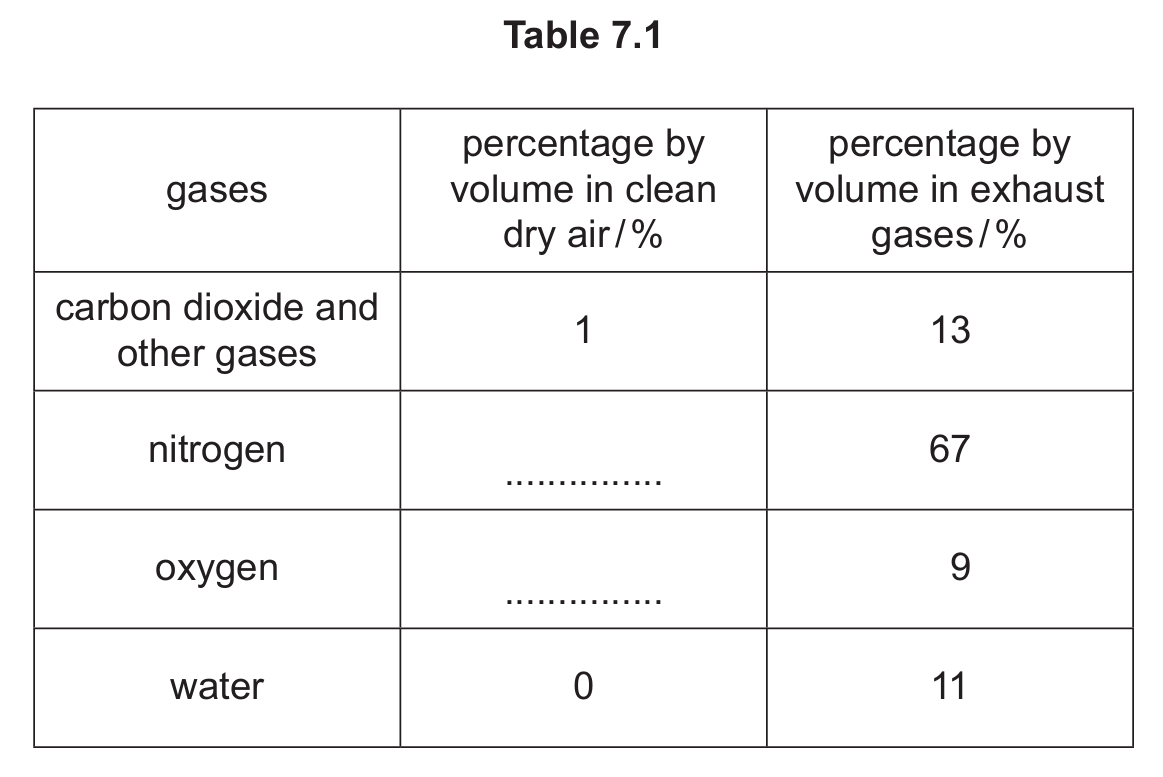
(a)(ii) nitrogen: 78% ; oxygen: 21%
Clean dry air is approximately 78% nitrogen and 21% oxygen by volume. The remaining 1% consists of carbon dioxide, noble gases and other trace gases. These values are the standard composition of unpolluted air.
(a)(iii) 1. carbon dioxide ; 2. water
The complete combustion of hydrocarbons such as gasoline/petrol produces carbon dioxide and water as the main products. Table 7.1 shows that exhaust gases contain 13% carbon dioxide and 11% water vapour, confirming these as the oxidation products.
(a)(iv) Test using anhydrous copper(II) sulfate: white to blue
Alternative test: anhydrous cobalt(II) chloride: blue to pink.
Anhydrous copper(II) sulfate is a white powder that turns blue when water is present. Anhydrous cobalt(II) chloride is blue and turns pink in the presence of water. Both tests are used to detect water in a sample.
(b)(i) Group VIII – 8 electrons in the outer shell; Period 2 – electrons in 2 shells
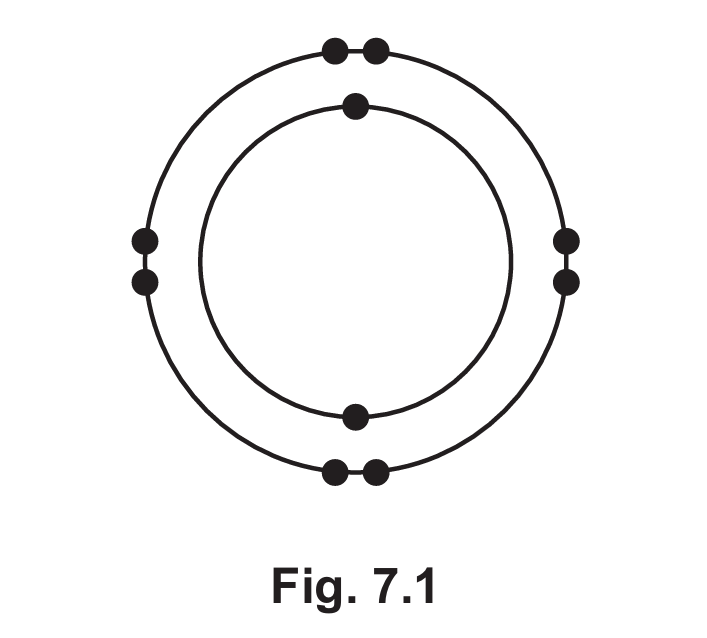
Neon has 8 electrons in its outer shell (2,8 configuration), which places it in Group VIII (the noble gases). It has electrons arranged in 2 shells, so it is in Period 2 of the Periodic Table.
(b)(ii) Neon has a full outer shell of electrons.
A full outer shell (8 electrons) means neon has a stable electronic configuration. It does not need to gain, lose or share electrons to achieve stability, making it chemically unreactive.
(c) Evaporation ; Condensation
Evaporation is the change of state from liquid to gas (vapour) that occurs at the surface of a liquid. Condensation is the change of state from gas (vapour) to liquid when the gas cools down.