
CIE iGCSE Co-Ordinated Science C8.5 Noble gases Exam Style Questions Paper 4
Question
Complete Table 5.1 by predicting the melting point of potassium and the density of rubidium.
Use ideas about trends down the group to help you.


Potassium hydroxide solution and hydrogen are made.
Complete the balanced equation for the reaction.
Include state symbols.
Chlorine displaces bromine from aqueous sodium bromide.
Most-appropriate topic codes (Cambridge IGCSE Co-ordinated Sciences 0654):
• Topic C8.2 — Group I properties (Part (a))
• Topic C8.2 — Group I properties (Part (b))
• Topic C12.5 — Qualitative analysis (Part (c))
• Topic C3.1 — Formulas (Part (d))
• Topic C8.3 — Group VII properties (Part (e))
• Topic C8.5 — Noble gases (Part (f))
▶️ Answer/Explanation
(a) Reactivity increases down the group
Going down Group I, the outer electron is further from the nucleus and more shielded.
This makes it easier to lose, so reactivity increases down the group.
(b) Melting point of potassium ≈ 64 °C (accepted range 38–97 °C); density of rubidium ≈ 1.63 g/cm³ (accepted range 0.90–1.92 g/cm³)
Melting point decreases going down Group I.
Density generally increases going down the group.
These values are predicted by following the trend between the surrounding elements.
(c) Yellow
Sodium compounds produce a characteristic yellow flame in flame tests, including when sodium burns in oxygen.
(d) \(2\text{K(s)} + 2\text{H}_2\text{O(l)} \rightarrow 2\text{KOH(aq)} + \text{H}_2\text{(g)}\)
The formulae must be correct and balanced.
State symbols (aq) for potassium hydroxide and (g) for hydrogen must be included.
(e)
A redox reaction involves the transfer of electrons — loss and gain occurring simultaneously.
The bromide ions (\(\text{Br}^-\)) lose electrons (oxidation) while chlorine atoms gain electrons (reduction).
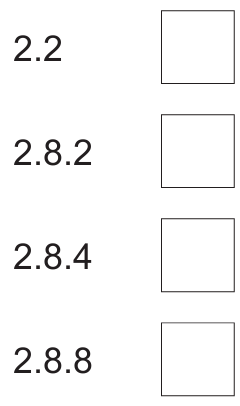
(f) 2.8.8
Group VIII (Group 0) elements have a full outer shell.
Argon has the electronic structure 2.8.8, representing a complete octet.