Home / iGCSE / Coordinated Sciences / C9.1 Properties of metals Paper 2

CIE iGCSE Co-Ordinated Science C9.1 Properties of metals Exam Style Questions Paper 2

Question

Which statement describes all metals?

A. They break when hit with a hammer.
B. They have good electrical conductivity.
C. They dissolve in water.
D. They have high densities.

▶️ Answer/Explanation
Good electrical conductivity is a universal property of all metals due to the presence of delocalised electrons in their metallic structure. Option A is incorrect because metals are malleable and do not break when hit (they dent or bend). Option C is incorrect because most metals do not dissolve in water (though some react). Option D is incorrect because not all metals have high densities (e.g. lithium and sodium have low densities). Therefore, only option B applies to all metals.
Answer: (B)

Question

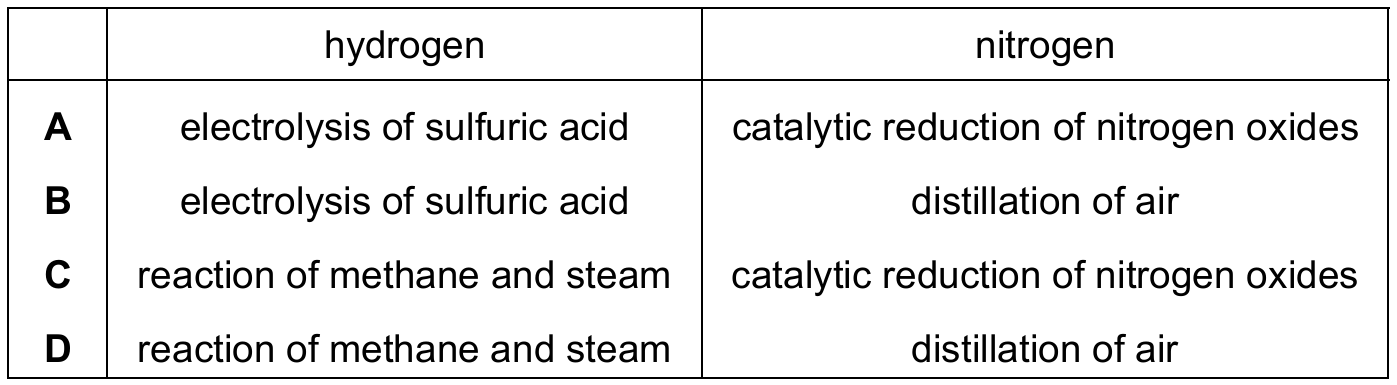
Which row describes how hydrogen and nitrogen are obtained for use in the Haber process?

▶️ Answer/Explanation
Hydrogen comes from \(CH_4 + H_2O \rightarrow CO + 3H_2\) (methane reacted with steam).
Nitrogen is obtained separately by fractional distillation of liquefied air, since air is about \(78\%\) nitrogen.
Answer: (D)

Question

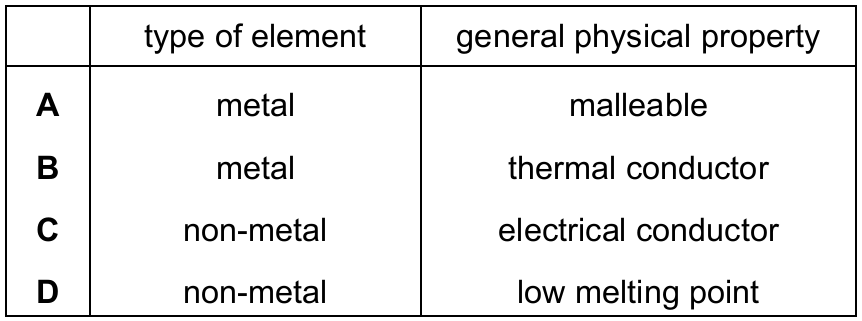
Which row does not link a general physical property to the type of element?

▶️ Answer/Explanation
Metals are generally malleable and good thermal conductors, so rows A and B correctly link property to element type.
Non-metals typically have low melting points compared to metals, so row D is also a correct link.
Non-metals are generally poor electrical conductors, not good ones (except graphite), so row C incorrectly links electrical conductor to non-metal.
Answer: (C)

Question

Which metal oxide is reduced when heated with magnesium powder?

A. calcium oxide
B. copper oxide
C. magnesium oxide
D. sodium oxide

▶️ Answer/Explanation
A more reactive metal can displace and reduce the oxide of a less reactive metal.
Magnesium is more reactive than copper, so it can remove oxygen from copper oxide, reducing it to copper metal.
Calcium and sodium are both more reactive than magnesium, and magnesium oxide is already the oxide of magnesium itself, so these cannot be reduced by magnesium.
Answer: (B)

Question

Zinc is used to galvanise iron.

Which statements about galvanising are correct?

  1. Iron is more reactive than zinc.
  2. Zinc oxidises instead of iron.
  3. Galvanised iron rusts if the zinc coating is scratched.
  4. Galvanising iron is an example of sacrificial protection.

A. 1 and 2
B. 1 and 3
C. 2 and 4
D. 3 and 4

▶️ Answer/Explanation
Zinc is more reactive than iron, not the other way round, so statement 1 is incorrect.
Because zinc is more reactive, it oxidises in preference to iron, protecting the iron underneath — this is sacrificial protection, so statements 2 and 4 are correct.
As long as any zinc coating remains nearby, it continues to protect the iron even if scratched, so statement 3 is incorrect.
Answer: (C)
Scroll to Top