
CIE iGCSE Co-Ordinated Science C9.2 Uses of metals Water Exam Style Questions Paper 4
Question
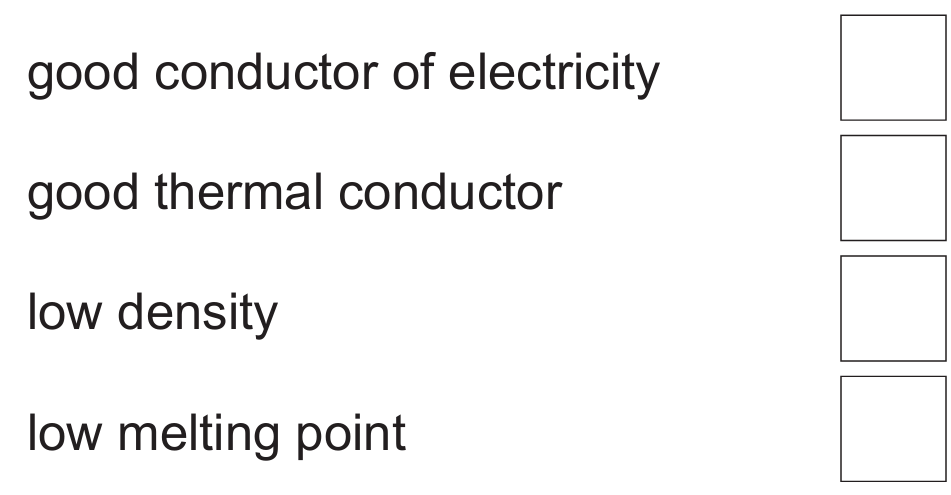
Explain why aluminium is resistant to corrosion.
Fig. 2.1 shows the structures of pure aluminium and an alloy of aluminium.
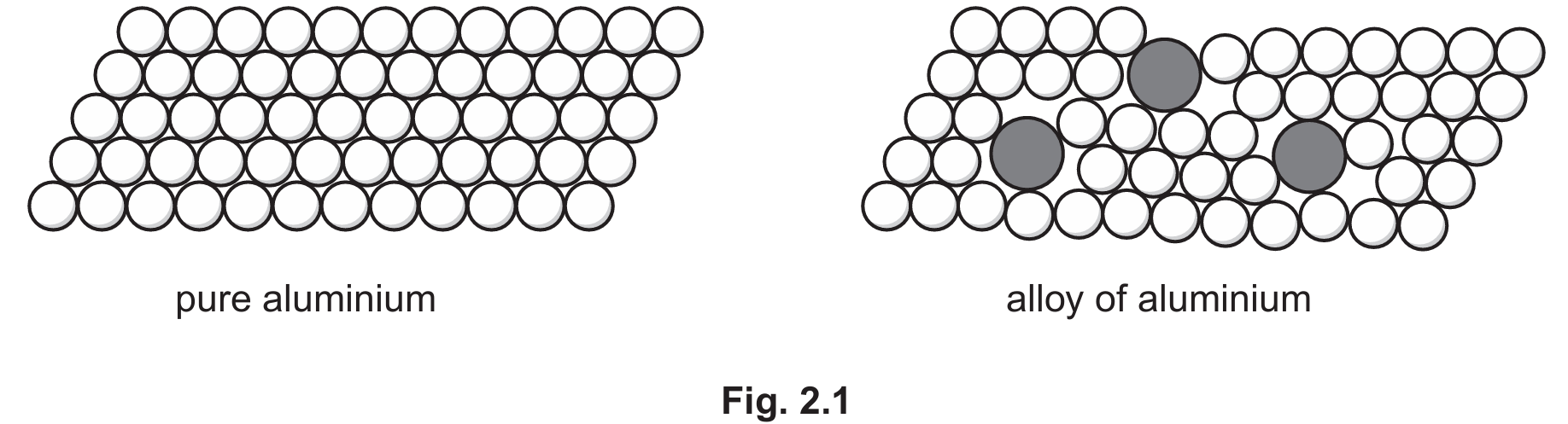
Explain, in terms of their structures and properties, why the alloy is used instead of pure aluminium.
The steel is usually coated with zinc before it is painted.
The zinc prevents rusting, even if the zinc layer is damaged.
Describe how the zinc prevents rusting.
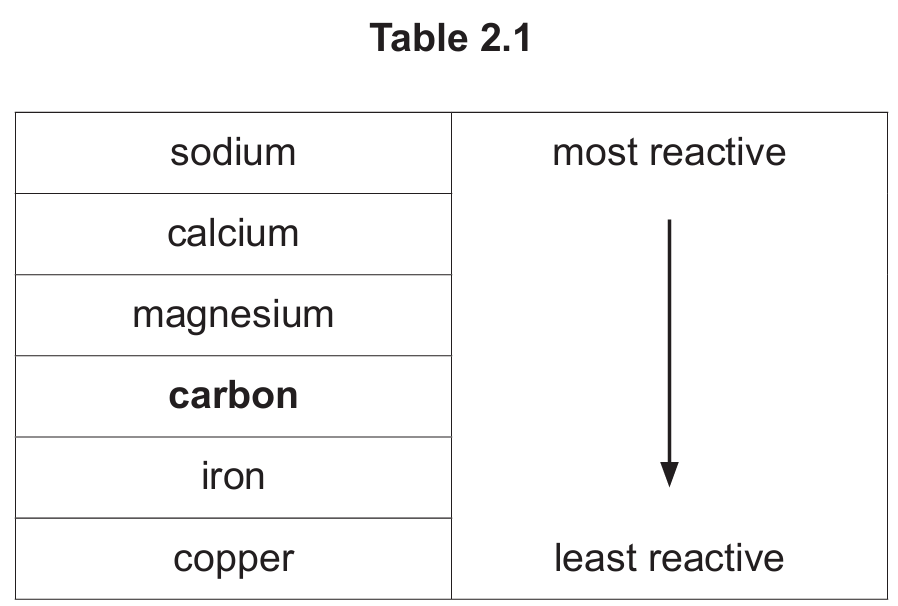
Carbon, a non-metal, is also shown in Table 2.1.
Most-appropriate topic codes (Cambridge IGCSE Co-ordinated Sciences 0654):
• Topic C9.2 — Uses of metals (Part (a), (b))
• Topic C9.3 — Alloys and their properties (Part (c))
• Topic C9.5 — Corrosion of metals (Part (d))
• Topic C9.4/C9.6 — Reactivity series / Extraction of metals (Part (e))
▶️ Answer/Explanation
(a) Low density
Aircraft need to be as light as possible to reduce fuel consumption and allow flight.
Aluminium’s low density makes it much lighter than most other structural metals of similar strength.
(b) Forms a protective oxide layer
Aluminium reacts with oxygen in the air to form a thin layer of aluminium oxide on its surface.
This oxide layer adheres tightly to the metal and prevents further oxygen or water from reaching the aluminium beneath, so corrosion does not continue.
(c) Alloy structure prevents layers sliding
In the alloy, atoms of other elements (different sizes) are mixed in among the aluminium atoms, creating an irregular arrangement.
This distorts the regular layers of atoms found in pure aluminium.
The layers can no longer slide over each other as easily, so more energy/force is needed to deform the metal, making duralumin harder and stronger than pure aluminium.
(d) Sacrificial protection
Zinc is more reactive than iron.
Since zinc is more reactive, it oxidises/corrodes in preference to the iron, even where the zinc coating is scratched or damaged.
This is called sacrificial protection.
(e) Metal: sodium (or calcium or magnesium)
This metal is more reactive than carbon in the reactivity series.
Since carbon cannot displace it from its compound/ore by heating, it cannot be extracted by reduction with carbon.
Instead, it must be extracted using electrolysis, which is used for metals above carbon in reactivity.