Home / iGCSE / Coordinated Sciences / C9.3 Alloys and their properties Paper 4

CIE iGCSE Co-Ordinated Science C9.3 Alloys and their properties Exam Style Questions Paper 4

Question
Iron is extracted from hematite by reduction of iron(III) oxide in a blast furnace.
(a) Iron(III) oxide reacts with carbon monoxide.
Complete the equation for the reduction of iron(III) oxide.
\( \text{Fe}_2\text{O}_3 + 3\text{CO} \rightarrow \text{……} + \text{……} \)
(b) The iron made in the blast furnace is an alloy containing about 90–95% iron.
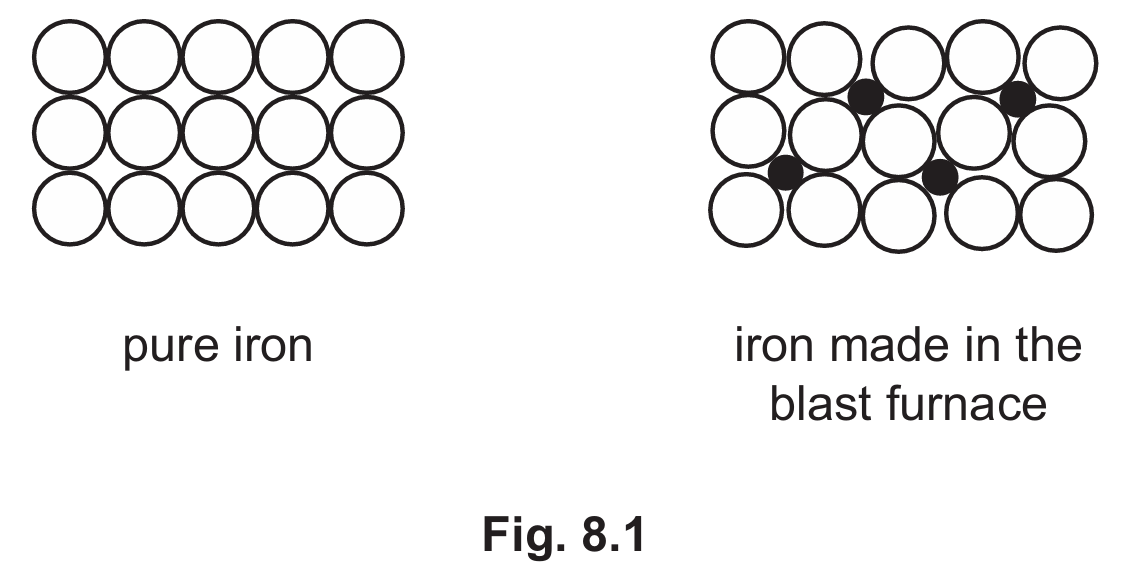
Fig. 8.1 shows pure iron and the iron made in the blast furnace.
(i) Complete the sentences.
Pure iron is an element because ………………………………
Iron from the blast furnace is a mixture because ………………………………
(ii) Iron from the blast furnace is harder than pure iron.
Explain why. Use Fig. 8.1 to help you.
(iii) Pure iron is very malleable.
Explain why. Use Fig. 8.1 to help you.
(c) Calcium carbonate, \( \text{CaCO}_3 \), is added to the blast furnace to remove impurities.
(i) The calcium carbonate is heated to make calcium oxide, CaO.
The equation for the reaction is shown.
\( \text{CaCO}_3 \rightarrow \text{CaO} + \text{CO}_2 \)
State the name of the type of reaction that occurs.
(ii) The calcium oxide reacts with silicon dioxide, \( \text{SiO}_2 \), which is an impurity in the iron ore, to make calcium silicate.
\( \text{CaO} + \text{SiO}_2 \rightarrow \text{CaSiO}_3 \)
Calculate the minimum mass of calcium oxide needed to remove 720 tonnes of silicon dioxide.
\( [A_r: \text{Ca}, 40; \text{O}, 16; \text{Si}, 28] \)
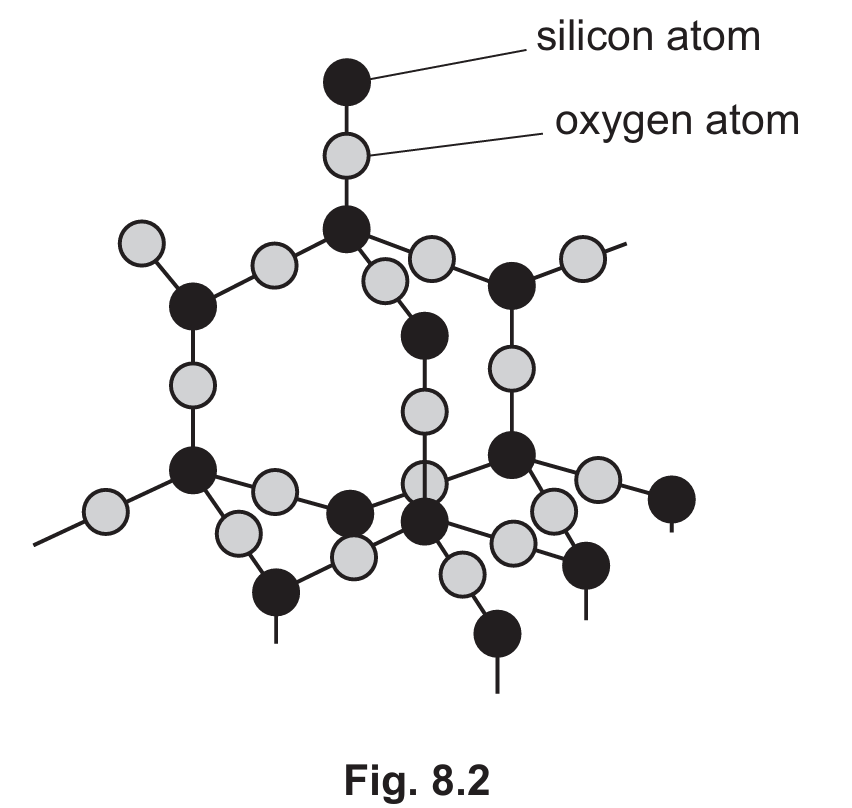
(iii) Fig. 8.2 shows the structure and bonding in silicon dioxide.
The structure and bonding is similar to diamond.
State the type of structure and bonding in silicon dioxide.
Choose from the list.
• giant ionic
• giant covalent
• giant metallic
• simple covalent

Most-appropriate topic codes (Cambridge IGCSE Co-ordinated Sciences 0654):

• Topic C9.6 — Extraction of metals / Blast furnace (Part (a))
• Topic C9.3 — Alloys and their properties (Part (b)(i), (b)(ii) & (b)(iii))
• Topic C6.1 — Physical and chemical changes / Thermal decomposition (Part (c)(i))
• Topic C3.2 — Relative masses / Stoichiometry (Part (c)(ii))
• Topic C2.6 — Giant covalent structures (Part (c)(iii))

▶️ Answer/Explanation

(a) \( \text{Fe}_2\text{O}_3 + 3\text{CO} \rightarrow 2\text{Fe} + 3\text{CO}_2 \)

Carbon monoxide reduces iron(III) oxide to iron metal, being oxidised to carbon dioxide. The equation is balanced with 2 Fe, 3 C, and 6 O atoms on both sides.

(b)(i) Pure iron is an element because it is made of only one type of atom. Iron from the blast furnace is a mixture because it contains two elements (iron and carbon/silicon) that are not chemically combined.

An element consists of identical atoms, while a mixture contains different substances that are not chemically bonded together.

(b)(ii) Iron from the blast furnace is harder because the atoms are different sizes, which prevents the layers of atoms from sliding over each other (unlike in pure iron where all atoms are the same size).

The different-sized atoms in the alloy disrupt the regular arrangement of layers, making it harder for them to slip past one another.

(b)(iii) Pure iron is malleable because layers of atoms can slide / move / slip over each other when a force is applied.

The regular, identical layers of atoms in pure iron can easily slide past one another, allowing the metal to be hammered or bent into shape.

(c)(i) Thermal decomposition

Calcium carbonate breaks down into calcium oxide and carbon dioxide when heated, which is a thermal decomposition reaction.

(c)(ii) Mass of CaO = 672 tonnes

\( M_r(\text{CaO}) = 40 + 16 = 56 \)
\( M_r(\text{SiO}_2) = 28 + (2 \times 16) = 60 \)
\( \text{Mass of CaO} = \frac{56}{60} \times 720 = 672 \text{ tonnes} \)
The mole ratio between CaO and SiO₂ is 1:1, so the mass of CaO needed is proportional to the ratio of their formula masses.

(c)(iii) Giant covalent

Silicon dioxide has a giant covalent structure similar to diamond, where each silicon atom is bonded to four oxygen atoms in a tetrahedral arrangement.

Question

(a) The ionic compound sodium sulfate contains the ions Na⁺ and SO₄²⁻. Determine the formula of sodium sulfate.
(b) Copper sulfate is also an ionic compound.
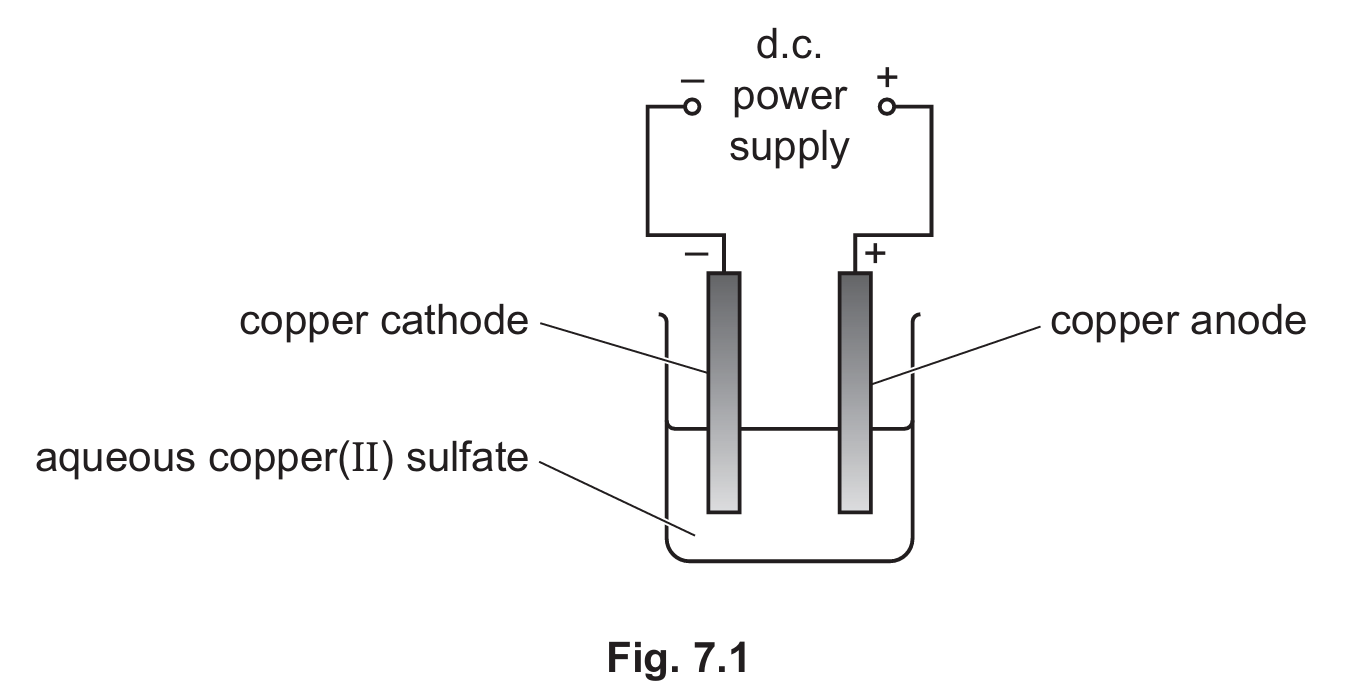
A student investigates the electrolysis of aqueous copper(II) sulfate using copper electrodes.
Fig. 7.1 shows the student’s experiment.
Describe what the student observes at the anode.
(c) (i) Copper is deposited at the cathode. Write the ionic half-equation for the formation of copper, Cu, from copper ions, Cu²⁺.
(ii) The ionic half-equation for the reaction at the anode is shown:
Cu → Cu²⁺ + 2e⁻
Explain if the reaction at the anode is oxidation or reduction.
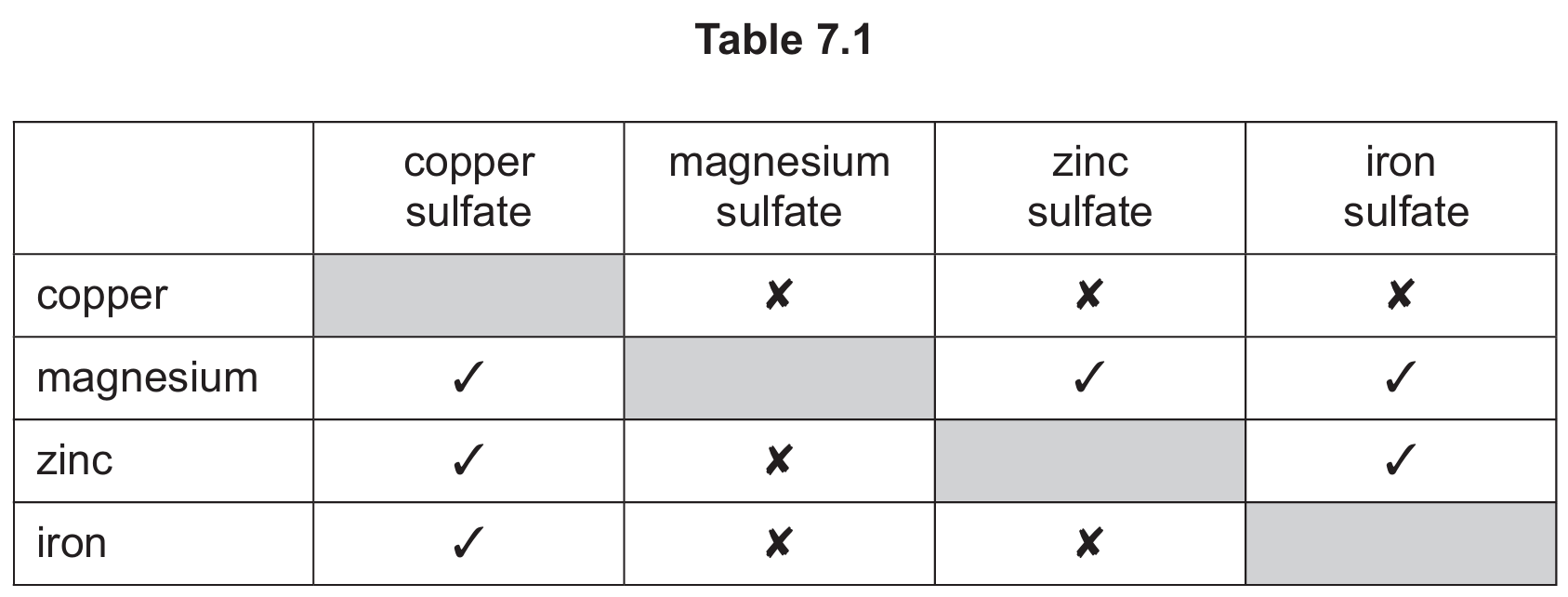
(d) A student investigates the displacement reactions of copper, magnesium, zinc and iron.
The student adds a piece of each metal to solutions of the metal sulfates.
Table 7.1 shows the student’s results.
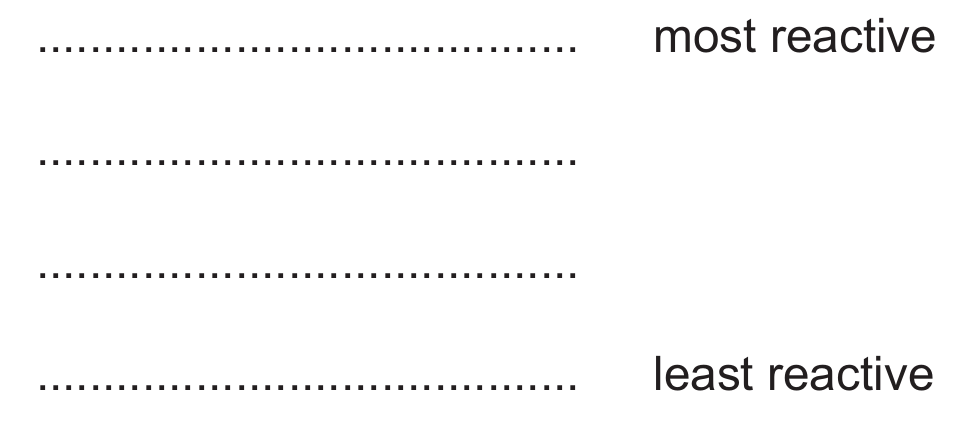
(i) Deduce the order of reactivity of the metals.
(ii) Construct the balanced symbol equation for the reaction of magnesium with zinc sulfate, ZnSO₄.
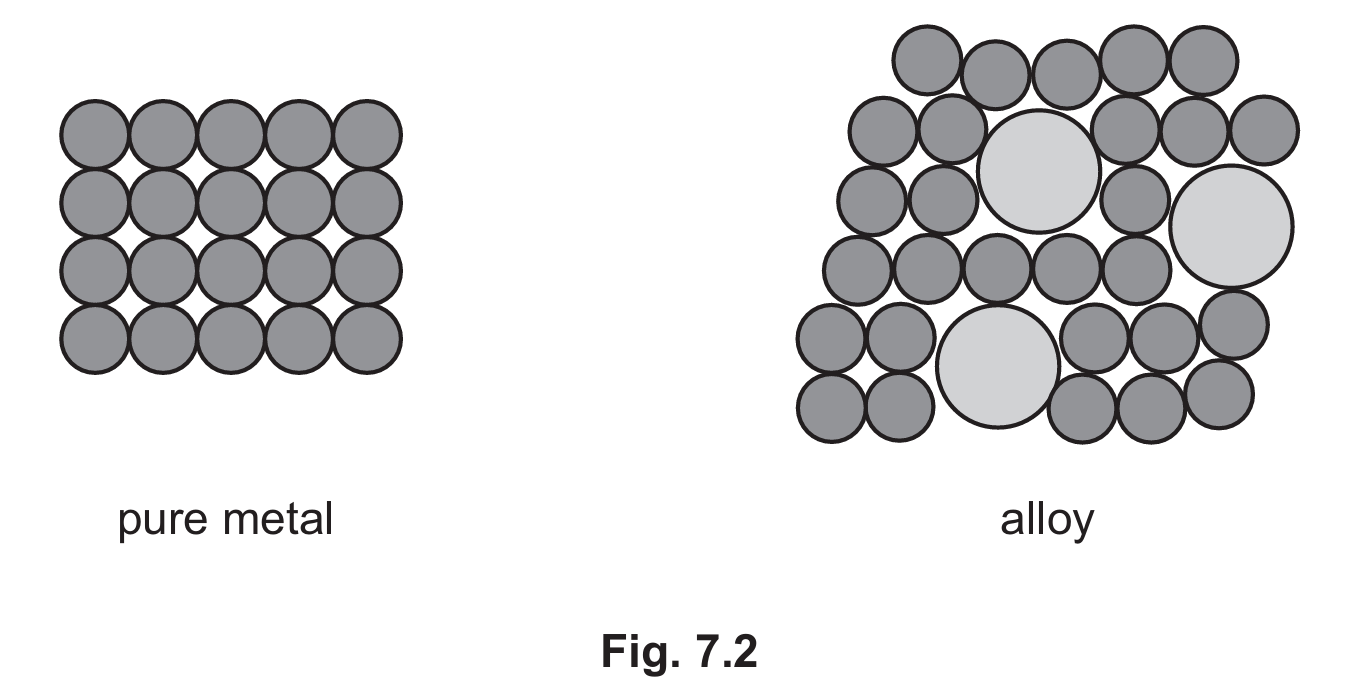
(e) Brass is an alloy of the metals copper and zinc. Fig. 7.2 shows the structure of a pure metal and of an alloy.
Explain why brass is harder and stronger than copper or zinc.

Most-appropriate topic codes (Cambridge IGCSE Co-ordinated Sciences 0654):

• Topic C3.1 — Formulas (Part (a))
• Topic C4.1 — Electrolysis (Part (b), (c))
• Topic C9.4 — Reactivity series (Part (d))
• Topic C9.3 — Alloys and their properties (Part (e))

▶️ Answer/Explanation

(a) Formula of sodium sulfate = Na₂SO₄
Two Na⁺ ions (each +1) balance one SO₄²⁻ ion (-2).

(b) Observation at the anode:
The copper anode dissolves/gets smaller. Cu atoms at the anode lose electrons to form Cu²⁺ ions, which go into the solution: Cu → Cu²⁺ + 2e⁻.

(c)(i) Ionic half-equation: Cu²⁺ + 2e⁻ → Cu
Copper ions gain two electrons to form copper atoms.

(c)(ii) The reaction at the anode is oxidation.
Oxidation is the loss of electrons. At the anode, copper atoms lose electrons to form Cu²⁺ ions.

(d)(i) Order of reactivity:
Most reactive → Least reactive: magnesium > zinc > iron > copper

(d)(ii) Balanced equation: Mg + ZnSO₄ → Zn + MgSO₄
Magnesium is more reactive than zinc, so it displaces zinc from zinc sulfate solution.

(e) Why brass is harder and stronger:
In pure metals, atoms are arranged in regular layers that can slide over each other. In an alloy like brass, the zinc atoms are different sizes from the copper atoms. This disrupts the regular arrangement of the layers, preventing them from sliding easily, making the alloy harder and stronger.

Scroll to Top