CIE iGCSE Co-Ordinated Science C9.4 Reactivity series Exam Style Questions Paper 2
Question
Substance Q is added to cold water. Q floats on the water and hydrogen gas is made.
What is Q?
A. iodine
B. lithium
C. magnesium
D. zinc
▶️ Answer/Explanation
✅ Answer: (B)
Question
Metal X reacts rapidly with steam but only very slowly with cold water.
What is X?
A. calcium
B. copper
C. magnesium
D. sodium
▶️ Answer/Explanation
✅ Answer: (C)
Question
Silver oxide is reduced by heating with carbon more easily than copper oxide is reduced by heating with carbon.
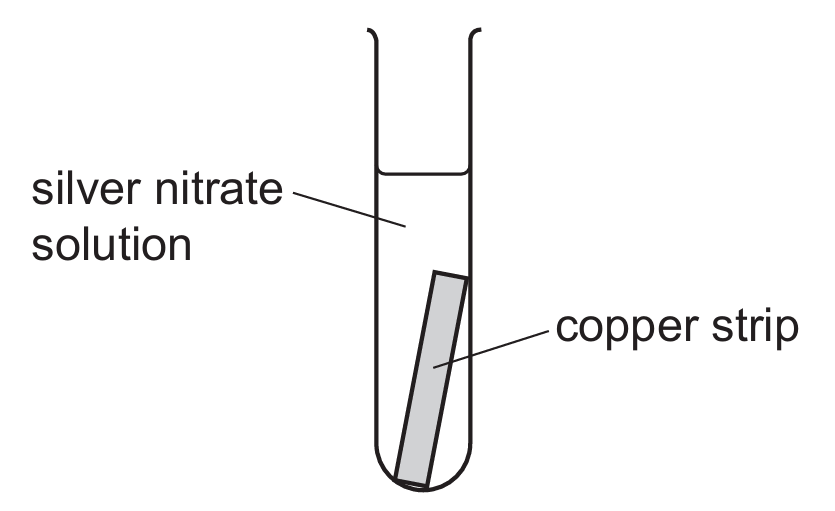
A copper strip is placed into a solution of silver nitrate as shown.

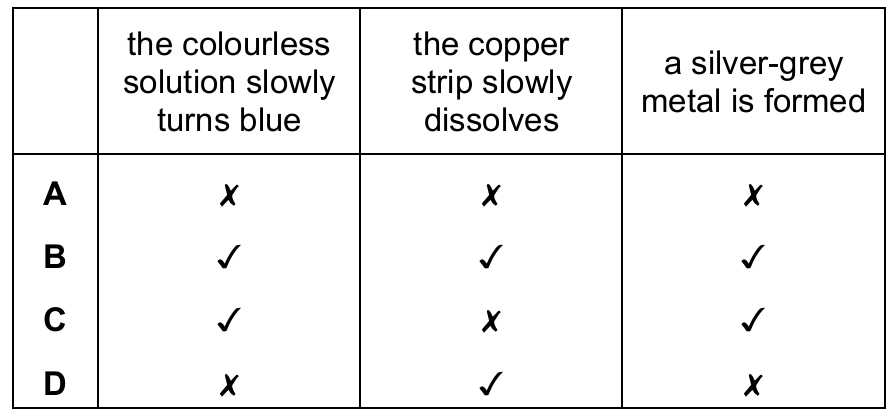
Which row describes the reaction?

▶️ Answer/Explanation
Copper atoms lose electrons to form blue \(\text{Cu}^{2+}\) ions in solution, so the colourless solution slowly turns blue and the copper strip slowly dissolves.
Silver ions gain electrons, depositing as silver-grey solid silver metal on the copper strip.
✅ Answer: (B)
Question
W, X, Y and Z are metals.
Three statements about these metals are listed.
- Metal W reduces the oxide of X.
- Metal Z is not able to reduce the oxide of W, but it does reduce the oxides of X and Y.
- Metal X displaces Y from its aqueous solution.
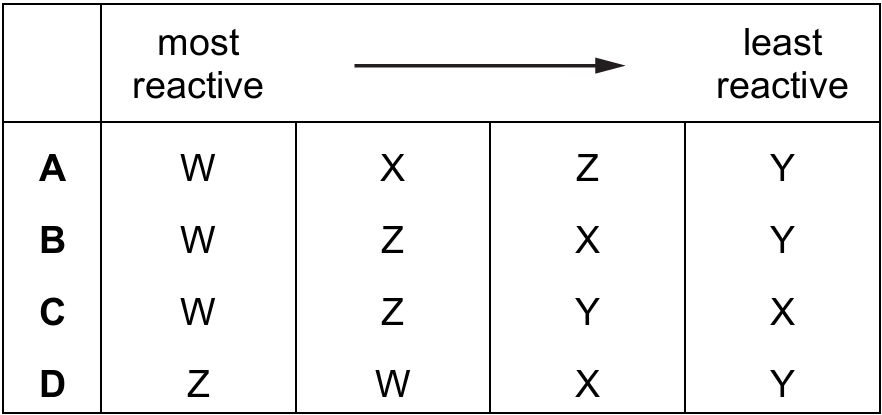
Which row shows the order of reactivity?

▶️ Answer/Explanation
Statement 2 shows Z is less reactive than W, but more reactive than X and Y.
Statement 3 shows X is more reactive than Y, giving the overall order W > Z > X > Y.
✅ Answer: (B)
Question
Which statement about reactions of metals is correct?
A. When copper is added to aqueous aluminium nitrate, the colourless solution turns blue.
B. When magnesium oxide is heated with iron, solid iron(III) oxide is formed.
C. When potassium oxide is heated with copper, an orange-brown solid is formed.
D. When zinc is added to aqueous copper sulfate, the blue solution turns colourless.
▶️ Answer/Explanation
As colourless zinc sulfate replaces the blue copper sulfate solution, the blue colour fades to colourless, and reddish-brown copper metal is deposited.
Copper is less reactive than aluminium so cannot displace it (A is wrong), magnesium is more reactive than iron so magnesium oxide would not be reduced by iron (B is wrong), and copper is less reactive than potassium so cannot displace it from potassium oxide (C is wrong).
✅ Answer: (D)
