
CIE iGCSE Co-Ordinated Science C9.4 Reactivity series Exam Style Questions Paper 4
Question
Most-appropriate topic codes (Cambridge IGCSE Co-ordinated Sciences 0654):
• Topic C3.1 — Formulas (Part (a))
• Topic C4.1 — Electrolysis (Part (b), (c))
• Topic C9.4 — Reactivity series (Part (d))
• Topic C9.3 — Alloys and their properties (Part (e))
▶️ Answer/Explanation
(a) Formula of sodium sulfate = Na₂SO₄
Two Na⁺ ions (each +1) balance one SO₄²⁻ ion (-2).
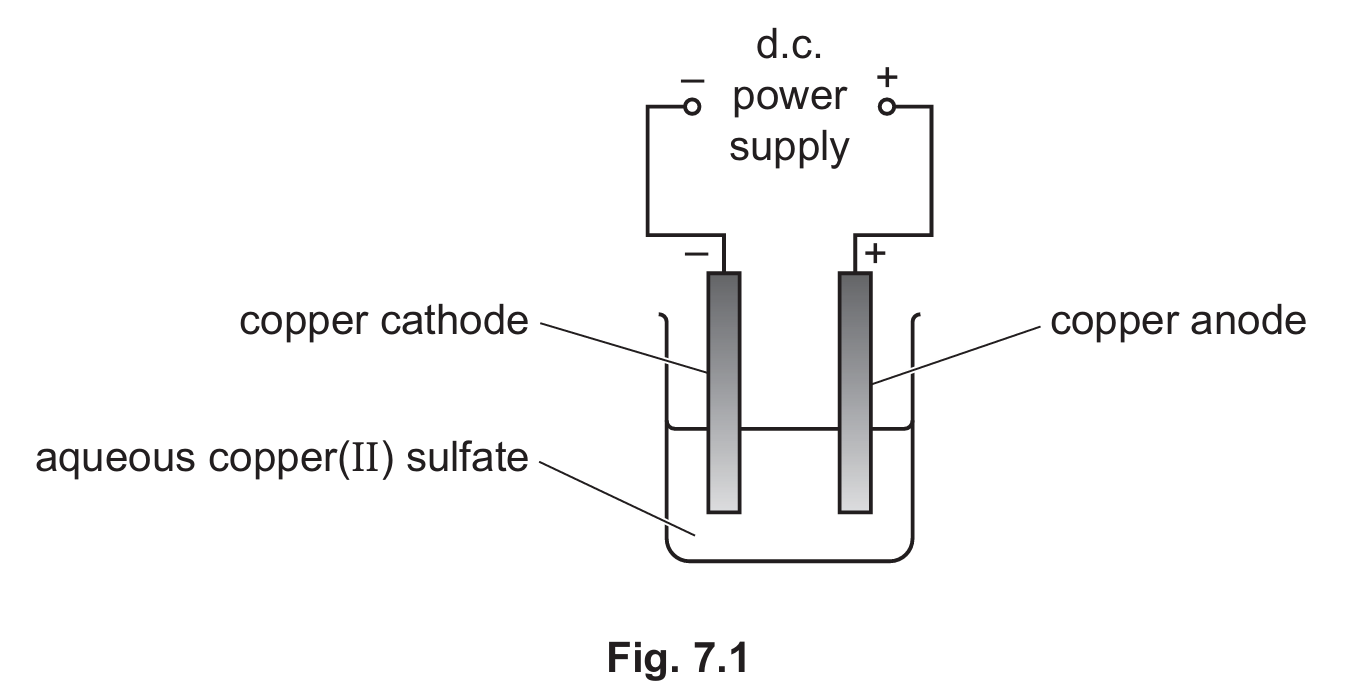
(b) Observation at the anode:
The copper anode dissolves/gets smaller. Cu atoms at the anode lose electrons to form Cu²⁺ ions, which go into the solution: Cu → Cu²⁺ + 2e⁻.
(c)(i) Ionic half-equation: Cu²⁺ + 2e⁻ → Cu
Copper ions gain two electrons to form copper atoms.
(c)(ii) The reaction at the anode is oxidation.
Oxidation is the loss of electrons. At the anode, copper atoms lose electrons to form Cu²⁺ ions.
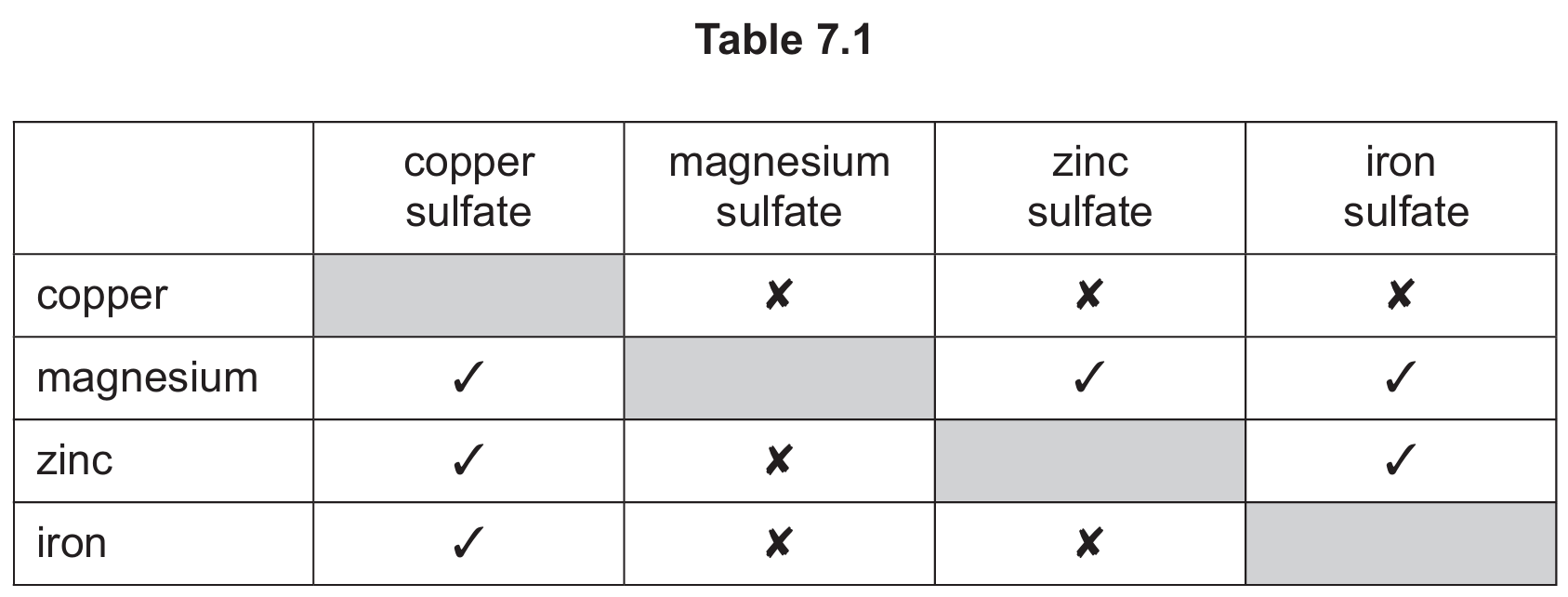
(d)(i) Order of reactivity:
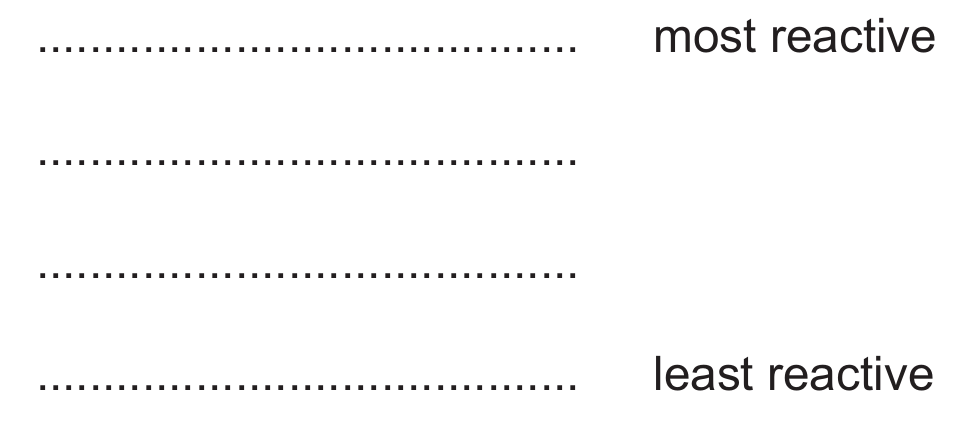
Most reactive → Least reactive: magnesium > zinc > iron > copper
(d)(ii) Balanced equation: Mg + ZnSO₄ → Zn + MgSO₄
Magnesium is more reactive than zinc, so it displaces zinc from zinc sulfate solution.
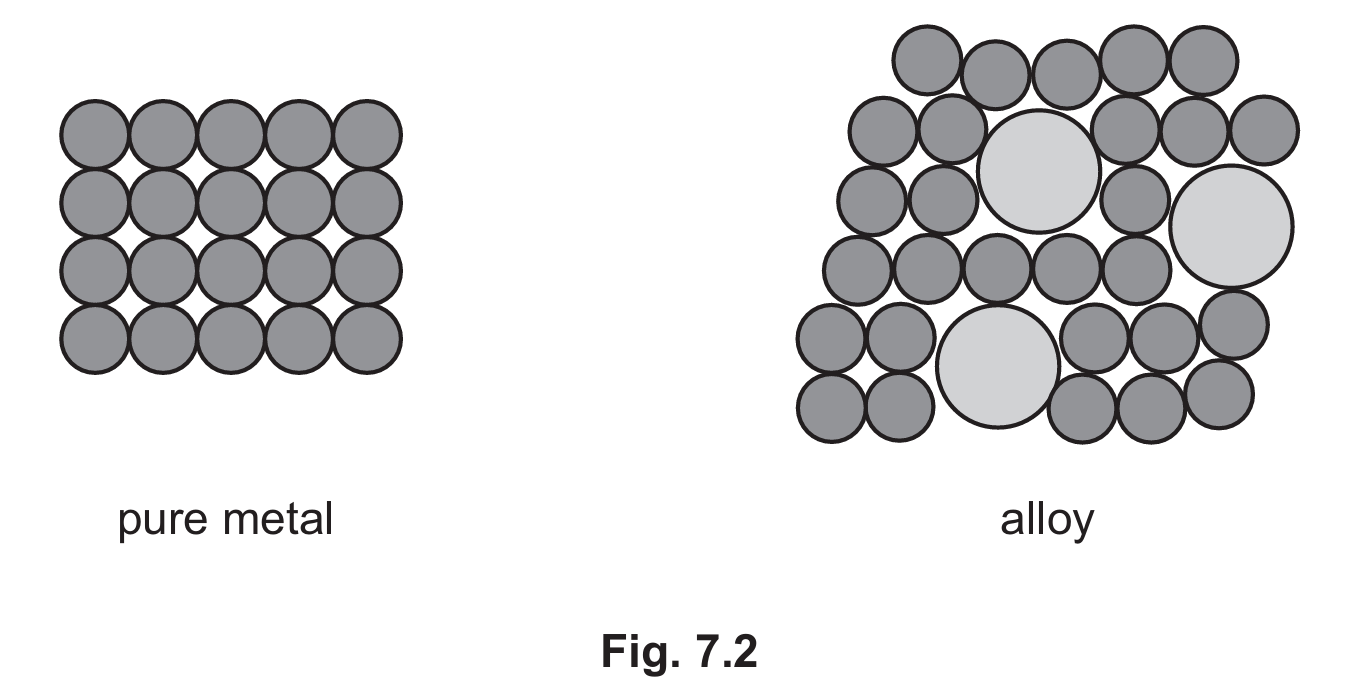
(e) Why brass is harder and stronger:
In pure metals, atoms are arranged in regular layers that can slide over each other. In an alloy like brass, the zinc atoms are different sizes from the copper atoms. This disrupts the regular arrangement of the layers, preventing them from sliding easily, making the alloy harder and stronger.
Question
You only need to draw the outer-shell electrons.
Most-appropriate topic codes (Cambridge IGCSE Co-ordinated Sciences 0654, 2025–2027 syllabus):
• Topic B12 — Respiration / Topic C9.4 — Extraction of metals (thermal decomposition) (Part (a))
• Topic C10.2 — Air quality and climate (Part (b))
• Topic C7.2 — Oxides (Part (c))
• Topic C2.5 — Simple molecules and covalent bonds (Part (d))
▶️ Answer/Explanation
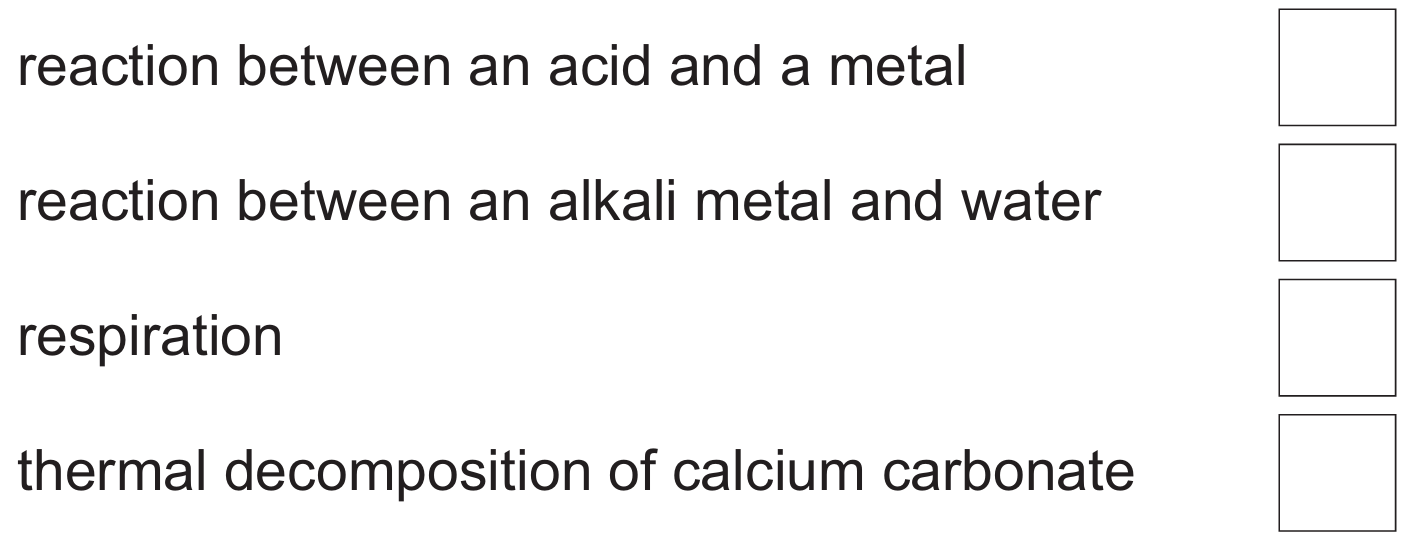
(a) 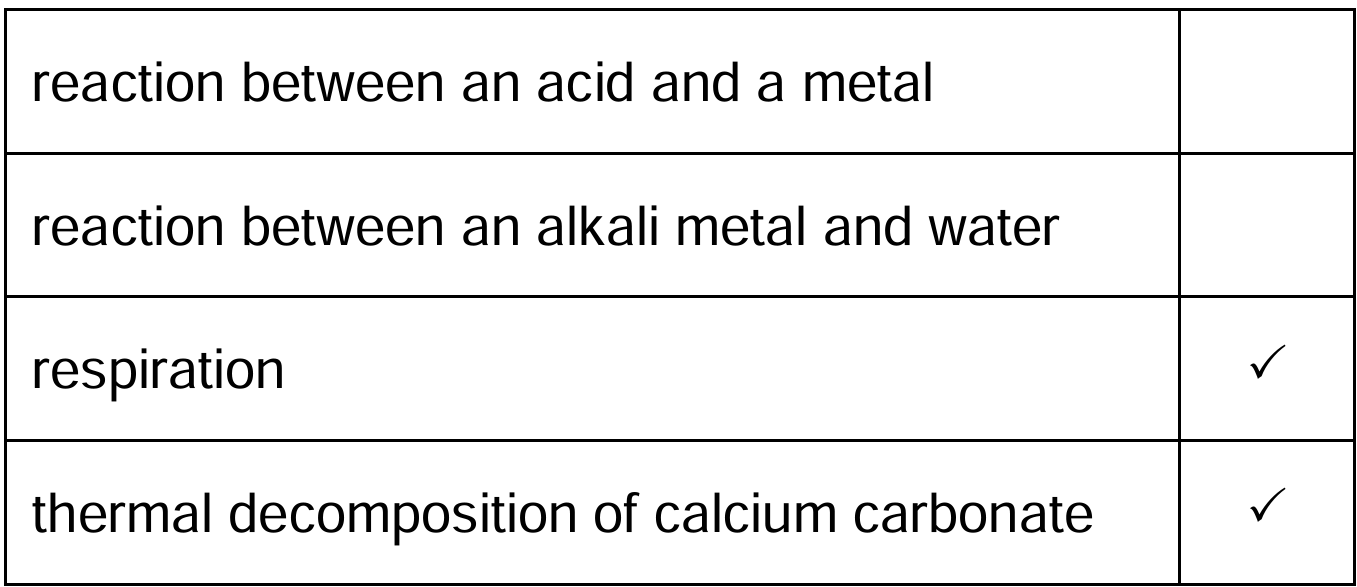
Respiration releases \(CO_2\) as a waste product: \(glucose + oxygen \rightarrow carbon\ dioxide + water\).
Thermal decomposition of calcium carbonate also releases \(CO_2\): \(CaCO_3 \rightarrow CaO + CO_2\).
A reaction between an acid and a metal produces hydrogen gas, not \(CO_2\), and an alkali metal with water also produces hydrogen gas.
(b) Carbon dioxide is a greenhouse gas
Carbon dioxide absorbs and re-emits thermal energy radiated from the Earth, contributing to the (enhanced) greenhouse effect.
Increasing concentrations of this and other greenhouse gases lead to global warming and climate change.
(c) Acidic
Carbon is a non-metal, and oxides of non-metals are classified as acidic oxides.
Carbon dioxide dissolves in water to form a weakly acidic solution (carbonic acid).
(d)(i) Covalent bonding
Carbon dioxide is a simple molecule formed when atoms share pairs of electrons.
Each oxygen atom shares two pairs of electrons with the carbon atom, forming two C=O double covalent bonds.
(d)(ii) 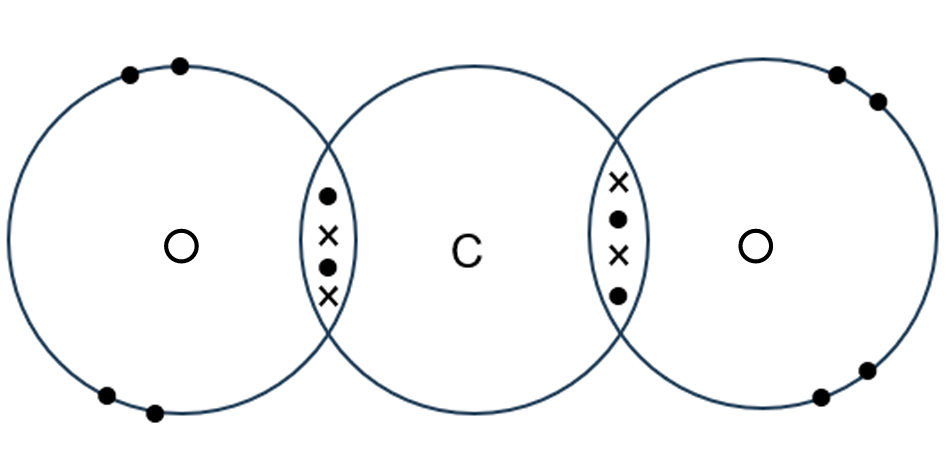
The diagram should show \(O::C::O\) with two double bonds.
Each double bond consists of two shared pairs of electrons (one shown as dots, one as crosses) between carbon and each oxygen.
Each oxygen atom also has two non-bonding (lone) pairs of electrons shown only as dots or crosses belonging to that oxygen, giving carbon 8 outer electrons and each oxygen 8 outer electrons.