
CIE iGCSE Co-Ordinated Science C9.5 Corrosion of metals Exam Style Questions Paper 4
Question
Topic codes:
• Topic C9.6 — Extraction of metals (Part (a), (b), (c), (d))
• Topic C9.5 — Corrosion of metals / Sacrificial protection (Part (e))
• Topic C2.7 — Metallic bonding (Part (f))
• Topic C5.1 — Exothermic and endothermic reactions (Part (a))
• Topic C6.3 — Redox (Part (b))
▶️ Answer/Explanation
(a) Exothermic — the reaction transfers thermal energy to the surroundings.
(b) The carbon dioxide undergoes reduction (it loses oxygen).
In this reaction: \(\text{C} + \text{CO}_2 \rightarrow 2\text{CO}\), carbon dioxide (\(\text{CO}_2\)) is reduced to carbon monoxide (\(\text{CO}\)) as it loses one oxygen atom.
(c) \(\text{Fe}_2\text{O}_3 + 3\text{CO} \rightarrow 2\text{Fe} + 3\text{CO}_2\)
Check: Iron: 2 atoms on each side; Carbon: 3 atoms on each side; Oxygen: 3 + 3 = 6 on each side.
(d) \(M_r\) of CaCO₃ = 40 + 12 + (3 × 16) = 100
\(M_r\) of CaO = 40 + 16 = 56
Mass of CaCO₃ needed = \(100 \times 7 \div 56 = 12.5\) tonnes
(e) Sacrificial protection works because zinc is more reactive than iron (higher in the reactivity series).
Zinc loses electrons more easily than iron, so zinc is oxidised preferentially (it acts as the anode). This means the iron is protected from losing electrons and therefore from rusting.
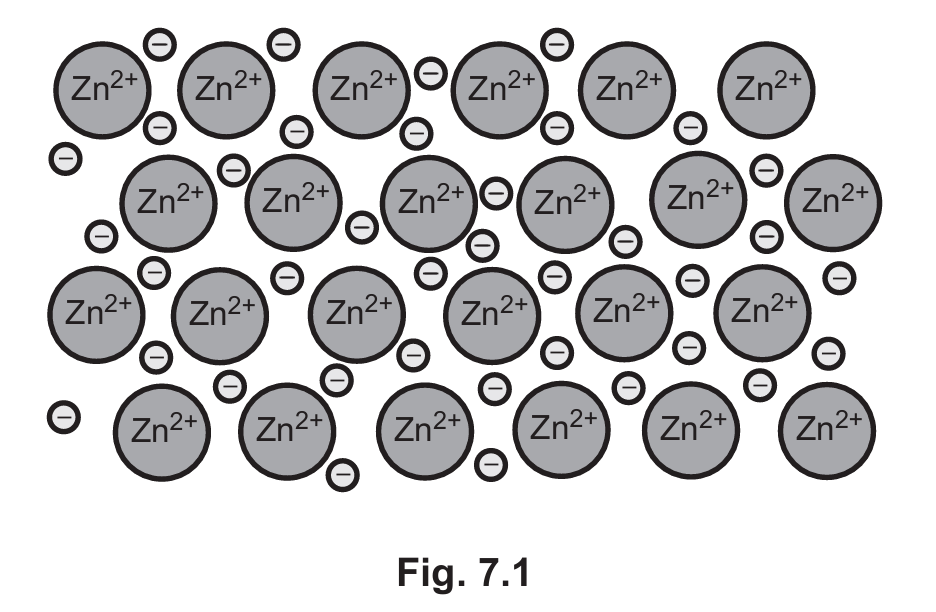
(f) Metallic bonding in zinc involves electrostatic attraction between the positive zinc (metal) ions and the ‘sea’ of delocalised electrons.
In the metallic lattice, the outer electrons of zinc atoms become delocalised and are free to move throughout the structure. These mobile electrons hold the positively charged zinc ions together.
Question
Calcium chloride, water and carbon dioxide are made.
Explain why. Use ideas about collisions between reacting particles.
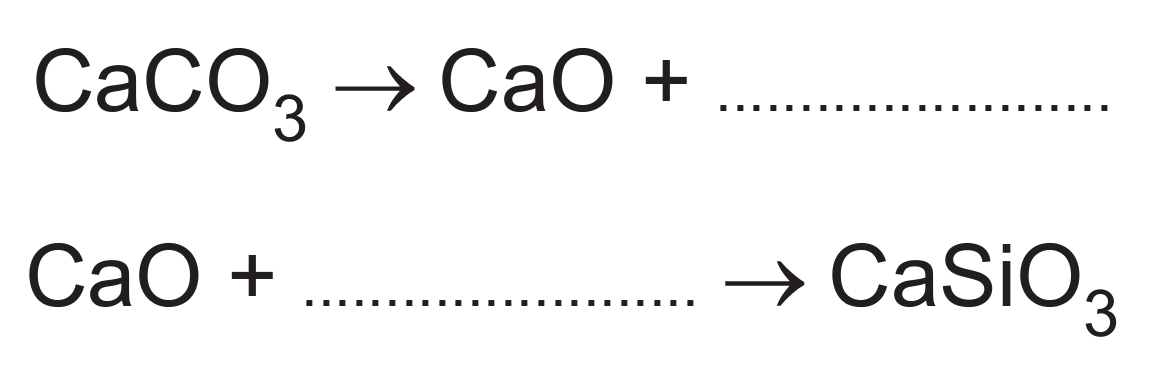
Calcium carbonate (limestone) is added to the blast furnace to remove impurities in the iron ore.
Complete the symbol equations to show the reactions to remove the impurities.
Most-appropriate topic codes (Cambridge IGCSE Co-ordinated Sciences 0654):
• Topic C6.2 — Rate of reaction, collision theory (Part (a)–(b))
• Topic C3.3 — The mole and the Avogadro constant, reacting masses (Part (c))
• Topic C9.6 — Extraction of metals (Part (d))
• Topic C9.5 — Corrosion of metals (Part (e))
▶️ Answer/Explanation
(a) gas syringe / measuring cylinder over water
A gas syringe can be connected to the reaction vessel to directly measure the volume of gas produced.
Alternatively, the gas can be collected over water in an inverted measuring cylinder.
(b) any three from: particles have more kinetic energy/move faster; more particles have energy ≥ activation energy; more frequent collisions; more successful collisions
Increasing temperature gives reacting particles more kinetic energy, so they move faster.
This results in more frequent collisions, with a greater proportion having energy equal to or above the activation energy, so more collisions are successful and the rate increases.
(c) 22.2 g
\(M_r\) of \(\text{CaCO}_3 = 100\) and \(M_r\) of \(\text{CaCl}_2 = 111\).
Mass of \(\text{CaCl}_2 = \dfrac{111}{100} \times 20 = 22.2\,\text{g}\).
(d)(i) carbon is more reactive than iron
A more reactive element can displace a less reactive one from its compound.
Since carbon is more reactive than iron, it can reduce iron oxide to extract the metal.
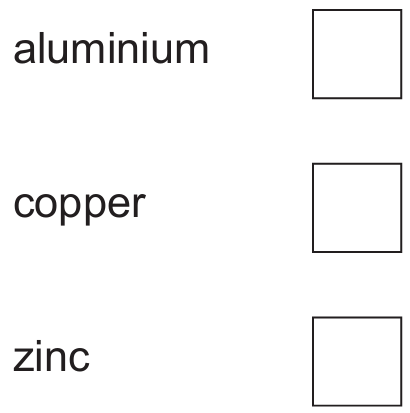
(d)(ii) aluminium
Aluminium is more reactive than carbon, so carbon cannot displace it from its ore.
Aluminium must instead be extracted by electrolysis.
(d)(iii) \(\text{CaCO}_3 \rightarrow \text{CaO} + \text{CO}_2\); \(\text{CaO} + \text{SiO}_2 \rightarrow \text{CaSiO}_3\)
Limestone decomposes on heating to form calcium oxide and carbon dioxide.
The calcium oxide then reacts with silicon dioxide impurities to form molten slag (calcium silicate).
(e) zinc loses electrons more readily than iron
Zinc is more reactive than iron, so it loses electrons more readily.
Zinc is oxidised in preference to iron, sacrificially protecting the iron from rusting.