Home / iGCSE / Coordinated Sciences / C9.6 Extraction of metals Paper 2

CIE iGCSE Co-Ordinated Science C9.6 Extraction of metals Exam Style Questions Paper 2

Question

The ore cassiterite contains tin dioxide.

Tin is more reactive than copper but less reactive than iron.

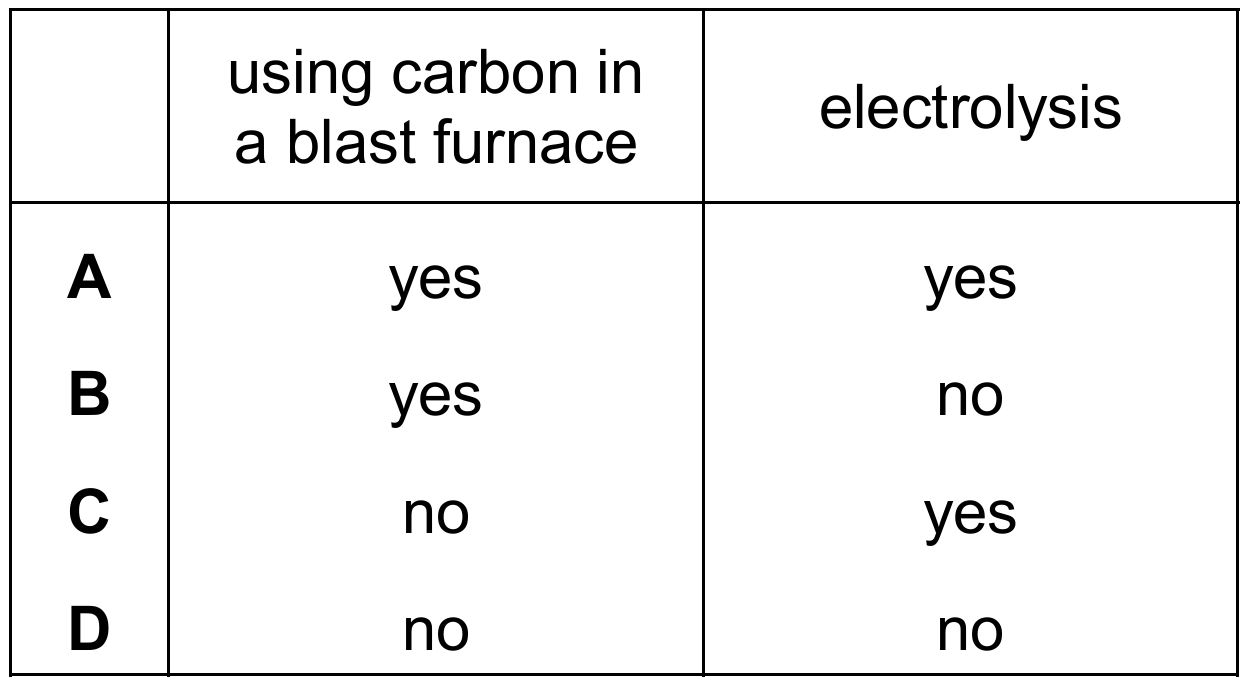
Which row shows the industrial method used to extract tin based on tin’s position in the reactivity series?

▶️ Answer/Explanation
Metals below carbon in the reactivity series (like tin) can be extracted by reduction with carbon in a blast furnace. Tin is less reactive than iron but more reactive than copper, placing it in the middle of the series, still below carbon, so carbon reduction is used. Electrolysis is not needed for tin extraction.
Answer: (B)

Question

Which statement about the extraction of metals is correct?

A. Aluminium ore is called hematite.
B. Aluminium is extracted from its ore by heating with carbon.
C. Iron oxide is reduced to iron by heating with carbon monoxide.
D. Limestone is used to remove basic impurities in a blast furnace.

▶️ Answer/Explanation
In the blast furnace, iron oxide (haematite, \(\text{Fe}_2\text{O}_3\)) is reduced to iron by carbon monoxide: \(\text{Fe}_2\text{O}_3 + 3\text{CO} \rightarrow 2\text{Fe} + 3\text{CO}_2\) — this makes statement C correct.
Aluminium ore is bauxite (not haematite); aluminium is extracted by electrolysis (not heating with carbon); and limestone removes acidic impurities (like silica), not basic ones.
Answer: (C)

Question

Which word equation describes the manufacture of lime from limestone?

A. calcium carbonate → calcium hydroxide + carbon dioxide
B. calcium carbonate → calcium oxide + carbon dioxide
C. calcium hydroxide → calcium oxide + water
D. calcium oxide + carbon dioxide → calcium carbonate

▶️ Answer/Explanation
Lime (calcium oxide) is manufactured by heating limestone (calcium carbonate) strongly, a thermal decomposition reaction.
This releases carbon dioxide gas, leaving calcium oxide (lime) as the solid product.
Answer: (B)

Question

Which metal can only be extracted from its ore using electrolysis?

A. calcium
B. copper
C. iron
D. zinc

▶️ Answer/Explanation
Metals more reactive than carbon, such as calcium, cannot be displaced from their ores by carbon reduction.
These very reactive metals must instead be extracted by electrolysis of their molten compounds.
Copper, iron and zinc are all less reactive than carbon and can be extracted by heating with carbon.
Answer: (A)

Question

Which statements about limestone are correct?

  1. It contains calcium oxide.
  2. It is used to manufacture lime.
  3. It neutralises acidic industrial waste products.
  4. It neutralises alkaline soil.

A. 1 and 3  
B. 1 and 4  
C. 2 and 3  
D. 2 and 4

▶️ Answer/Explanation
Limestone is calcium carbonate, not calcium oxide, but it is heated to manufacture lime (calcium oxide), so statement 2 is correct.
Limestone (or lime made from it) is basic and neutralises acidic industrial waste, so statement 3 is correct; statement 4 is wrong since it is used to neutralise acidic (not alkaline) soil.
Answer: (C)
Scroll to Top