CIE iGCSE Co-Ordinated Science P1.1 Physical quantities and measurement techniques Exam Style Questions Paper 3
Question

The gravitational field strength, \(g\), is \(10 \, \text{N/kg}\).
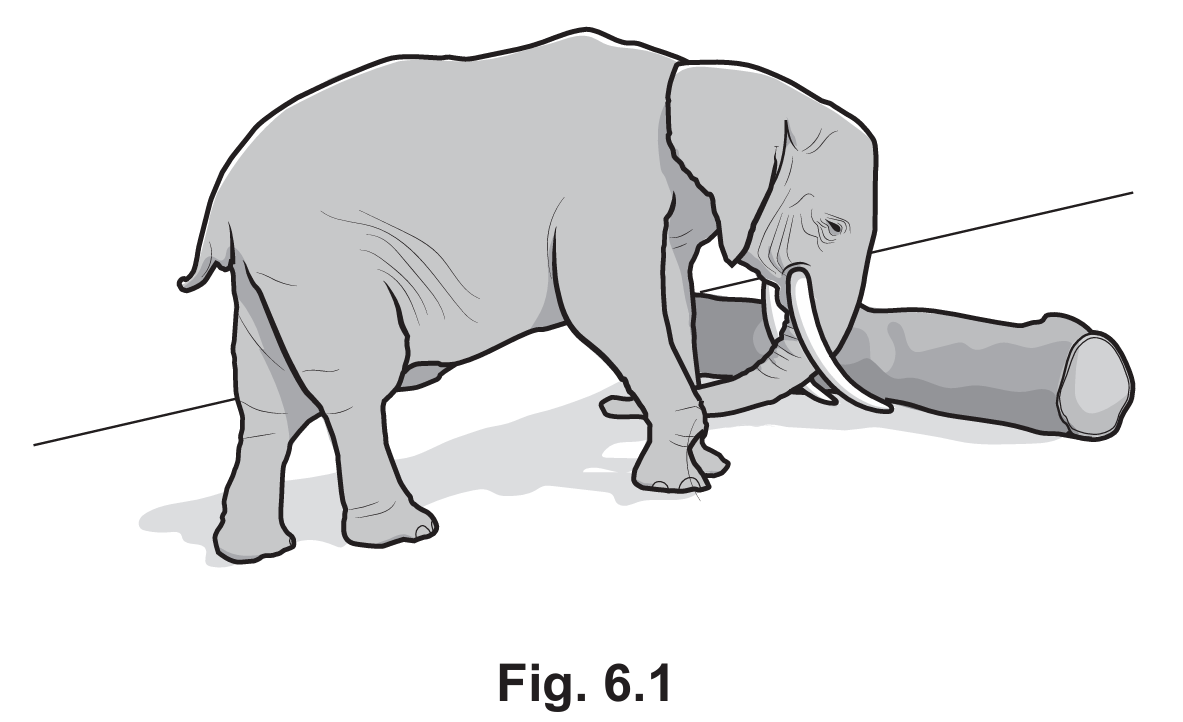
Calculate the average density of the elephant.

Most-appropriate topic codes (Cambridge IGCSE Co-ordinated Sciences 0654):
• Topic P1.6.2 — Work (Part (a)(i))
• Topic P1.6.1 — Energy (Part (a)(ii))
• Topic P1.3 — Mass and weight (Part (b)(i))
• Topic P1.4 — Density (Part (b)(ii))
• Topic P1.1 — Physical quantities and measurement techniques (Part (c))
▶️ Answer/Explanation
(a)(i) Force; distance
Work done is calculated using \(W = F \times d\).
So the elephant’s applied force and the distance the log moves must both be measured.
(a)(ii) Gravitational potential energy
As the elephant moves up the hill, its height above the ground increases.
This increases its gravitational potential energy.
(b)(i) 36 800 N
Combined mass = \(3500 + 180 = 3680 \, \text{kg}\).
Weight = \(mg = 3680 \times 10 = 36{,}800 \, \text{N}\).
(b)(ii) 1029 kg/m³
Density = mass ÷ volume.
Density = \(\dfrac{3500}{3.4} \approx 1029 \, \text{kg/m}^3\).
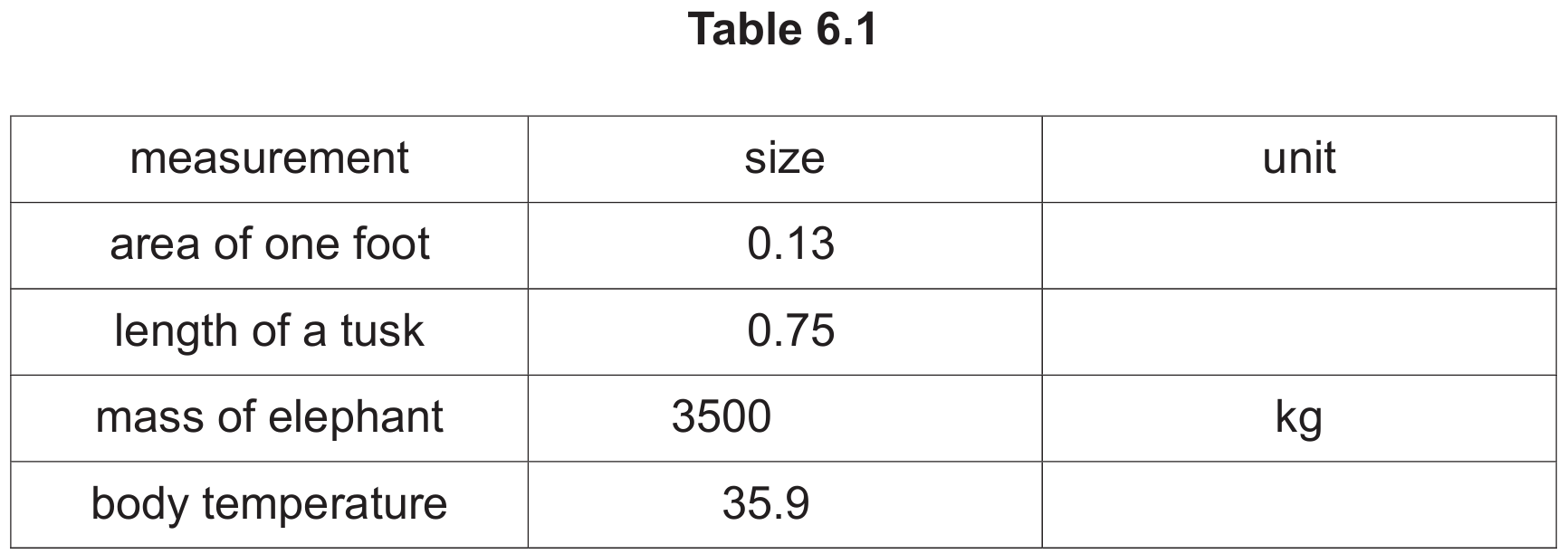
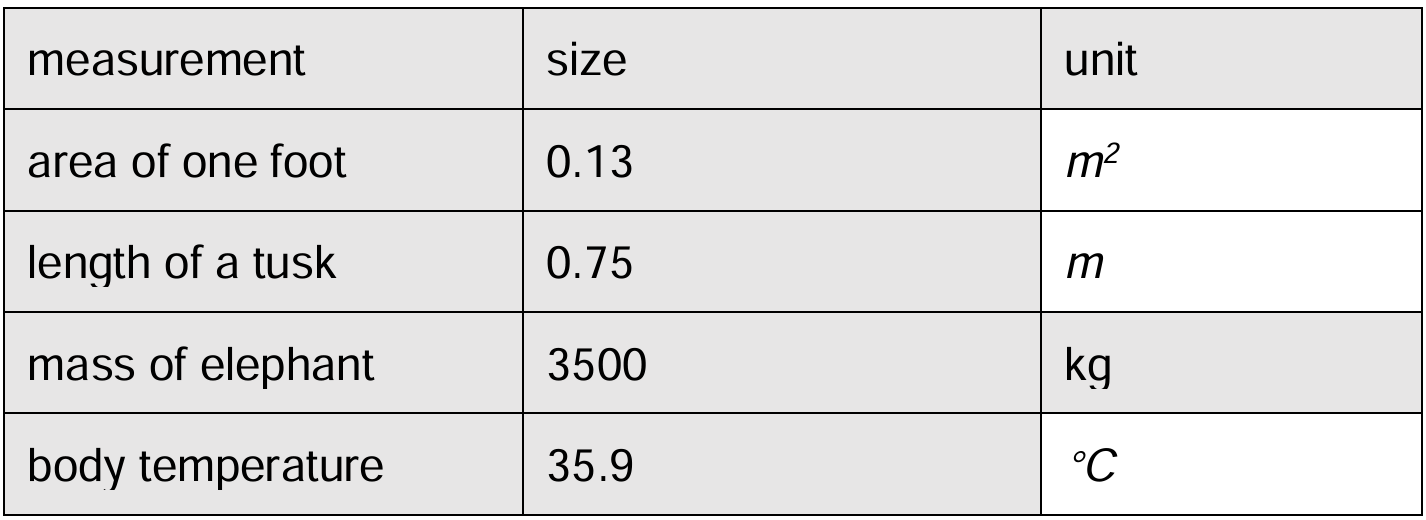
(c) Area of one foot — m²; length of a tusk — m; body temperature — °C

Area is measured in square metres (m²), so the unit for area of one foot is m².
Length is measured in metres (m), so the tusk length uses m.
Temperature is measured in degrees Celsius (°C).
Question
(a) A train travels between two stations X and Y.
Fig. 6.1 shows a speed–time graph for the journey.
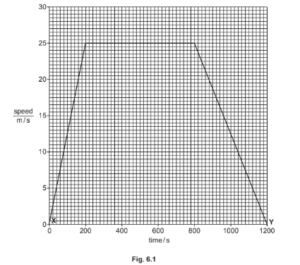
(i) State the time taken for the journey from station X to station Y.
time = ………………………………………………. s
(ii) On Fig. 6.1, mark with the letter C a point on the graph when the train is travelling at a constant speed.
(iii) Calculate the distance travelled by the train between station X and station Y.
distance = ………………………………………………m
(b) Fig. 6.2 shows some railway track.
Railway track is made of lengths of steel rails with small gaps between them.
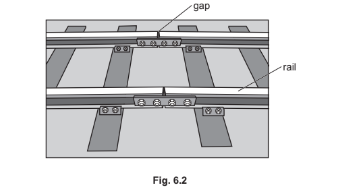
(i) Explain why leaving gaps in the rails avoids damage to the track in hot weather.
………………………………………………………………………………………………………………………….
………………………………………………………………………………………………………………………….
(ii) A length of steel rail has a weight of 10270N.
The density of steel is 7870kg/m$^{3}$.
Calculate the volume of steel used to make the steel rail.
The gravitational force g on unit mass is 10N/kg.
volume = ……………………………………………. m$^{3}$
▶️Answer/Explanation
Ans : 6(a)(i) 1200 (s) ;
6(a)(ii) anywhere between 200 s and 800 s ;
6(a)(iii) idea of area under graph ;
25× 200× 0.5 + 25× 600 + 25× 400× 0.5 or 2500 + 15 000 + 5000 ;
= 22 500 (m) ;
6(b)(i) gap allows track to expand / stops rail buckling when track expands ;
6(b)(ii) mass of rail = 1027 kg ;
volume = mass/density (in any form) or 1027 / 7870 ;
= 0.13 (m$^{3}$) ;
