
CIE iGCSE Co-Ordinated Science P1.1 Physical quantities and measurement techniques Exam Style Questions Paper 4
Question
Most-appropriate topic codes (Cambridge IGCSE Co-ordinated Sciences 0654):
• Topic P1.1 — Physical quantities and measurement techniques (Part (a)(i))
• Topic P1.2 — Motion (Parts (a)(ii) & (b))
• Topic P1.3 — Mass and weight (Part (c)(i))
• Topic P1.6.2 — Work / Kinetic energy (Part (c)(ii))
▶️ Answer/Explanation
(a)(i) Vector quantities: gravitational field strength, weight.
Vector quantities have both magnitude and direction. Gravitational field strength and weight are vectors; energy, temperature, and time are scalars (magnitude only).
(a)(ii) Velocity is speed in a given direction.
Velocity is a vector quantity that describes the rate of change of displacement (distance travelled per unit time in a specific direction).
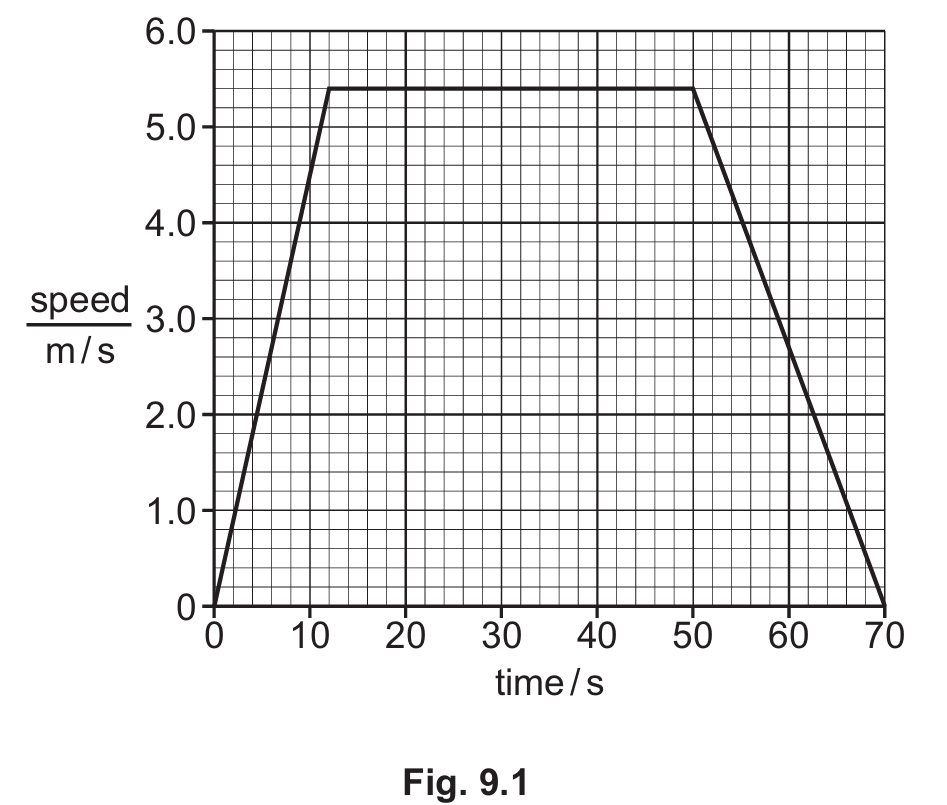
(b) Acceleration = 0.45 m/s².
Acceleration is the gradient of a speed-time graph. During the first 12 seconds, the speed increases from 0 to 5.4 m/s.
\(a = \frac{\Delta v}{\Delta t} = \frac{5.4 – 0}{12 – 0} = \frac{5.4}{12} = 0.45\text{ m/s}^2\)
(c)(i) Ratio = 3.6 (or –3.6).
\(\text{ratio} = \frac{35}{9.8} = 3.57 \approx 3.6\)
(The negative sign indicates deceleration/opposite direction.)
(c)(ii) Mass = 1200 kg.
\(E_k = \frac{1}{2}mv^2\)
\(470000 = \frac{1}{2} \times m \times 28^2\)
\(470000 = \frac{1}{2} \times m \times 784\)
\(470000 = 392m\)
\(m = \frac{470000}{392} = 1198.98 \approx 1200\text{ kg}\)
Question
Most-appropriate topic codes (Cambridge IGCSE Co-ordinated Sciences 0654):
• Topic P1.1 — Physical quantities and measurement techniques (Part a)
• Topic P1.2 — Motion (Parts b(i) & b(ii))
• Topic P1.6.1 — Energy (Parts c(i) & c(ii))
▶️ Answer/Explanation
(a) Vector quantities:
Acceleration and weight are vector quantities because they have both magnitude and direction. Speed, temperature, and time are scalar quantities as they only have magnitude.
(b)(i) Motion between t = 250 s and t = 375 s:
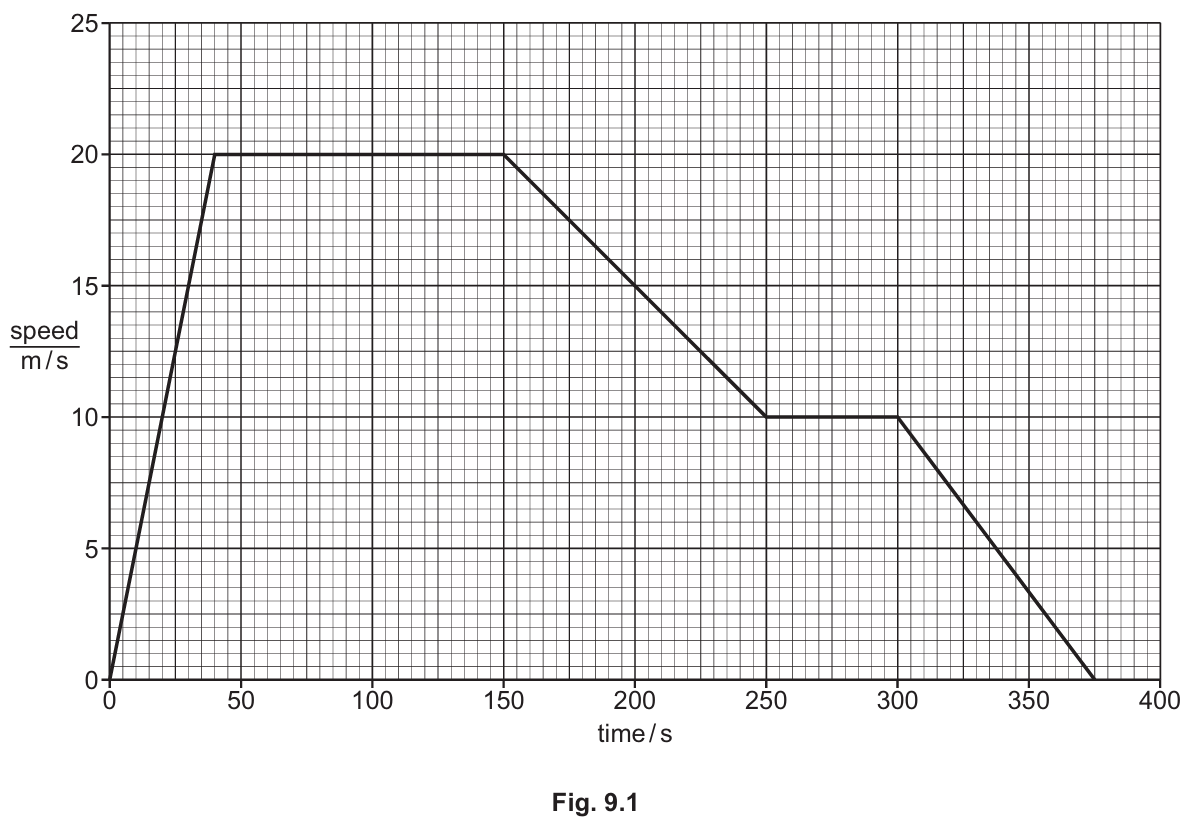
From 250 s to 300 s, the car travels at a constant speed of 20 m/s. From 300 s to 375 s, the car decelerates (speed decreases from 20 m/s to 0 m/s) at a constant rate.
(b)(ii) Acceleration in the first 40 s:
From the graph, at t = 0 s, speed = 0 m/s. At t = 40 s, speed = 20 m/s.
Using \(a = \frac{\Delta v}{\Delta t}\):
\(a = \frac{20 – 0}{40 – 0} = \frac{20}{40} = 0.50 \, \text{m/s}^2\)
Unit: m/s² (or m s⁻²)
(c)(i) Complete the sentence:
The amount of energy in the chemical energy store decreases and the amount of energy in the kinetic energy store increases.
When the car accelerates, the engine burns fuel, releasing chemical energy. This energy is transferred to the kinetic energy store of the car, increasing its speed.
(c)(ii) Energy stores when travelling at constant speed:
The two energy stores are the chemical energy store and the thermal energy store of the surroundings.
• The amount of energy in the chemical energy store decreases as fuel is continuously burned to maintain motion.
• The amount of energy in the thermal energy store of the surroundings increases because energy is dissipated as heat due to friction (air resistance and rolling resistance).