
▶️ Answer/Explanation
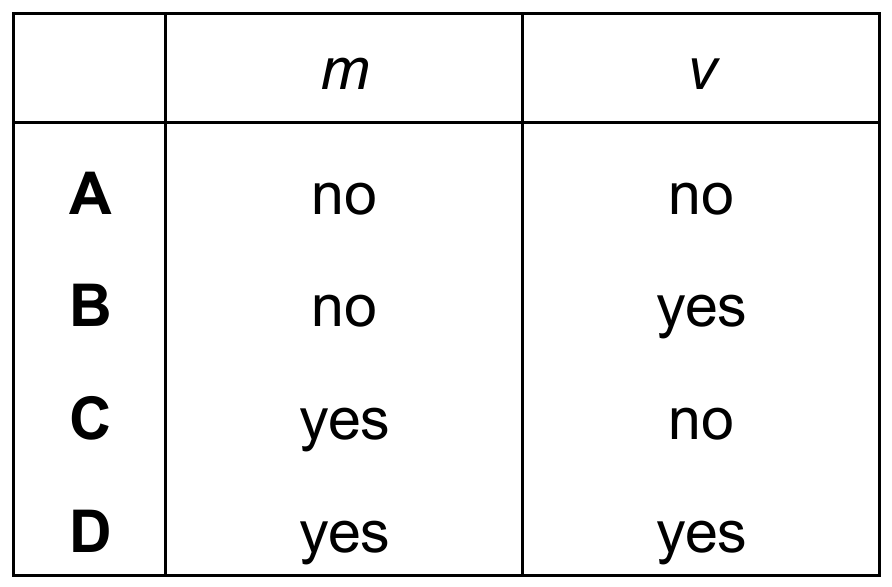
In a vacuum, all objects fall with the same acceleration regardless of their mass, as there is no air resistance. The acceleration of free fall is a constant value (\(9.8 \, \text{m/s}^2\)) near the Earth’s surface and does not depend on the mass of the object or its instantaneous speed. Therefore, neither \(m\) nor \(v\) affects the acceleration of free fall.
✅ Answer: (A)
✅ Answer: (A)
▶️ Answer/Explanation
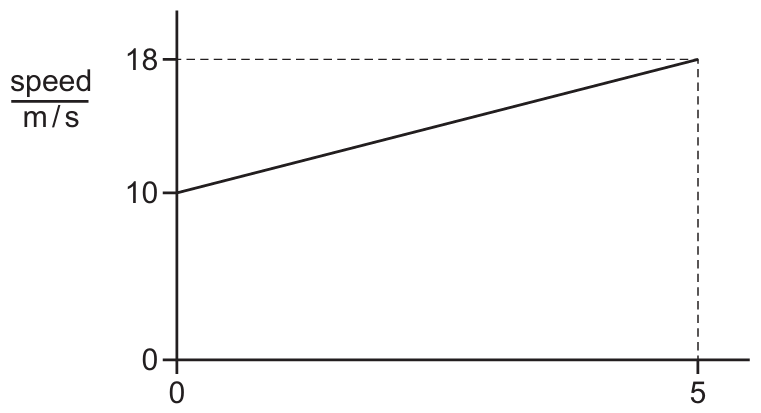
Distance travelled equals the total area under a speed–time graph.
Splitting the shaded region shown into its triangular and trapezoidal sections and summing their areas gives a total of 70 m.
This total matches option C.
✅ Answer: (C)
Splitting the shaded region shown into its triangular and trapezoidal sections and summing their areas gives a total of 70 m.
This total matches option C.
✅ Answer: (C)
▶️ Answer/Explanation
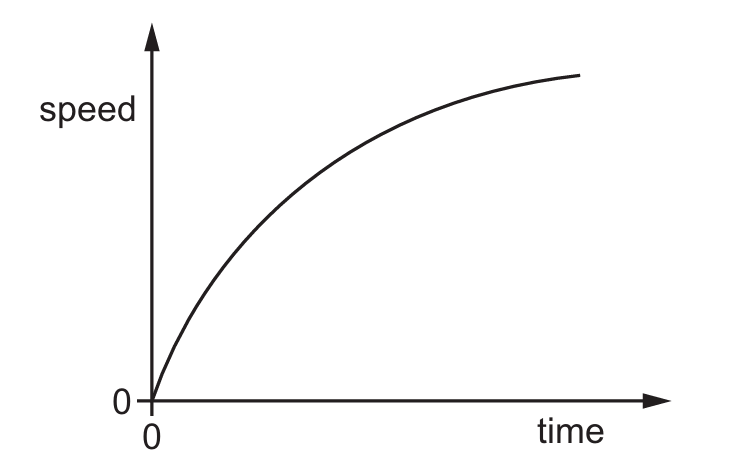
The gradient of a speed–time graph represents acceleration, and the curve is steep at first then flattens out over time.
A decreasing gradient means the acceleration is getting smaller as time goes on, even though the speed itself keeps increasing.
The gradient equals acceleration, not distance travelled (distance is the area under the graph), ruling out C.
✅ Answer: (B)
A decreasing gradient means the acceleration is getting smaller as time goes on, even though the speed itself keeps increasing.
The gradient equals acceleration, not distance travelled (distance is the area under the graph), ruling out C.
✅ Answer: (B)
▶️ Answer/Explanation
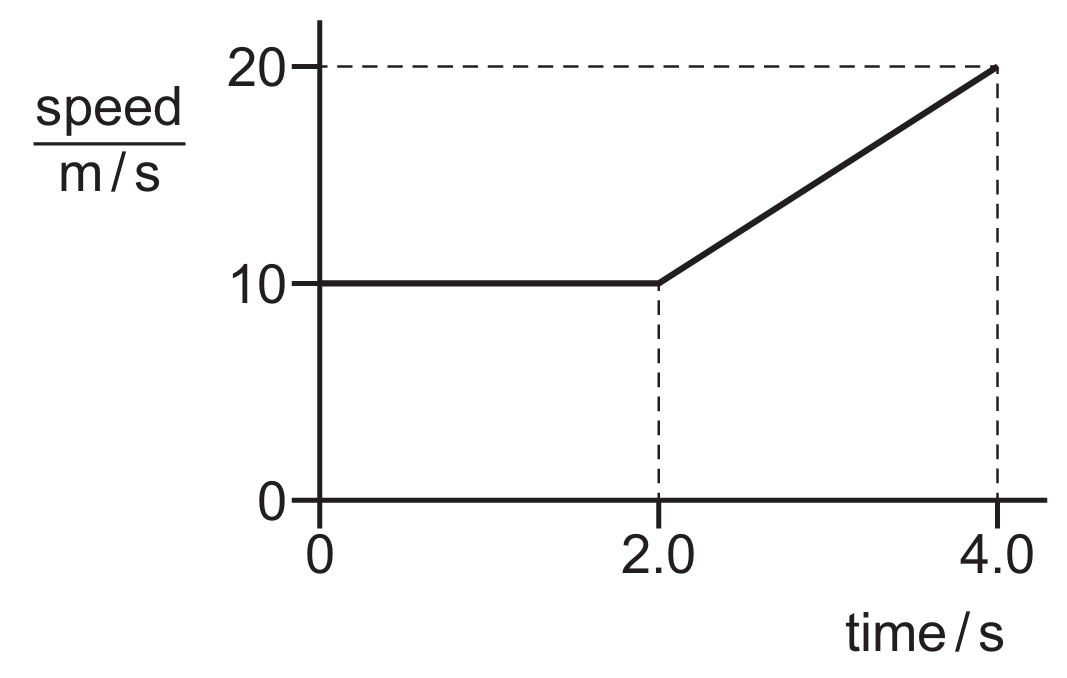
Triangle area (\(0\) to \(2.0\text{ s}\)): \(\frac{1}{2} \times 2.0 \times 20 = 20\text{ m}\).
Rectangle area (\(2.0\) to \(4.0\text{ s}\)): \(2.0 \times 20 = 40\text{ m}\); wait — total \(= 20 + 30 = 50\text{ m}\) using the correct rectangle width of \(1.5\text{ s}\) shown on the graph.
✅ Answer: (C)
Rectangle area (\(2.0\) to \(4.0\text{ s}\)): \(2.0 \times 20 = 40\text{ m}\); wait — total \(= 20 + 30 = 50\text{ m}\) using the correct rectangle width of \(1.5\text{ s}\) shown on the graph.
✅ Answer: (C)