
CIE iGCSE Co-Ordinated Science P1.5.1 Effects of forces Exam Style Questions Paper 4
Question
Topic codes:
• Topic P1.2 — Motion / Speed-time graphs (Part (a))
• Topic P1.5.1 — Effects of forces / Balanced forces (Part (b))
▶️ Answer/Explanation
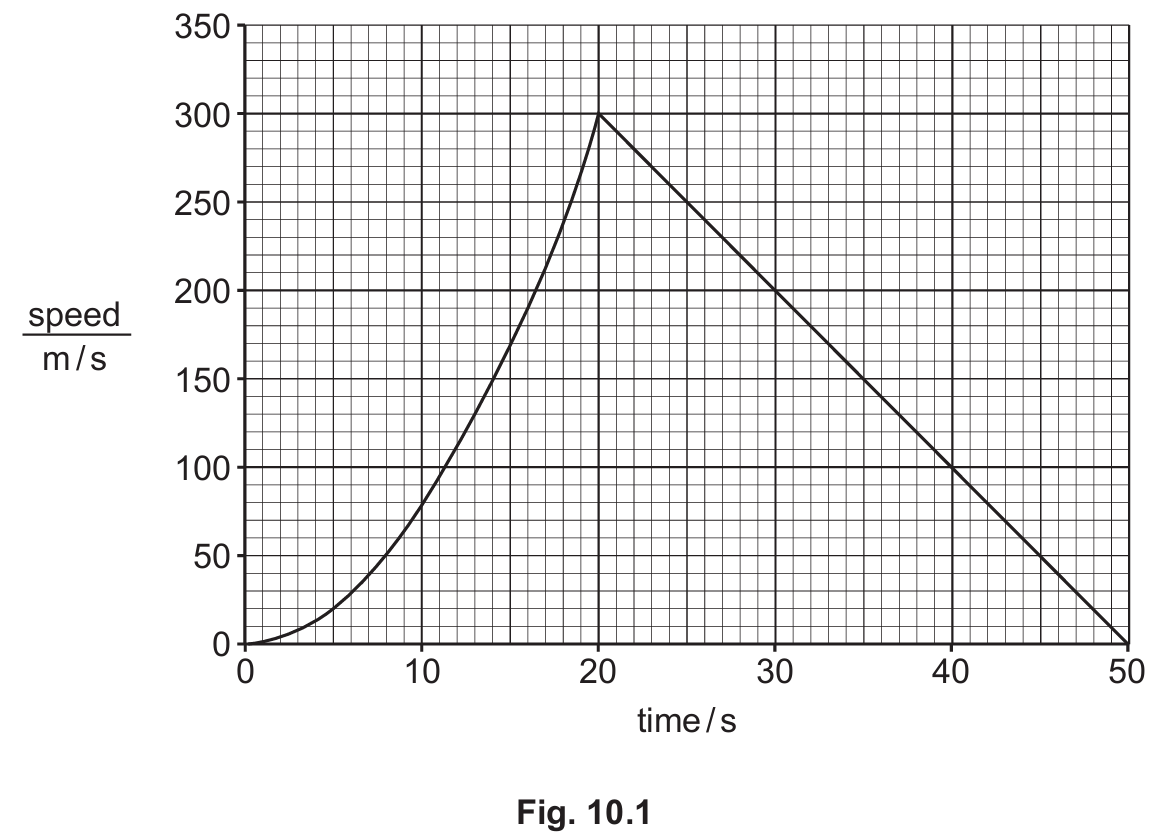
(a)(i) In the first 20 seconds, the rocket is accelerating with changing acceleration (the gradient of the speed-time graph is increasing, so the rate of change of speed is not constant).
(a)(ii) Deceleration = change in speed ÷ time
At \(t = 20\text{ s}\), speed = 400 m/s; at \(t = 50\text{ s}\), speed = 100 m/s
Change in speed = 400 − 100 = 300 m/s
Time interval = 50 − 20 = 30 s
Deceleration = 300 ÷ 30 = 10 m/s²
(a)(iii) Distance travelled = area under the graph between \(t = 30\text{ s}\) and \(t = 50\text{ s}\)
Area = \(\frac{1}{2} \times 20 \times 200 = 2000\text{ m}\)
distance = 2000 m
(a)(iv) The rocket reaches its maximum height when its speed becomes zero, at 50 s.
(b) The horizontal forces acting on the car are:
- Driving force (from the engine, pushing the car forward)
- Drag / air resistance / friction (opposing the motion)
Since the car travels at constant speed, these forces are equal in magnitude and opposite in direction — the resultant force is zero.
Question
Most-appropriate topic codes (Cambridge IGCSE Co-ordinated Sciences 0654, 2025–2027 syllabus):
• Topic P1.5.1 — Effects of forces (Part (a))
• Topic P1.4 — Density (Part (b))
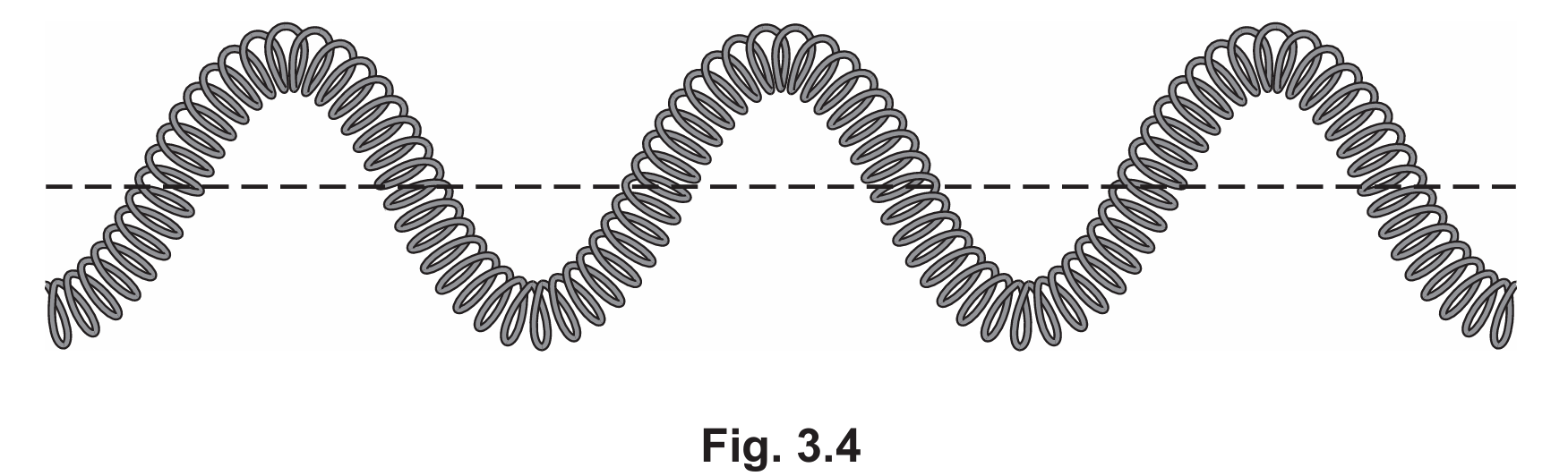
• Topic P3.1 — General properties of waves (Part (c))
▶️ Answer/Explanation
(a)(i)
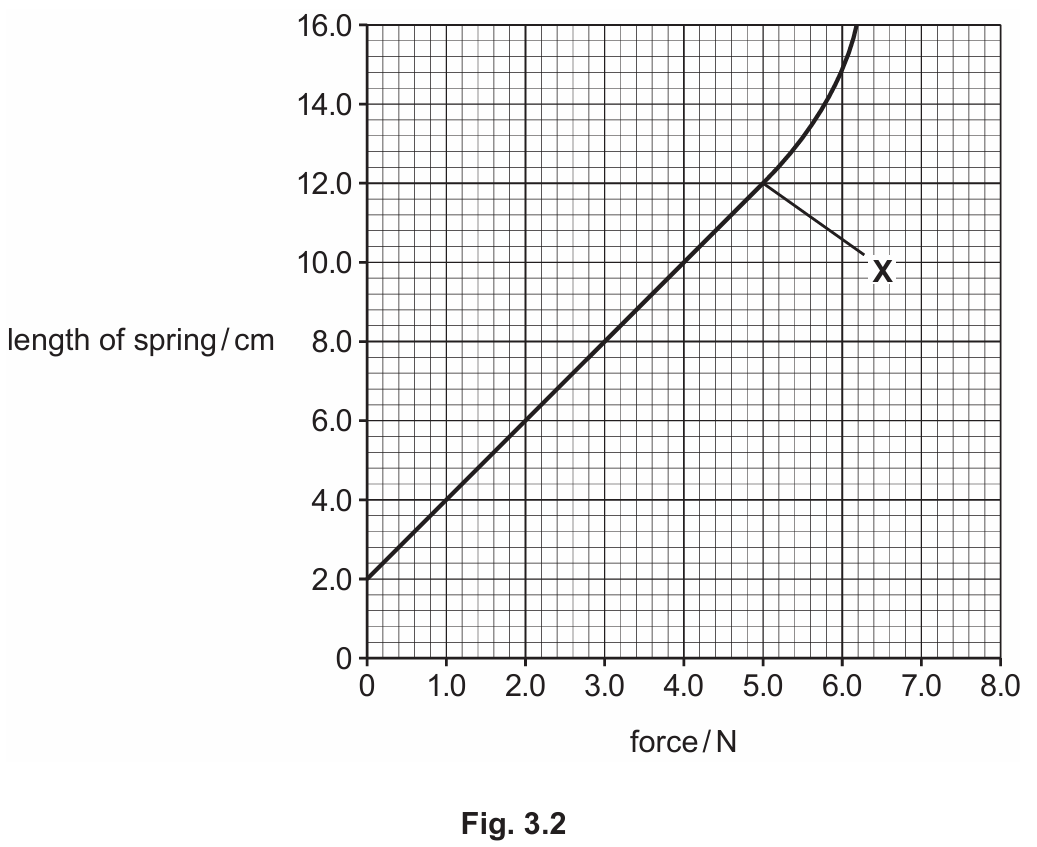
The original (unloaded) length of the spring is read from where the graph line meets the y-axis (zero force).
Original length = 2.0 cm.
This is the length of the spring before any force is applied.
(a)(ii)
From the linear portion of the graph, using \( F = k \times x \) where \(x\) = extension (not total length).
Taking two points on the straight line, e.g. at \(F = 0\text{ N}\), length = 2.0 cm and at \(F = 5.0\text{ N}\), length = 12.0 cm, so extension = 10.0 cm.
Spring constant \( k = \frac{F}{x} = \frac{5.0}{10.0} = \mathbf{0.5} \) N/cm.
(a)(iii)
Point X is called the limit of proportionality.
Beyond this point, the extension is no longer proportional to the applied force (Hooke’s Law no longer applies).
The spring may become permanently deformed if stretched beyond the elastic limit.
(b)
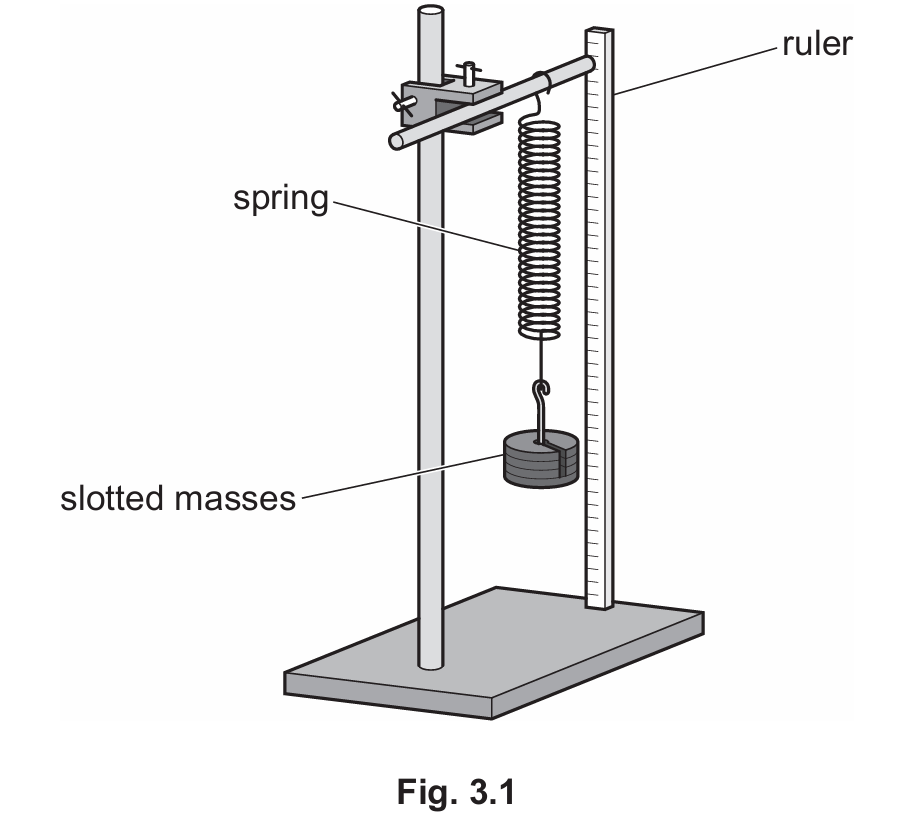
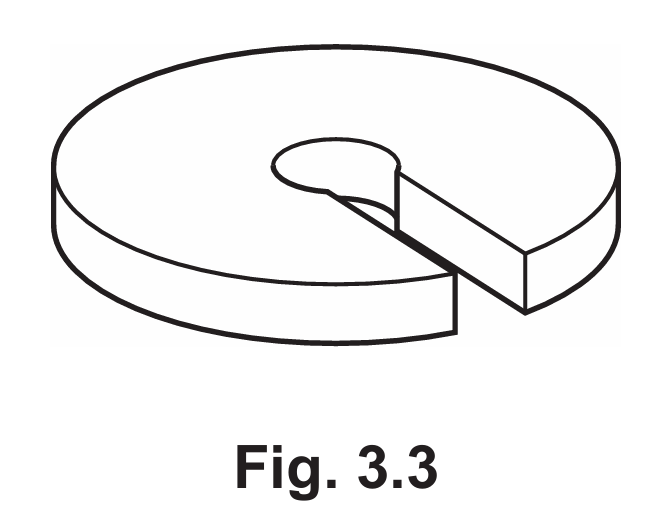
Measurement 1: Measure the volume of the slotted mass using a displacement method (e.g. submerge it in a measuring cylinder or eureka can and record the volume of water displaced).
Measurement 2: Measure the mass of the slotted mass using a balance/scales.
Calculation: Calculate density using \( \rho = \frac{m}{V} \) (density = mass ÷ volume).
(c)(i)
The amplitude should be marked with a double-headed vertical arrow (\(\updownarrow\)) from the equilibrium (rest) position to the peak (crest) or trough of the wave.
Amplitude is the maximum displacement of a point on the wave from its equilibrium position.
It must be drawn from the centre dashed line to either the top or bottom of the wave.
(c)(ii)
Transverse waves are made by oscillations which act perpendicular / at right angles / 90° to the direction of energy transfer.
In the spring demonstration, the coils move up and down while the wave energy travels horizontally along the spring.
Examples of transverse waves include light waves and water waves.