
CIE iGCSE Co-Ordinated Science P1.5.2 Turning effect of forces Exam Style Questions Paper 4
Question
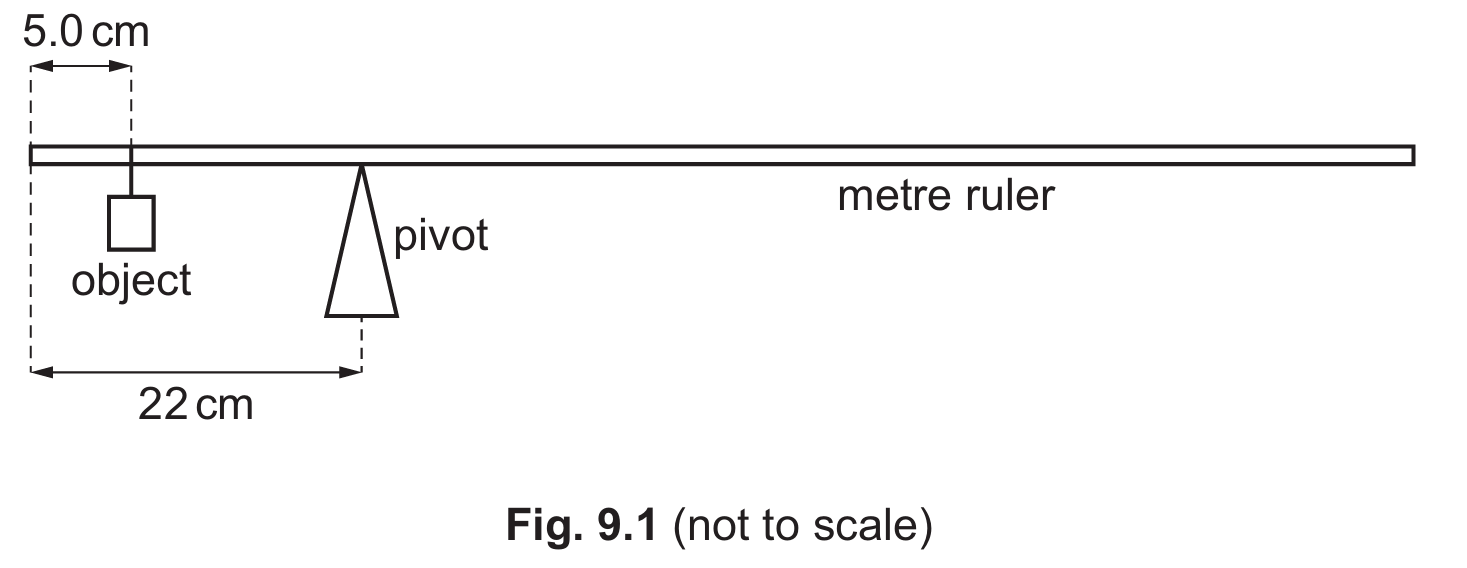
Most-appropriate topic codes (Cambridge IGCSE Co-ordinated Sciences 0654):
• Topic P1.5.2 — Turning effect of forces
• Topic P1.3 — Mass and weight
▶️ Answer/Explanation
(a)(i) force × perpendicular distance from pivot
The moment of a force is a measure of its turning effect about a pivot. It is calculated by multiplying the magnitude of the force by the perpendicular distance from the pivot to the line of action of the force.
(a)(ii) no resultant force ; no resultant moment
For an object to be in equilibrium, the net force acting on it must be zero and the net moment about any point must be zero. This means all forces and turning effects are balanced.
(b)(i) (W = mg) = 0.040 × 9.8 = 0.39 N
Weight is calculated by multiplying mass (in kg) by gravitational field strength. The mass of 40 g is converted to 0.040 kg.
(b)(ii) 0.24 N
Appreciation of weight acting from centre of ruler
0.39 × 17 = W × 28
W = 0.24 N
The weight of the ruler acts at its centre (50 cm from the end). Taking moments about the pivot: the 0.39 N weight at 17 cm from pivot balances the ruler’s weight at 28 cm from pivot.
Question
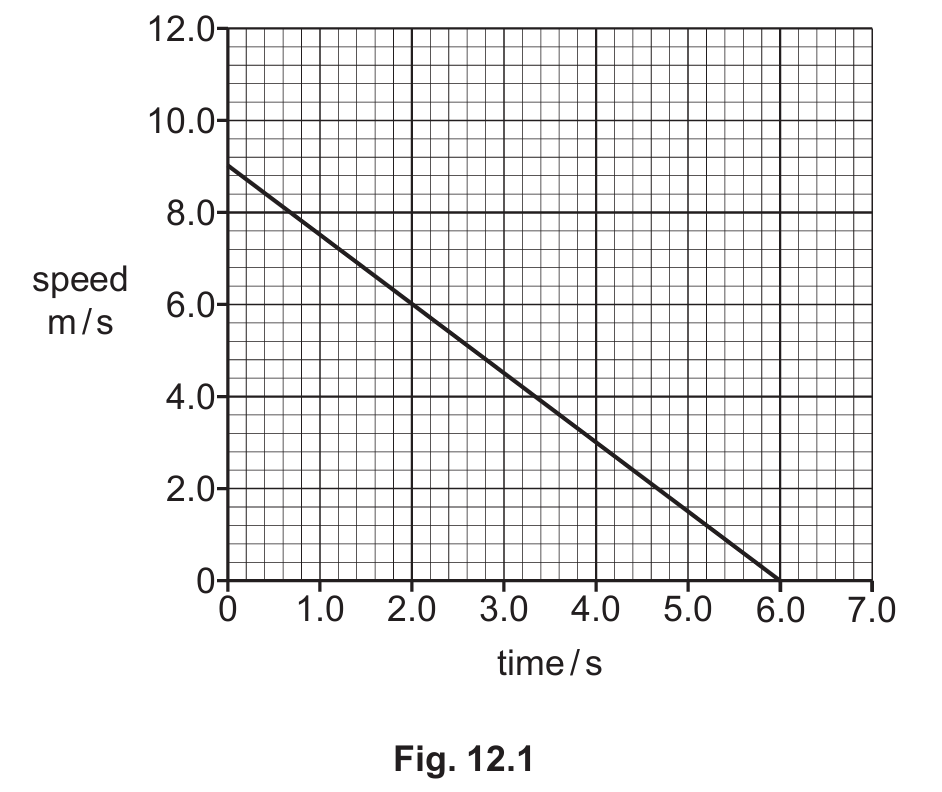
The kinetic energy of the car is transferred to ……………………… energy of the surroundings.
Calculate the work done by the braking force in stopping the car.
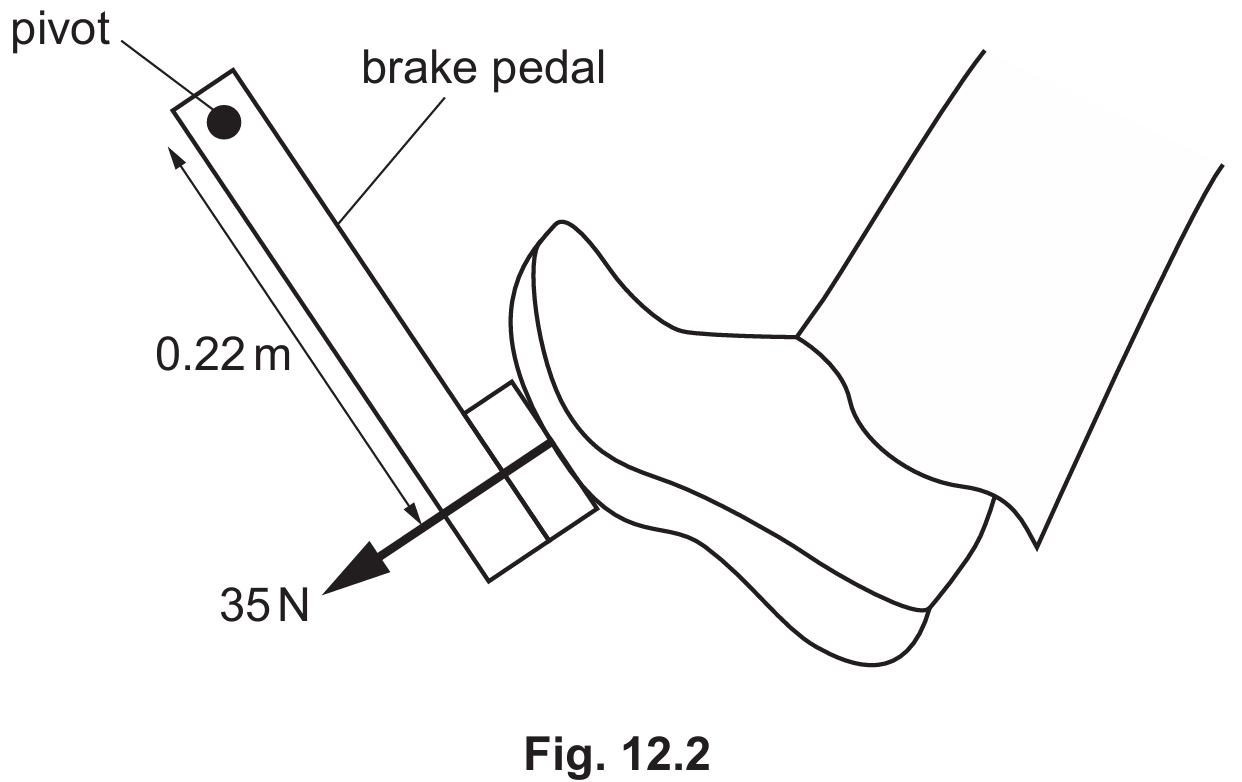
The force is applied 0.22m from the pivot.
Calculate the moment of the force about the pivot.
Calculate the potential difference across the lamp.
Calculate the frequency of the light emitted by the lamp.
State the unit for your answer.
Most-appropriate topic codes (Cambridge IGCSE Co-ordinated Sciences 0654):
• Topic P1.6.2 — Work (Part (a))
• Topic P1.5.2 — Turning effect of forces / moments (Part (b))
• Topic P4.2.5 — Electrical power (Part (c)(i))
• Topic P3.3 — Electromagnetic spectrum (wave speed equation) (Part (c)(ii))
▶️ Answer/Explanation
(a)(i) Thermal energy
Friction between the brakes and wheels converts the car’s kinetic energy into thermal (heat) energy released to the surroundings.
(a)(ii) 68 000 J
Distance travelled is the area under the speed–time graph: \(\tfrac{1}{2} \times 9.0 \times 6.0 = 27\) m.
Work done \(= F \times d = 2500 \times 27 = 68\,000\) J.
(b) 7.7 Nm
Moment \(= F \times d = 35 \times 0.22 = 7.7\) Nm.
(c)(i) 12 V
Power is related to potential difference and current by \(P = VI\), so \(V = \dfrac{P}{I}\).
\(V = \dfrac{36}{3.0} = 12\) V.
(c)(ii) \(4.0 \times 10^{14}\) Hz
Using \(v = f\lambda\) with the speed of light \(v = 3.0 \times 10^8\) m/s, \(f = \dfrac{v}{\lambda} = \dfrac{3.0 \times 10^8}{7.5 \times 10^{-7}}\).
\(f = 4.0 \times 10^{14}\) Hz (the unit for frequency is hertz, Hz).