
CIE iGCSE Co-Ordinated Science P1.6.1 Energy Exam Style Questions Paper 3
Question
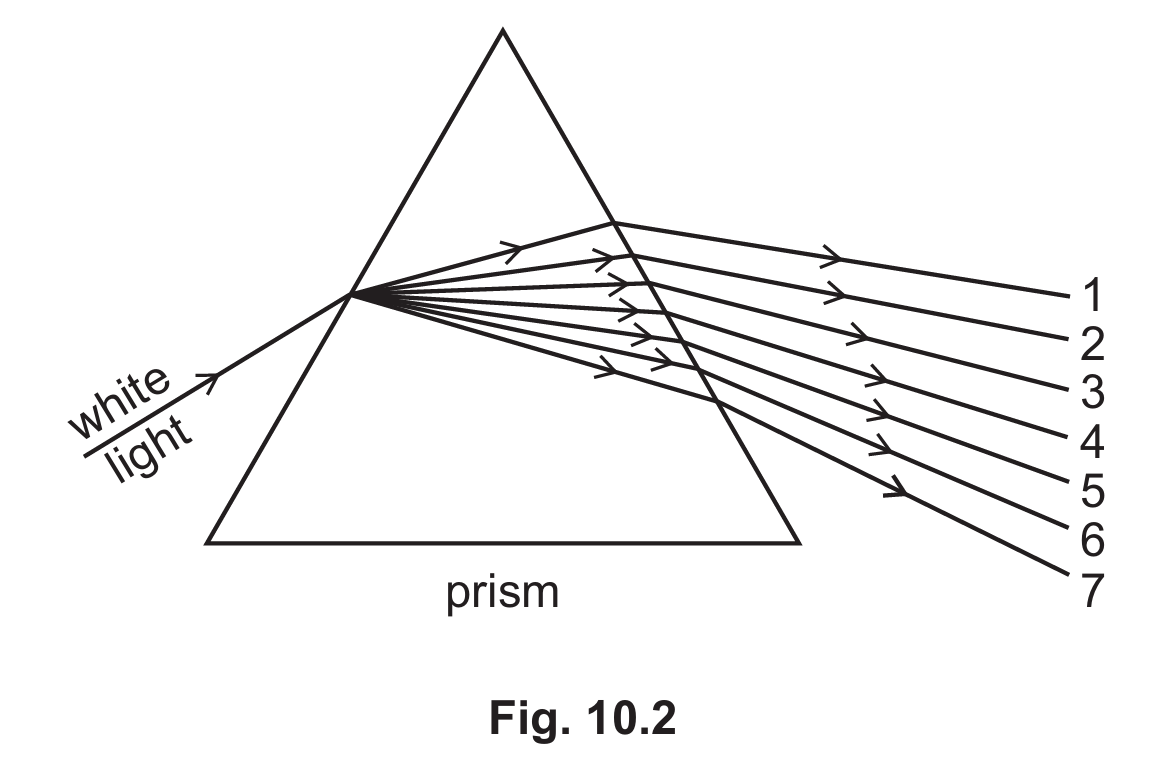
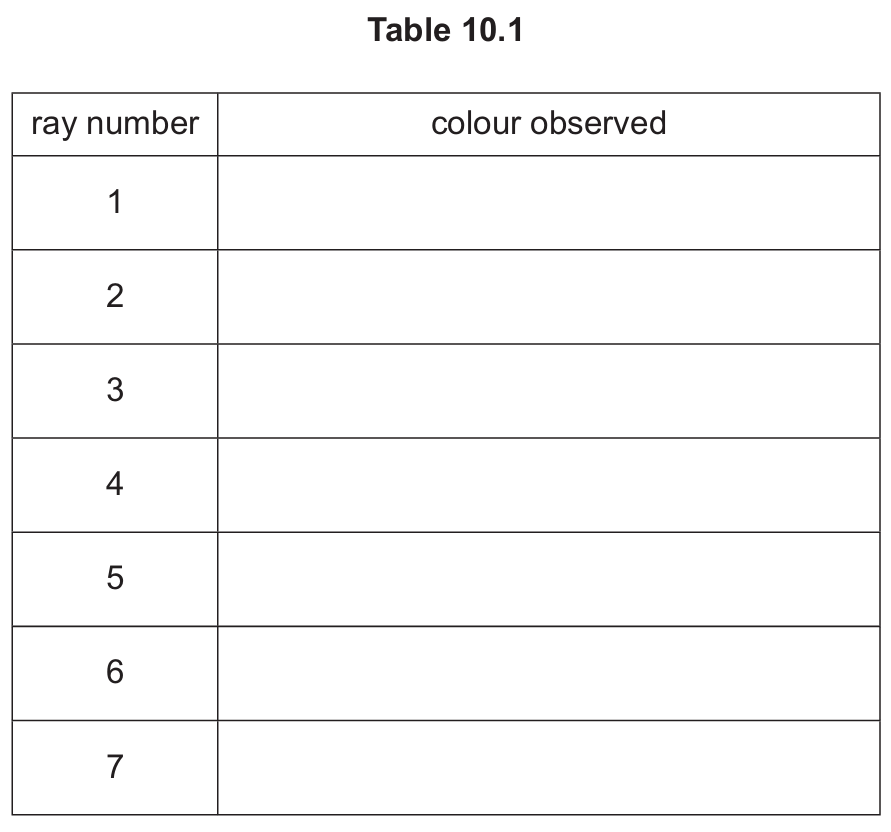
The seven colours are shown as the numbers 1 to 7.
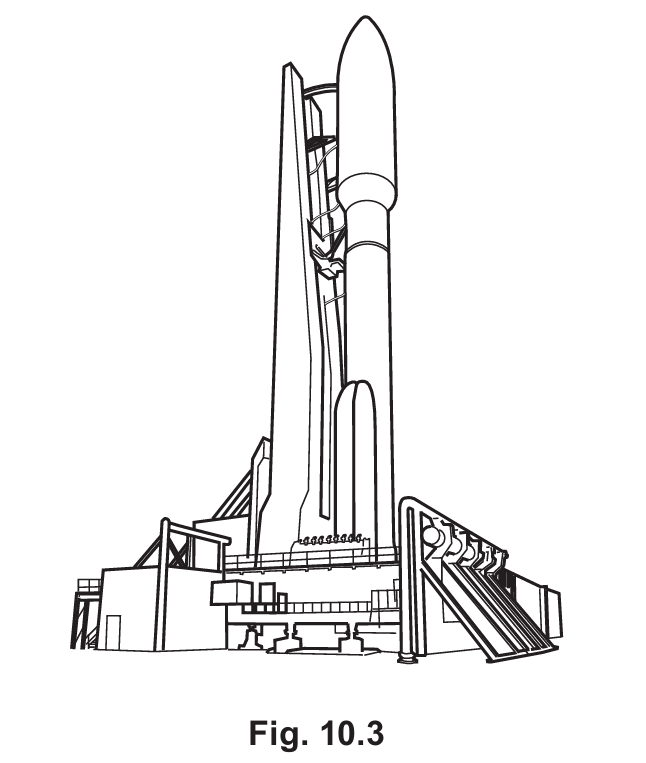
When the rocket engines start to operate, the upward force exerted by the rocket engines is 9,000,000 N.
Calculate the resultant upward force on the spacecraft and the rocket.
Most-appropriate topic codes (Cambridge IGCSE Co-ordinated Sciences 0654):
• Topic P6.2.1 — The Sun as a star (Parts (a)(i), (a)(ii), (a)(iii))
• Topic P3.3 — Electromagnetic spectrum (Parts (a)(iv), (b)(i), (b)(ii))
• Topic P3.2.4 — Dispersion of light (Part (c))
• Topic P1.5.1 — Effects of forces (Part (d)(i))
• Topic P1.2 — Motion (Part (d)(ii))
• Topic P1.6.1 — Energy (Part (d)(iii))
▶️ Answer/Explanation
(a)(i) hydrogen and helium
The Sun is composed primarily of hydrogen (about 73%) and helium (about 25%). Nuclear fusion reactions in the Sun’s core convert hydrogen into helium, releasing vast amounts of energy.
(a)(ii) 100,000 light-years
The Milky Way galaxy has an approximate diameter of 100,000 light-years. It contains billions of stars, including our Sun.
(a)(iii) Conduction and convection require a medium (matter) to transfer energy, but space is a vacuum.
Conduction requires particles to collide and transfer energy, while convection requires a fluid (liquid or gas) to circulate. Since space is mostly empty (a vacuum), neither conduction nor convection can occur. Radiation, however, does not require a medium and can travel through empty space.
(a)(iv) refraction
When light from a distant star enters the Earth’s atmosphere, it changes speed and direction due to the different densities of air layers. This bending of light is called refraction.
(b)(i) \(1.2 \times 10^{-6} \, \text{m}\)
Using the wave equation: \(\text{speed} = \text{frequency} \times \text{wavelength}\)
Wavelength \(= \frac{\text{speed}}{\text{frequency}} = \frac{3.0 \times 10^8}{2.5 \times 10^{14}} = 1.2 \times 10^{-6} \, \text{m}\).
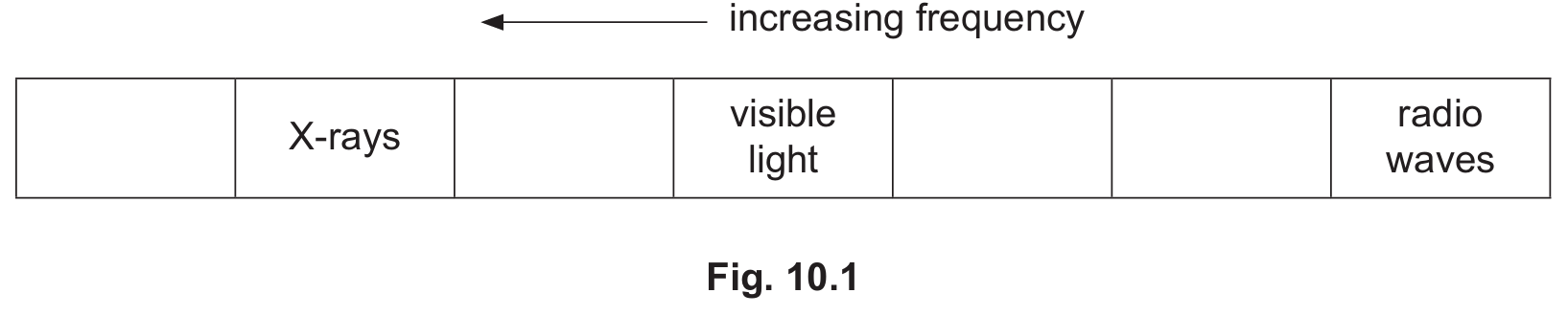
(b)(ii) Infrared radiation in the box to the right of ‘visible light’
In the electromagnetic spectrum, the order from low frequency to high frequency is: radio waves, microwaves, infrared, visible light, ultraviolet, X-rays, gamma rays. Therefore, infrared should be placed between radio waves and visible light.
(c) The seven colours in order from least refracted to most refracted:
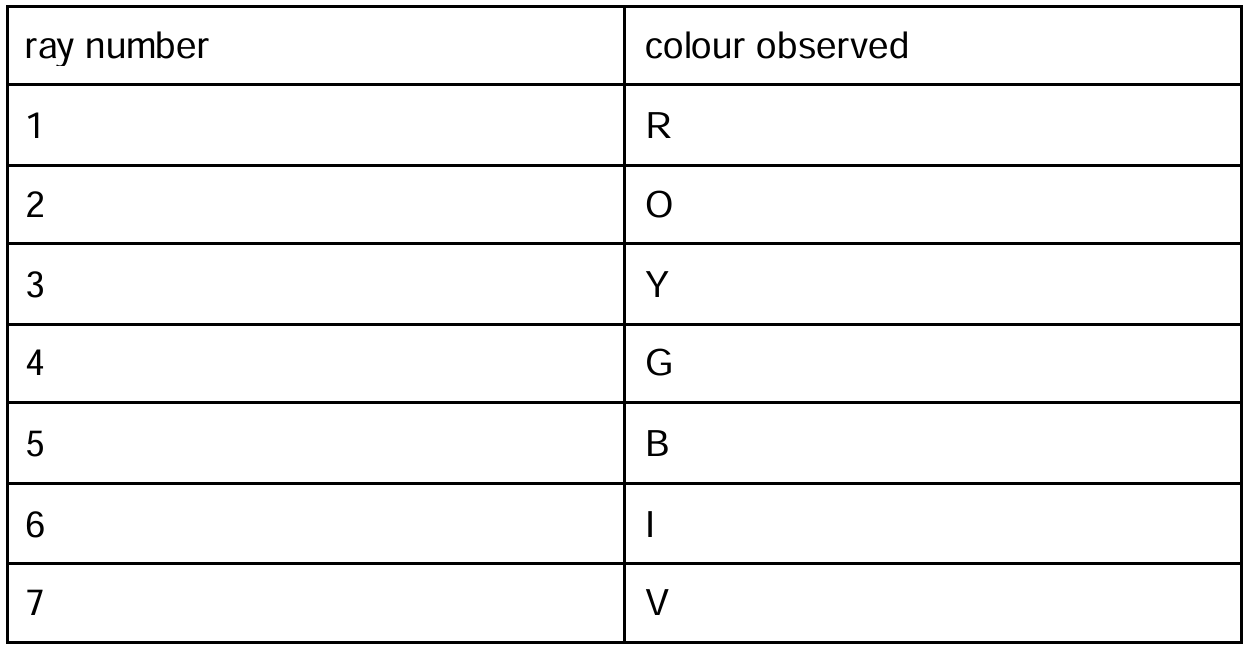
Red light has the longest wavelength and is refracted the least, so it appears at the top of the spectrum (ray 1). Violet light has the shortest wavelength and is refracted the most, appearing at the bottom (ray 7). The mnemonic “ROYGBIV” helps remember the order.
(d)(i) 3,000,000 N
Resultant force = upward force − weight = 9,000,000 − 6,000,000 = 3,000,000 N upwards.
(d)(ii) Acceleration means an increase in speed or velocity.
Specifically, acceleration is the rate of change of velocity. In this context, the rocket’s speed is increasing as it leaves the ground.
(d)(iii) gravitational potential (GPE) and kinetic energy
As the rocket accelerates upwards, it gains height (increasing gravitational potential energy) and increases its speed (increasing kinetic energy). Thermal energy may also increase due to friction with the atmosphere, but GPE and kinetic are the two main stores that increase.
Question

greatest penetration ………………………………
least penetration ………………………………
Calculate the mass of plutonium-239 remaining after 96 000 years.
plutonium-239 → …………………………… + ……………………………
Most-appropriate topic codes (Cambridge IGCSE Co-ordinated Sciences 0654):
• Topic P1.6.3 — Energy resources (Parts (a)(i), (ii), (iv))
• Topic P1.6.1 — Energy (Part (a)(iii) — chemical energy store)
• Topic P3.3 — Electromagnetic spectrum (Part (b)(i)–(ii))
• Topic P5.2.2 — The three types of nuclear emission (Part (b)(iii)–(iv))
• Topic P5.2.4 — Half-life (Part (c)(i))
• Topic P5.2.3 — Radioactive decay (Part (c)(ii))
▶️ Answer/Explanation
(a)(i) Coal
Coal is a fossil fuel, so burning it to generate electricity releases carbon dioxide.
Geothermal, hydroelectric, nuclear and solar do not involve combustion, so they do not directly produce carbon dioxide.
(a)(ii) Tides / wind / waves
Tidal, wind and wave power are all renewable energy resources not included in the original list.
These resources do not run out and have a much lower environmental impact than fossil fuels.
(a)(iii) Chemical (potential) energy
Coal is a fuel, and fuels store energy in their chemical bonds.
This chemical energy is released as thermal energy when the coal is burned.
(a)(iv) Advantage: no nuclear waste / no risk of nuclear accidents; Disadvantage: only available during the day (depends on sunlight)
Solar power does not produce hazardous radioactive waste, unlike nuclear power.
However, solar power can only generate electricity when there is sufficient sunlight, so it is unreliable at night or in poor weather, whereas nuclear power can generate continuously.
(b)(i) γ-rays
Alpha and beta emissions are streams of particles, not waves.
Gamma rays are electromagnetic waves, so they form part of the electromagnetic spectrum.
(b)(ii) Left-hand box (immediately to the left of X-rays)
The spectrum in Fig. 6.1 is arranged in order of increasing frequency from right to left.
Gamma rays have a higher frequency than X-rays, so they belong in the box to the left of X-rays.
(b)(iii) Greatest penetration: γ-rays; then β-particles; least penetration: α-particles
Gamma rays are the most penetrating because they are uncharged electromagnetic waves that interact weakly with matter.
Alpha particles are large and heavily charged, so they are stopped easily and are the least penetrating; beta particles lie in between.
(b)(iv) A helium nucleus (2 protons and 2 neutrons)
An α-particle consists of 2 protons and 2 neutrons bound together.
This is identical in composition to the nucleus of a helium atom, so it carries a charge of +2.
(c)(i) 6.25 g
Number of half-lives elapsed: \( \dfrac{96000}{24000} = 4 \) half-lives.
Remaining mass: \( 100 \times \left(\dfrac{1}{2}\right)^4 = 100 \times \dfrac{1}{16} = 6.25 \, \text{g} \).
(c)(ii) Plutonium-239 → uranium-235 + α (particle)
In α-decay, the unstable plutonium-239 nucleus emits an alpha particle.
This reduces the proton number by 2 and the nucleon number by 4, forming a uranium-235 nucleus.