Home / iGCSE / Coordinated Sciences / P1.6.1 Energy Paper 4

CIE iGCSE Co-Ordinated Science P1.6.1 Energy Exam Style Questions Paper 4

Question

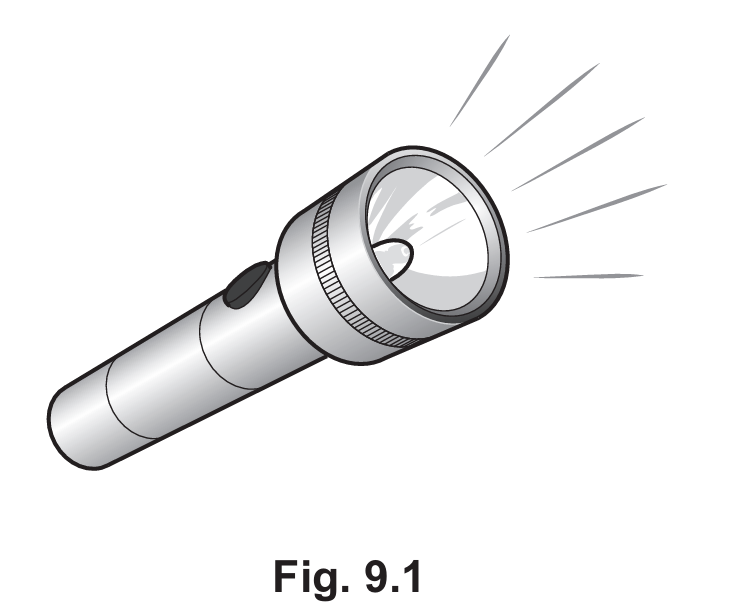
(a) A simple torch (flashlight) is made from a battery connected to a lamp.
(i) State the name of the energy store in the battery.
(ii) Describe how energy is transferred from this store to the lamp when the lamp is lit.
(b) A ball of mass 0.56 kg is dropped from a height of 9.4 m above the ground.
(i) Calculate the gravitational potential energy transferred by the ball.
(ii) Calculate the speed at which the ball hits the ground.
Air resistance is negligible.
(c) (i) The ball rebounds to a height of 8.2 m.
Air resistance is negligible.
Suggest why the ball does not reach a height of 9.4 m after it bounces.
(ii) Calculate the percentage efficiency of the energy transfer in the bounce.

Most-appropriate topic codes (Cambridge IGCSE Co-ordinated Sciences 0654):

• Topic P1.6.1 — Energy / Energy stores (Part (a)(i))
• Topic P1.6.2 — Work / Energy transfer (Part (a)(ii))
• Topic P1.6.1 — Gravitational potential energy (Part (b)(i))
• Topic P1.6.1 — Kinetic energy / Conservation of energy (Part (b)(ii))
• Topic P1.6.1 — Energy transfers / Energy losses (Part (c)(i))
• Topic P1.6.3 — Efficiency (Part (c)(ii))

▶️ Answer/Explanation

(a)(i) Chemical energy

The battery stores energy in the form of chemical potential energy, which is released during the electrochemical reaction inside the battery.

(a)(ii) Energy is transferred as an electrical current / by electrical work done from the battery to the lamp.

The chemical energy in the battery is converted to electrical energy, which flows through the circuit and is transferred to the lamp, where it becomes light and heat energy.

(b)(i) \( \Delta E_p = mg\Delta h = 0.56 \times 9.8 \times 9.4 = 52 \text{ J} \)

Gravitational potential energy is calculated using mass × gravitational field strength × change in height. The ball loses this energy as it falls to the ground.

(b)(ii) \( E_k = \frac{1}{2}mv^2 \) and \( E_k = E_p = 52 \text{ J} \)

\( 52 = 0.5 \times 0.56 \times v^2 \)
\( v^2 = \frac{52}{0.28} = 185.7 \)
\( v = \sqrt{185.7} = 14 \text{ m/s} \)
Assuming no air resistance, all gravitational potential energy is converted to kinetic energy, allowing us to calculate the impact speed.

(c)(i) Work is done compressing / deforming the ball and by the ball on the ground during the bounce.

Some kinetic energy is transferred to the ground and used to deform the ball, so it is not all converted back to gravitational potential energy. This energy is dissipated as heat and sound.

(c)(ii) Efficiency = \( \frac{\text{useful energy output}}{\text{total energy input}} \times 100 = \frac{8.2}{9.4} \times 100 = 87\% \)

Efficiency is calculated by comparing the height reached after the bounce (useful energy output) to the original drop height (energy input). The ratio of heights gives the efficiency because both heights correspond to gravitational potential energy.

Question

(a) A torch (flashlight) consists of a battery, a switch and a lamp connected in series.
(i) State the energy store which decreases when the battery powers the lamp.
(ii) State the energy transfer from the battery to the lamp.
(iii) State the energy transfer from the lamp to the surroundings.
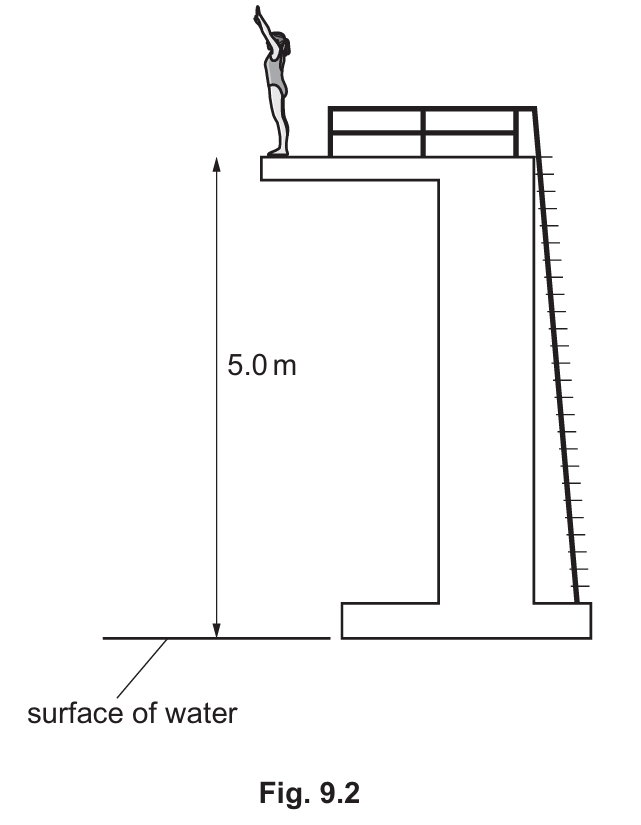
(b) A diver with mass 70 kg stands 5.0 m above a swimming pool as shown in Fig. 9.2.
(i) The diver falls 5.0 m. Calculate the change in gravitational potential energy of the diver.
(ii) As the diver falls toward the water, there are no frictional forces acting on the diver. State the kinetic energy of the diver just before entering the water.
(iii) Calculate the speed of the diver just before entering the water.

Most-appropriate topic codes (Cambridge IGCSE Co-ordinated Sciences 0654):

• Topic P1.6.1 — Energy (Part (a))
• Topic P1.6.2 — Work (Part (b)(i))
• Topic P1.2 — Motion (Part (b)(ii), (b)(iii))

▶️ Answer/Explanation

(a)(i) Chemical energy store
The battery stores chemical energy, which is converted to electrical energy when the circuit is complete.

(a)(ii) Chemical → Electrical
Energy is transferred from the battery to the lamp as electrical energy.

(a)(iii) Electrical → Light and Thermal
The lamp transfers electrical energy to the surroundings as light and thermal (heat) energy.

(b)(i) Change in gravitational potential energy:
ΔEₚ = mgΔh = 70 × 9.8 × 5.0 = 3430 J (≈ 3400 J)

(b)(ii) Kinetic energy just before entering the water = 3430 J
By conservation of energy, the gravitational potential energy lost is converted to kinetic energy (assuming no energy loss to friction).

(b)(iii) Speed:
Eₖ = ½mv²
3430 = 0.5 × 70 × v²
v² = 3430 ÷ 35 = 98
v = √98 = 9.9 m/s

Scroll to Top