Home / iGCSE / Coordinated Sciences / P1.6.2 Work Paper 2

CIE iGCSE Co-Ordinated Science P1.6.2 Work Exam Style Questions Paper 2

Question

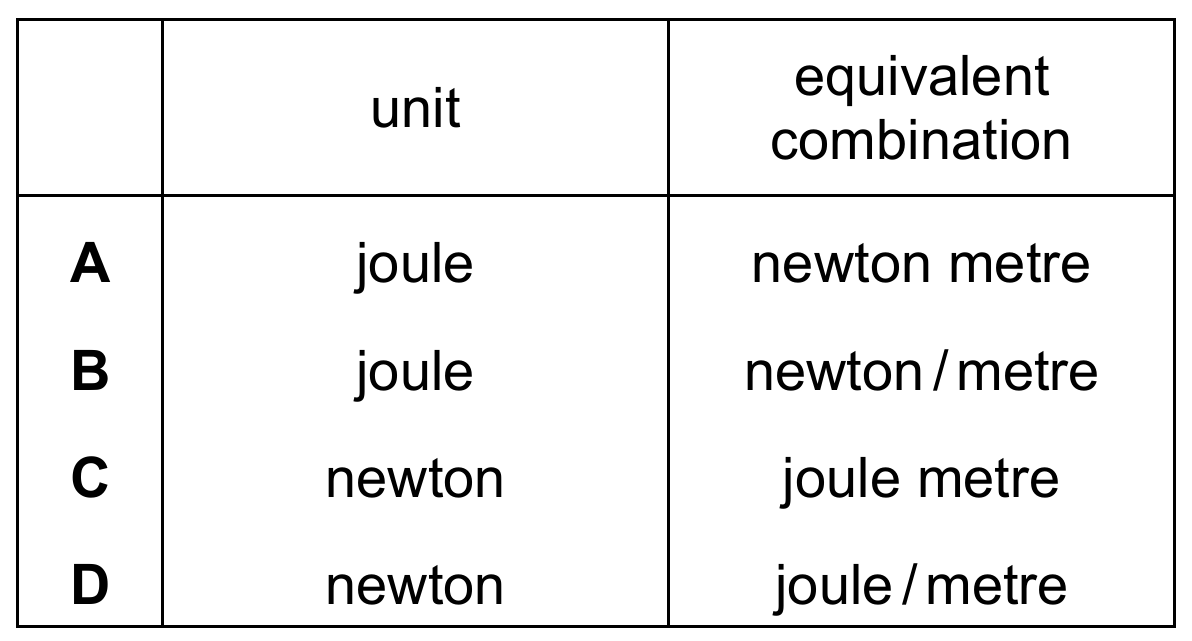
What is the unit of work and what is an equivalent combination of units?
▶️ Answer/Explanation
Work is measured in joules (J). One joule is the work done when a force of 1 newton moves an object 1 metre, so the equivalent combination is newton metre (N m). Option A is correct.
Answer: (A)

Question

A 60 W lamp is switched on and 30 J of energy is transferred by the lamp.

How long is the lamp switched on for?

A. 0.50 s
B. 2.0 s
C. 90 s
D. 1800 s

▶️ Answer/Explanation
Power is the rate of energy transfer, given by \(P = \frac{E}{t}\). Rearranging for time: \(t = \frac{E}{P}\). Substituting the values: \(t = \frac{30}{60} = 0.50 \, \text{s}\). The lamp is switched on for 0.50 seconds.
Answer: (A)

Question

A force of 4.0 N acts on an object for 4.0 s. The object moves a distance of 8.0 m in the direction of the force.

What is the work done by the force?

A. 1.0 J
B. 2.0 J
C. 16 J
D. 32 J

▶️ Answer/Explanation
Work done is calculated as \( W = F \times d \), using only the force and the distance moved in the direction of the force.
\( W = 4.0 \text{ N} \times 8.0 \text{ m} = 32 \text{ J} \).
The time of 4.0 s given in the question is not needed for this calculation.
Answer: (D)

Question

A passenger lift (elevator) has a total weight of 4000 N, including the people inside it. The power output of the lift motor is 800 W.

How much time does it take for the lift to rise 12 m vertically?

A. 2.4 s
B. 6.0 s
C. 24 s
D. 60 s

▶️ Answer/Explanation
The work done lifting the lift is calculated using \(W = Fd = 4000 \times 12 = 48000\ \text{J}\).
Power is the rate of doing work, so \(P = \frac{W}{t}\), which rearranges to \(t = \frac{W}{P}\).
Substituting values gives \(t = \frac{48000}{800} = 60\ \text{s}\).
Answer: (D)

Question

Which expression gives the kinetic energy of an object of mass \(m\) travelling at speed \(v\)?

A. \(\frac{1}{2} \times m \times v\)
B. \(\frac{1}{2} \times m \times v^2\)
C. \(\frac{1}{2} \times (m \times v)^2\)
D. \((\frac{1}{2} \times m \times v)^2\)

▶️ Answer/Explanation
Kinetic energy is the energy an object possesses due to its motion. The correct formula is \(E_k = \frac{1}{2}mv^2\). This shows that kinetic energy is directly proportional to mass and to the square of the speed. Option A is missing the square, and options C and D incorrectly square the product.
Answer: (B)
Scroll to Top