
CIE iGCSE Co-Ordinated Science P1.6.2 Work Exam Style Questions Paper 3
Question
Most-appropriate topic codes (Cambridge IGCSE Co-ordinated Sciences 0654):
• Topic P1.2 — Motion (Part (a)(i))
• Topic P1.6.2 — Work (Part (a)(ii))
• Topic P1.6.4 — Power (Part (a)(iii))
• Topic P3.4 — Sound (Part (b))
• Topic P5.1 — The nucleus (Part (c)(i), (c)(ii))
• Topic P5.2.4 — Half-life (Part (c)(iii))
▶️ Answer/Explanation
(a)(i) average speed = 1.3 m/s
\(\text{speed} = \frac{\text{distance}}{\text{time}} = \frac{400}{300} = 1.33 \text{ m/s}\)
Rounded to 1.3 m/s (2 significant figures).
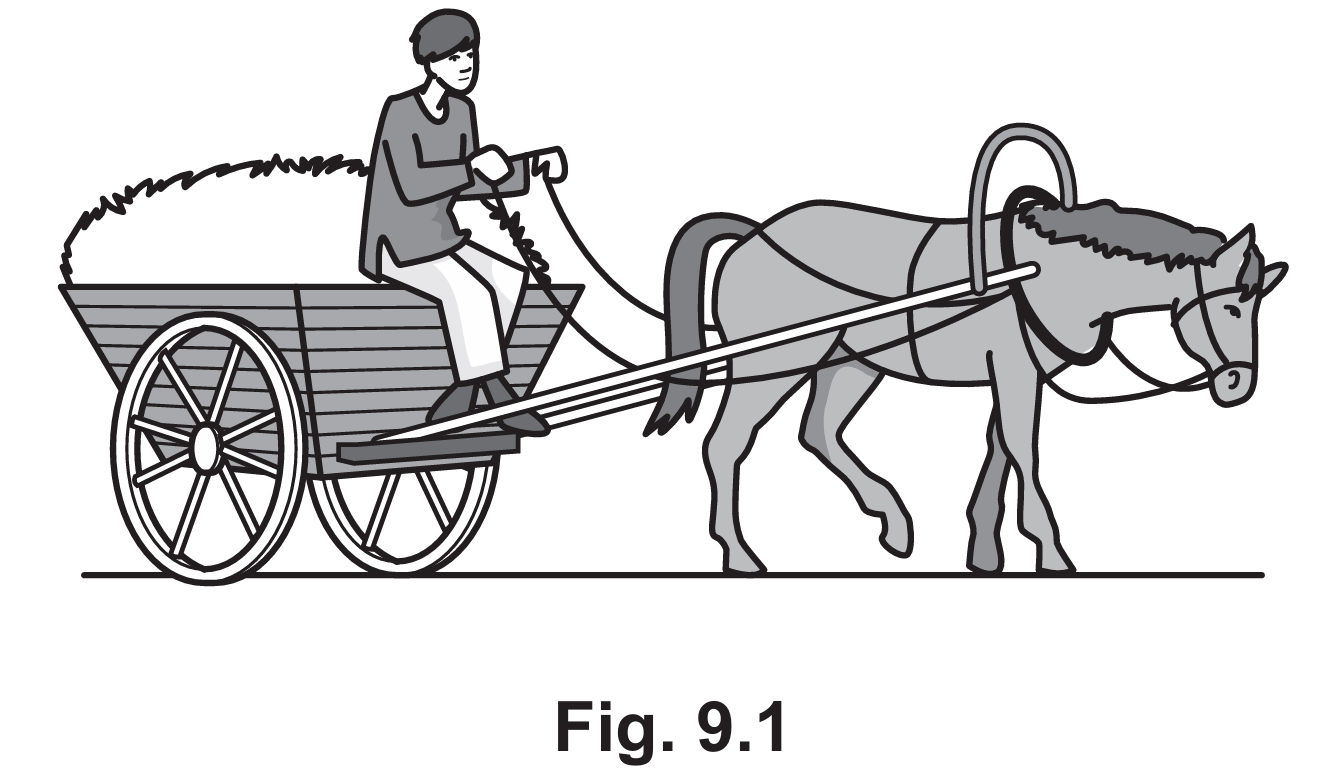
(a)(ii) work done = force × distance = 1200 × 400 = 480,000 J
Work done is calculated by multiplying the force applied by the distance moved in the direction of the force. The unit of work is the joule (J).
(a)(iii) power output = 1600 W
\(\text{power} = \frac{\text{work done}}{\text{time}} = \frac{480000}{300} = 1600 \text{ W}\)
Power is the rate at which work is done, measured in watts (W).
(b) Humans can hear lower frequencies (20 Hz to 20,000 Hz) than horses (55 Hz to 33 kHz). Horses can hear higher frequencies than humans. Horses can hear a wider/higher range of frequencies.
The human audible range is approximately 20 Hz to 20,000 Hz (20 kHz). Horses have a higher lower limit (55 Hz) but can hear frequencies up to 33 kHz, which is beyond the human range.
(c)(i) number of protons = 77
In the nuclide notation \(^{A}_{Z}\text{X}\), the subscript \(Z\) is the proton number (atomic number). For iridium-192, \(Z = 77\).
(c)(ii) number of neutrons = 115
Number of neutrons = mass number − proton number = 192 − 77 = 115.
The mass number \(A\) is the total number of protons and neutrons in the nucleus.
(c)(iii) time taken = 148 days
After 1 half-life (74 days), 50% remains. After 2 half-lives (148 days), 25% remains.
\(100\% \rightarrow 50\% \rightarrow 25\%\)
\(74 \times 2 = 148 \text{ days}\).
Question
Most-appropriate topic codes (Cambridge IGCSE Co-ordinated Sciences 0654):
• Topic P1.6.2 — Work (Part (a)(i))
• Topic P1.7 — Pressure (Part (a)(ii))
• Topic P3.4 — Sound (Part (b))
▶️ Answer/Explanation
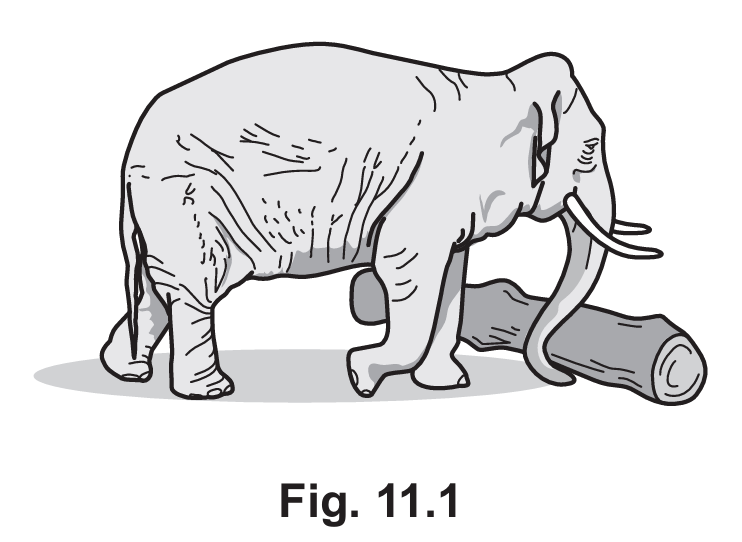
(a)(i) 30,000 J
Work done = force × distance moved in the direction of the force.
Work done = \(1500 \, \text{N} \times 20 \, \text{m} = 30,000 \, \text{J}\) (or \(3.0 \times 10^4 \, \text{J}\)).
The unit of work is the joule (J).
(a)(ii) 130,000 N/m²
Pressure = force ÷ area.
Total area in contact with the ground = \(4 \times 0.070 = 0.28 \, \text{m}^2\).
Pressure = \(\frac{36,000}{0.28} = 128,571 \, \text{N/m}^2 \approx 130,000 \, \text{N/m}^2\) (or 130,000 Pa).
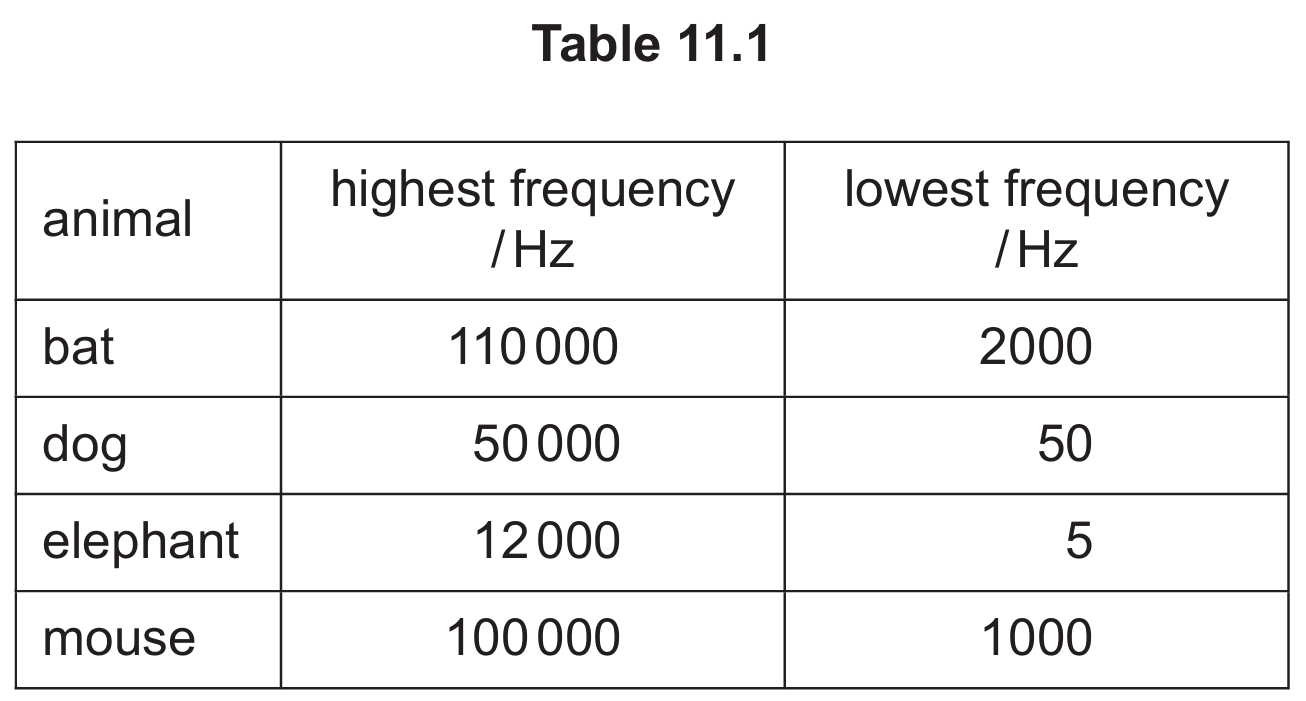
(b)(i) elephant
Frequency range = highest frequency − lowest frequency:
- Bat: 110,000 − 2,000 = 108,000 Hz
- Dog: 50,000 − 50 = 49,950 Hz
- Elephant: 12,000 − 5 = 11,995 Hz (smallest range)
- Mouse: 100,000 − 1,000 = 99,000 Hz
(b)(ii) 20 Hz to 20,000 Hz
The typical human audible frequency range is approximately 20 Hz (lowest frequency heard) to 20,000 Hz (highest frequency heard). This range varies with age and individual hearing ability.