
CIE iGCSE Co-Ordinated Science P1.6.4 Power Exam Style Questions Paper 3
Question
Another student wears a white T-shirt in the Sun and does not become as hot.
Explain why.
Most-appropriate topic codes (Cambridge IGCSE Coordinated Sciences 0654):
• Topic P1.2 — Motion (Part (a)(i))
• Topic P1.6.4 — Power (Part (a)(ii))
• Topic P2.2.2 — Melting, boiling and evaporation (Part (b)(i))
• Topic P2.3.3 — Radiation (Part (b)(ii))
• Topic P6.2.1 — The Sun as a star (Part (b)(iii), (b)(iv))
▶️ Answer/Explanation
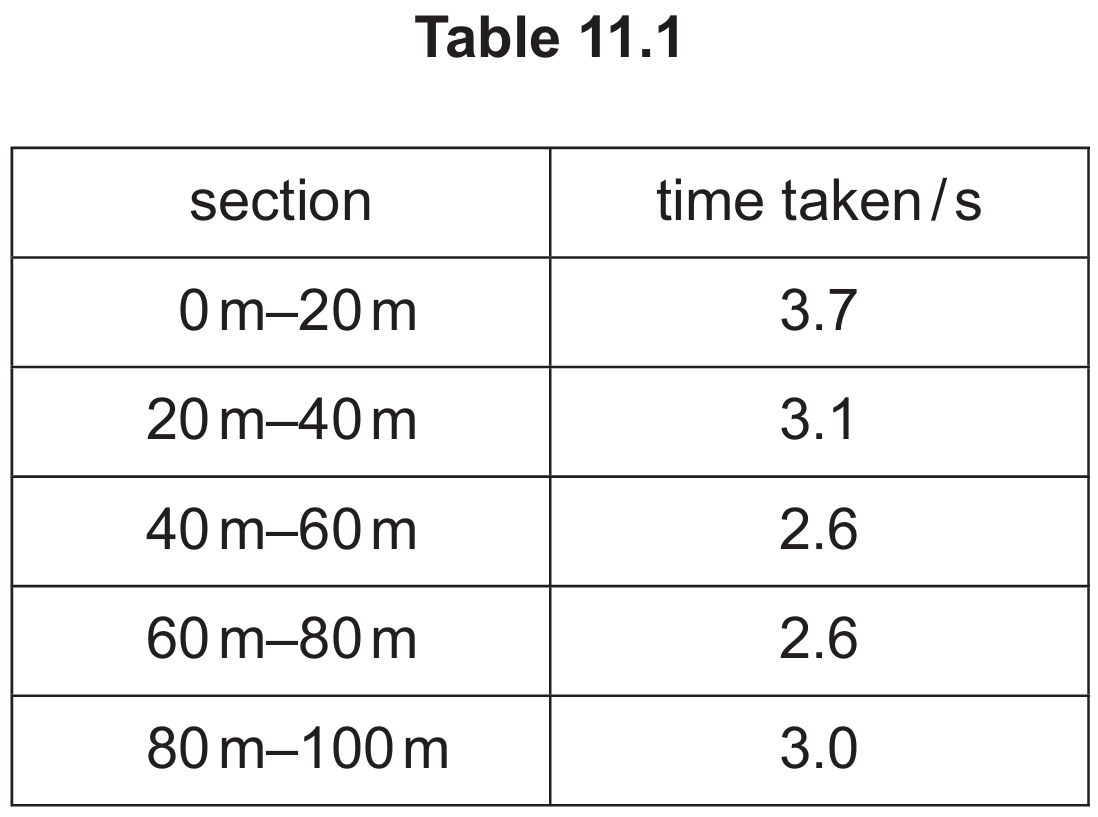
(a)(i) evidence of total time = 15 (s); v = s/t (in any form) OR (average speed =) 100/15; 6.7 (m/s)
Total time = 3.7 + 3.1 + 2.6 + 2.6 + 3.0 = 15.0 s. Average speed = 100/15 = 6.7 m/s.
(a)(ii) P = W/t (in any form) OR (work done =) 600 × 3.0; 1800; J
Work done = power × time = 600 × 3.0 = 1800 J. The unit for work is the joule (J).
(b)(i) evaporation
Sweating cools the body because the most energetic water particles evaporate from the skin surface, taking thermal energy with them and lowering the skin temperature.
(b)(ii) white absorbs less (thermal) radiation / white reflects more (thermal) radiation
White surfaces reflect most incident radiation, so less thermal energy is absorbed. Black surfaces absorb more radiation, leading to greater heating.
(b)(iii) helium or hydrogen
The Sun is composed mainly of hydrogen (about 75%) and helium (about 25%), with small amounts of other elements.
(b)(iv) infrared; (visible) light; ultraviolet
The Sun emits energy across the electromagnetic spectrum, but most is in the infrared, visible, and ultraviolet regions.
Question
Most-appropriate topic codes (Cambridge IGCSE Co-ordinated Sciences 0654):
• Topic P1.2 — Motion (Part (a)(i))
• Topic P1.6.2 — Work (Part (a)(ii))
• Topic P1.6.4 — Power (Part (a)(iii))
• Topic P3.4 — Sound (Part (b))
• Topic P5.1 — The nucleus (Part (c)(i), (c)(ii))
• Topic P5.2.4 — Half-life (Part (c)(iii))
▶️ Answer/Explanation
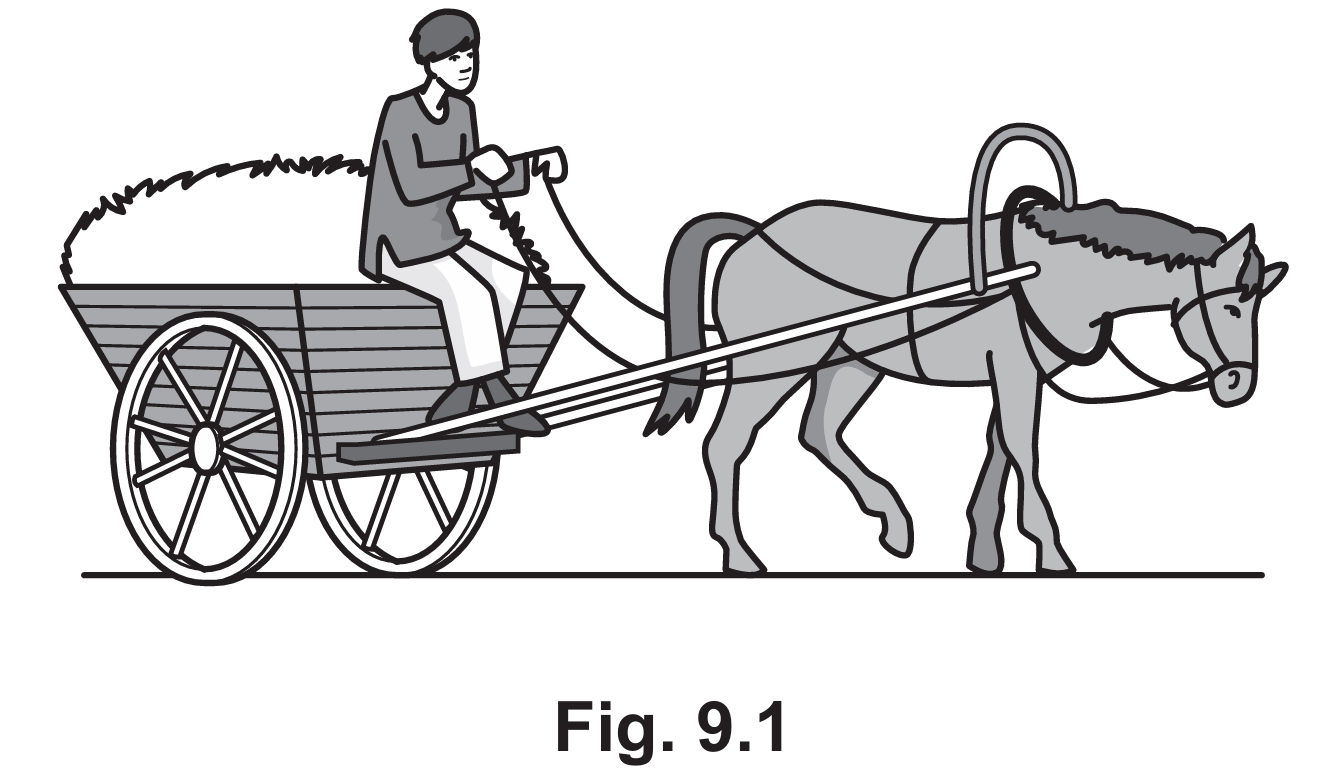
(a)(i) average speed = 1.3 m/s
\(\text{speed} = \frac{\text{distance}}{\text{time}} = \frac{400}{300} = 1.33 \text{ m/s}\)
Rounded to 1.3 m/s (2 significant figures).
(a)(ii) work done = force × distance = 1200 × 400 = 480,000 J
Work done is calculated by multiplying the force applied by the distance moved in the direction of the force. The unit of work is the joule (J).
(a)(iii) power output = 1600 W
\(\text{power} = \frac{\text{work done}}{\text{time}} = \frac{480000}{300} = 1600 \text{ W}\)
Power is the rate at which work is done, measured in watts (W).
(b) Humans can hear lower frequencies (20 Hz to 20,000 Hz) than horses (55 Hz to 33 kHz). Horses can hear higher frequencies than humans. Horses can hear a wider/higher range of frequencies.
The human audible range is approximately 20 Hz to 20,000 Hz (20 kHz). Horses have a higher lower limit (55 Hz) but can hear frequencies up to 33 kHz, which is beyond the human range.
(c)(i) number of protons = 77
In the nuclide notation \(^{A}_{Z}\text{X}\), the subscript \(Z\) is the proton number (atomic number). For iridium-192, \(Z = 77\).
(c)(ii) number of neutrons = 115
Number of neutrons = mass number − proton number = 192 − 77 = 115.
The mass number \(A\) is the total number of protons and neutrons in the nucleus.
(c)(iii) time taken = 148 days
After 1 half-life (74 days), 50% remains. After 2 half-lives (148 days), 25% remains.
\(100\% \rightarrow 50\% \rightarrow 25\%\)
\(74 \times 2 = 148 \text{ days}\).