
CIE iGCSE Co-Ordinated Science P1.6.4 Power Exam Style Questions Paper 4
Question
The half-life of tellurium-109 is \( 4.63 \, \text{s} \).
Calculate the time taken for a sample of pure tellurium-109 to contain 87.5% tin.
Most-appropriate topic codes (Cambridge IGCSE Co-ordinated Sciences 0654):
• Topic P5.2.3/P5.2.4 — Radioactive decay / Half-life (Part (a))
• Topic P1.6.3/P1.6.4 — Energy resources / Power (Part (b))
▶️ Answer/Explanation
(a)(i) Z reduces by 2; neutrons reduce by 2; A reduces by 4
An alpha particle consists of 2 protons and 2 neutrons (like a helium nucleus).
Emitting one therefore reduces the proton number (\( Z \)) by 2, the number of neutrons by 2, and the nucleon number (\( A \)) by 4.
(a)(ii) \( 13.9 \, \text{s} \)
87.5% tin means 12.5% tellurium-109 remains.
\( 100\% \rightarrow 50\% \rightarrow 25\% \rightarrow 12.5\% \) is 3 half-lives.
Time \( = 3 \times 4.63 = 13.9 \, \text{s} \).
(b)(i) Advantage: no CO₂ emissions; Disadvantage: doesn’t work at night
Solar cells generate electricity without producing carbon dioxide or contributing to climate change.
However, they don’t generate electricity at night, and require a large surface area to produce significant power.
(b)(ii) Black absorbs light/radiation well
A black surface is a good absorber of light and thermal radiation, meaning more of the incoming solar energy is absorbed rather than reflected, improving efficiency.
(b)(iii) \( 168 \, \text{W} \)
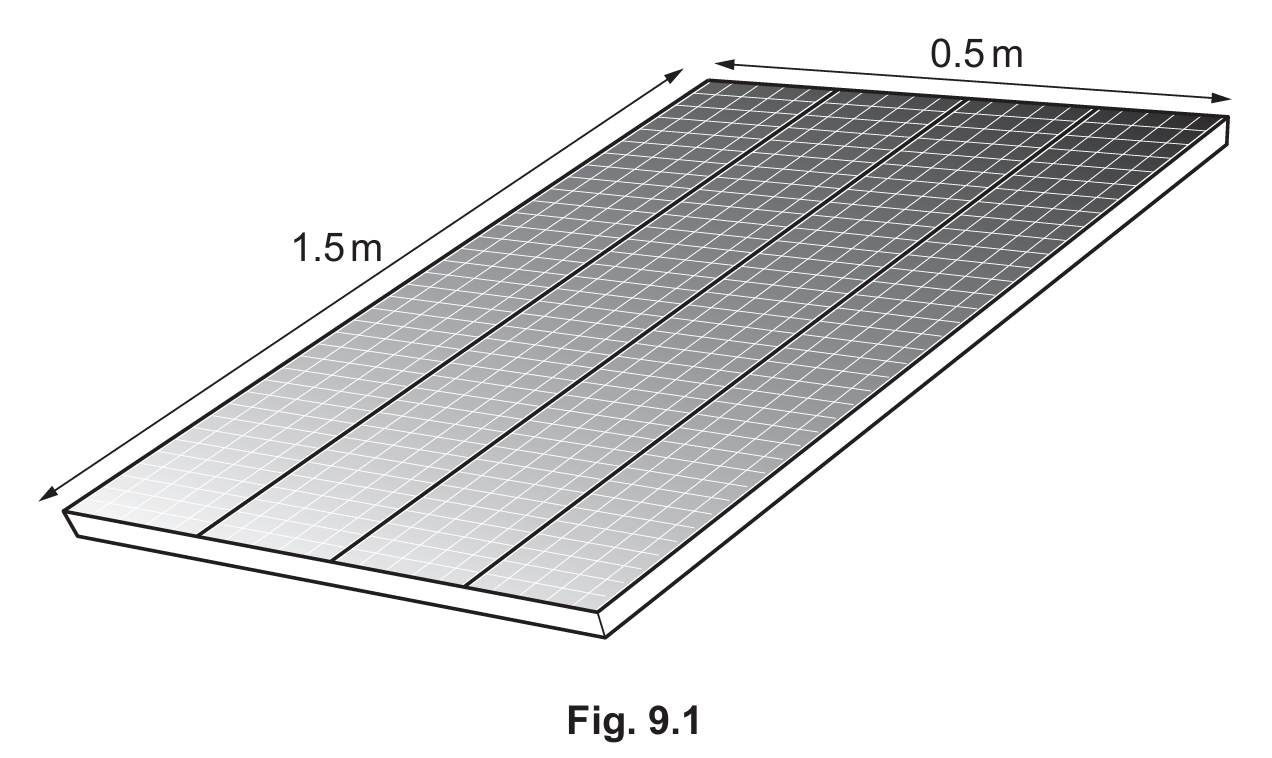
Area of the panel \( = 1.5 \times 0.5 = 0.75 \, \text{m}^2 \).
Power input \( = 1400 \times 0.75 = 1050 \, \text{W} \).
Power output \( = 1050 \times 0.16 = 168 \, \text{W} \).
Question

Describe one environmental impact of using natural gas in this way.
The combustion of natural gas provides an input energy of 1.50 kJ.
Calculate the useful energy output from the boiler.
Describe the process of convection in terms of density changes.
Transverse waves are produced by vibrations acting ………………………………………………. to the direction of energy transfer.
Longitudinal waves are produced by vibrations acting ………………………………………………. to the direction of energy transfer.
An example of a longitudinal wave is a ………………………………………………. wave.
Most-appropriate topic codes (Cambridge IGCSE Co-ordinated Sciences 0654, 2025–2027 syllabus):
• Topic C10.2 — Air quality and climate (Part (a))
• Topic P1.6.4 — Power (Part (b))
• Topic P2.3.2 — Convection (Part (c))
• Topic P3.1 — General properties of waves (Part (d))
▶️ Answer/Explanation
(a) Contributes to global warming / enhanced greenhouse effect
Burning natural gas releases carbon dioxide.
This is a greenhouse gas that contributes to global warming/climate change.
(b) useful energy output = 1.35 kJ
\( \text{Output} = \text{efficiency} \times \text{input} \)
\( = 0.90 \times 1.50 = 1.35\ \text{kJ} \)
(c) Heated water becomes less dense and rises
Water near the flame is heated and expands, becoming less dense.
This less dense (hotter) water rises, while cooler, denser water sinks to take its place, setting up a convection current.
(d)(i) frequency \( \approx 6.5 \times 10^{14}\ \text{Hz}\)
Speed of light, \(c = 3 \times 10^8\ \text{m/s}\)
\( f = \dfrac{c}{\lambda} = \dfrac{3\times10^{8}}{4.6\times10^{-7}} \approx 6.5\times10^{14}\ \text{Hz} \)
(d)(ii) Transverse: perpendicular; Longitudinal: parallel; example: sound
In transverse waves, vibrations act perpendicular to the direction of energy transfer.
In longitudinal waves, vibrations act parallel to the direction of energy transfer.
Sound is a common example of a longitudinal wave.