Home / iGCSE / Coordinated Sciences / P1.7 Pressure Paper 1 |IITIAN ACADEMY

CIE iGCSE Co-Ordinated Science P1.7 Pressure Exam Style Questions Paper 1

Question

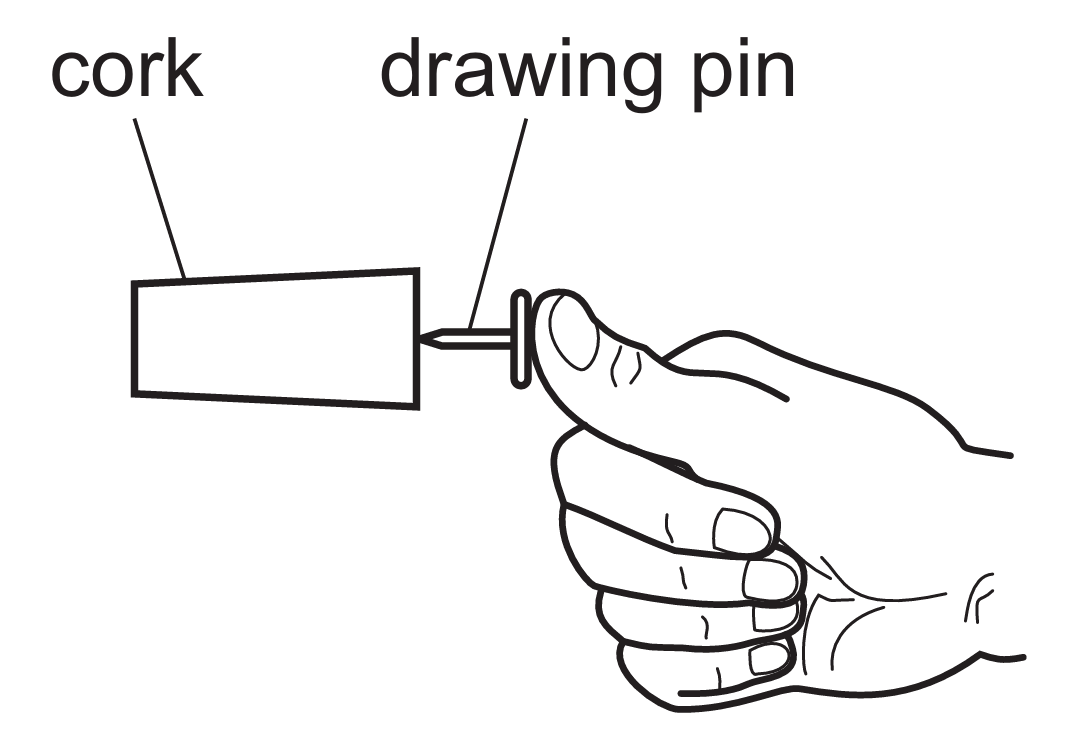
A person pushes a drawing pin into a cork with their thumb.

Which statement explains why the pin goes into the cork and not into the thumb?

A. The force on the cork is greater than the force on the thumb.
B. The force on the cork is less than the force on the thumb.
C. The pressure on the cork is greater than the pressure on the thumb.
D. The pressure on the cork is less than the pressure on the thumb.

▶️ Answer/Explanation
The force applied on the pin is the same on both ends, but pressure depends on the area over which the force is applied. The sharp point of the pin has a very small area, so pressure on the cork is much higher than the pressure on the thumb (which has a larger area). This greater pressure allows the pin to penetrate the cork without causing injury to the thumb. Since pressure is inversely proportional to area, the smaller area of the pin tip creates a greater pressure, pushing it into the cork.
Answer: (C)

Question

A student places four identical beakers on a bench.

Two beakers contain salt water of density 1.1 g/cm³ and two beakers contain pure water of density 1.0 g/cm³. The quantity of water in each beaker is shown.

Which beaker exerts the greatest pressure on the bench?

▶️ Answer/Explanation
Since all beakers are identical (same base area), the pressure on the bench depends only on the total weight of the beaker and liquid: \(P = \frac{F}{A} = \frac{mg}{A}\), where \(m = \rho \times V\).
Beaker A contains the largest volume of salt water (highest density), giving it the greatest mass and therefore the greatest weight and pressure on the bench.
Answer: (A)

Question

The weight of a box exerts pressure on the ground.
Which pair of changes to the box must reduce the pressure?

A. decreasing the weight and decreasing the area of the base
B. decreasing the weight and increasing the area of the base
C. increasing the weight and decreasing the area of the base
D. increasing the weight and increasing the area of the base

▶️ Answer/Explanation
Pressure is calculated using \(P = \dfrac{F}{A}\), where \(F\) is the force (weight) and \(A\) is the contact area.
Decreasing the weight reduces the numerator, and increasing the base area increases the denominator.
Both changes together must reduce the overall pressure, since \(P\) decreases whenever \(F\) falls and \(A\) rises.
Answer: (B)

Question

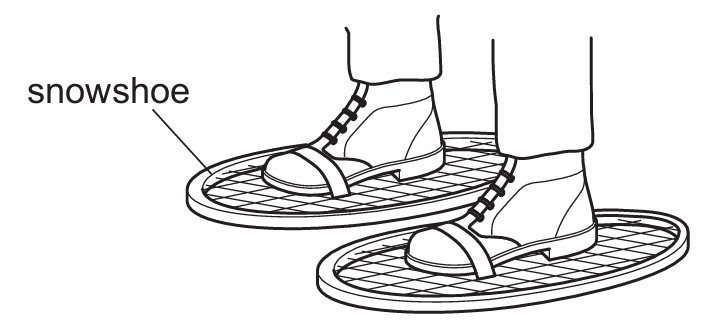
A person wearing snowshoes is walking on snow.

How do snowshoes decrease the pressure on the snow?

A. by applying the person’s weight over a larger area
B. by applying the person’s weight over a smaller area
C. by decreasing the person’s weight
D. by increasing the person’s weight

▶️ Answer/Explanation
Pressure is calculated using \( P = \dfrac{F}{A} \), where F is the force (the person’s weight) and A is the contact area.
Snowshoes spread the person’s weight over a much larger area of snow than a normal boot.
Since the force (weight) stays the same but the area increases, the pressure on the snow decreases.
Answer: (A)

Question 

When driving cars on soft sand, drivers are advised to reduce the pressure of the air in the tyres. Why does this cause the cars to sink less into the sand?

A. The area of the tyres in contact with the sand is decreased.

B. The area of the tyres in contact with the sand is increased.

C. The downward force on the sand is decreased.

D. The downward force on the sand is increased.

▶️Answer/Explanation

Answer: B. The area of the tyres in contact with the sand is increased.

Explanation: Reducing tyre pressure increases the contact area between the tyres and the sand, distributing the car’s weight over a larger area and reducing the pressure on the sand, which prevents sinking.

Scroll to Top