
▶️ Answer/Explanation
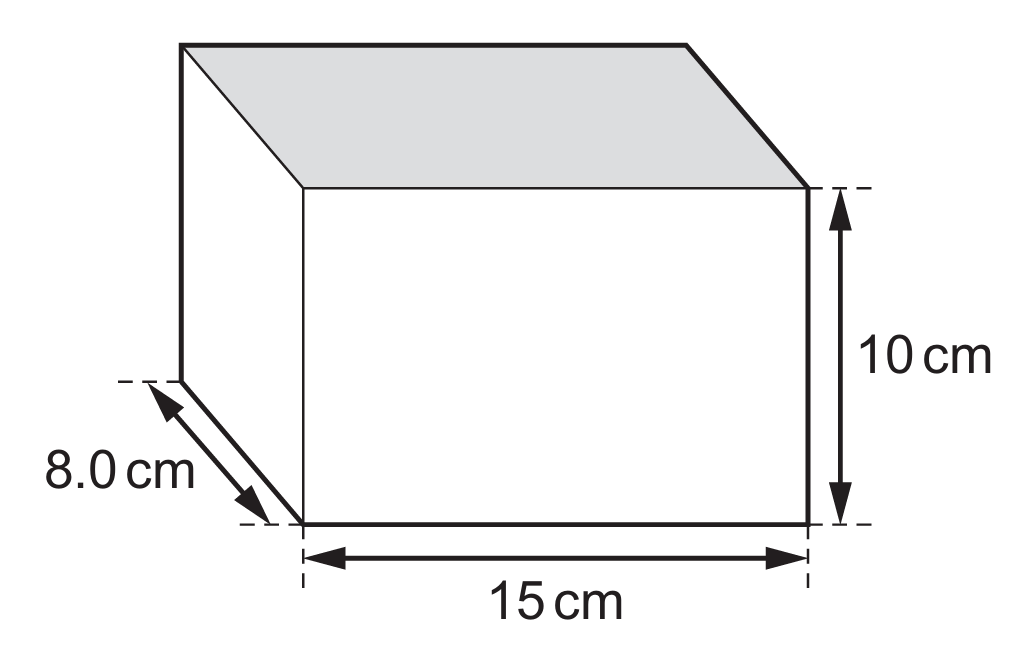
Minimum pressure occurs when the block rests on its face with the largest area, since \(P = \frac{F}{A}\) and pressure is inversely proportional to area.
The largest face has dimensions \(15\text{ cm} \times 10\text{ cm} = 150\text{ cm}^2\).
So the minimum pressure is \(\frac{1200\text{ N}}{150\text{ cm}^2} = 8.0\) N/cm².
✅ Answer: (B)
The largest face has dimensions \(15\text{ cm} \times 10\text{ cm} = 150\text{ cm}^2\).
So the minimum pressure is \(\frac{1200\text{ N}}{150\text{ cm}^2} = 8.0\) N/cm².
✅ Answer: (B)

▶️ Answer/Explanation
The base of the box in contact with the ground has an area \( A = 0.50\ m \times 0.40\ m = 0.20\ m^2 \).
Pressure is defined as \( P = \dfrac{F}{A} \), so rearranging gives \( F = P \times A \).
Substituting the values, \( F = 50\ Pa \times 0.20\ m^2 = 10\ N \), which is the weight of the box.
✅ Answer: (B)
Pressure is defined as \( P = \dfrac{F}{A} \), so rearranging gives \( F = P \times A \).
Substituting the values, \( F = 50\ Pa \times 0.20\ m^2 = 10\ N \), which is the weight of the box.
✅ Answer: (B)
▶️ Answer/Explanation
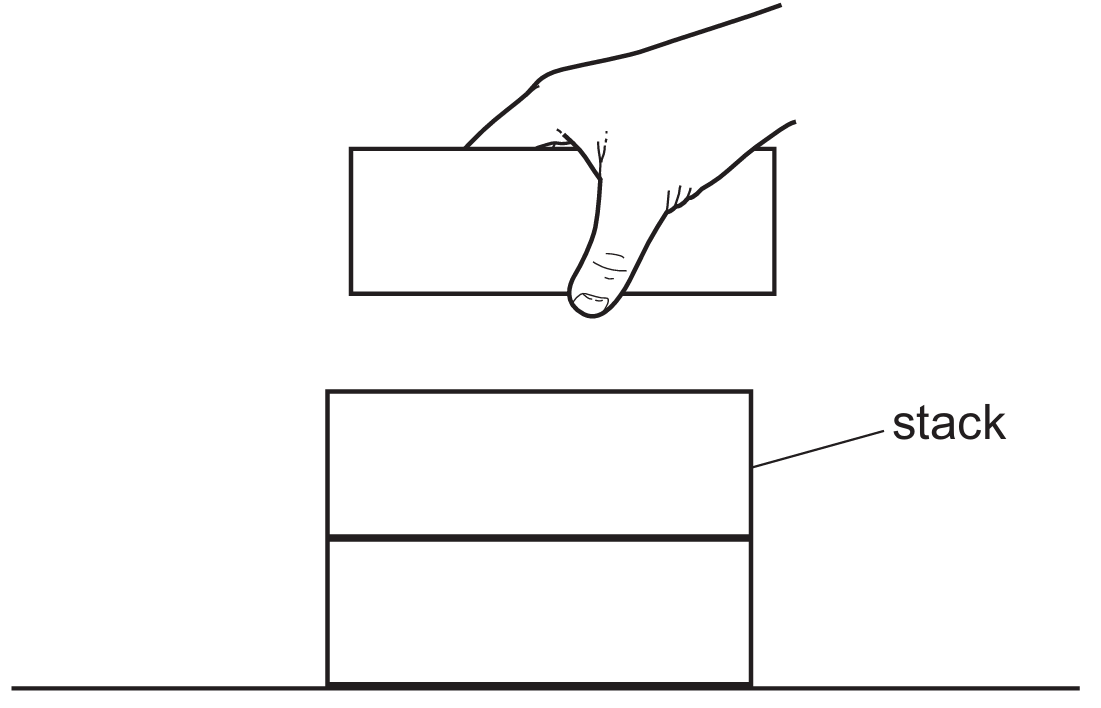
Weight of \(n\) bricks \(= n \times 1.5 \times 10 = 15n\,\text{N}\).
Using \(P = \frac{F}{A}\): \(5700 = \frac{15n}{0.030}\), so \(15n = 171\), giving \(n = 11.4\).
Since the pressure limit must not be exceeded, the number of bricks must be rounded down to the nearest whole number.
✅ Answer: (A)
Using \(P = \frac{F}{A}\): \(5700 = \frac{15n}{0.030}\), so \(15n = 171\), giving \(n = 11.4\).
Since the pressure limit must not be exceeded, the number of bricks must be rounded down to the nearest whole number.
✅ Answer: (A)