
CIE iGCSE Co-Ordinated Science P1.7 Pressure Exam Style Questions Paper 3
Question
The energy is stored in a battery in the car.
The battery supplies a current of 96 A at 120 V to the motor that drives the car.
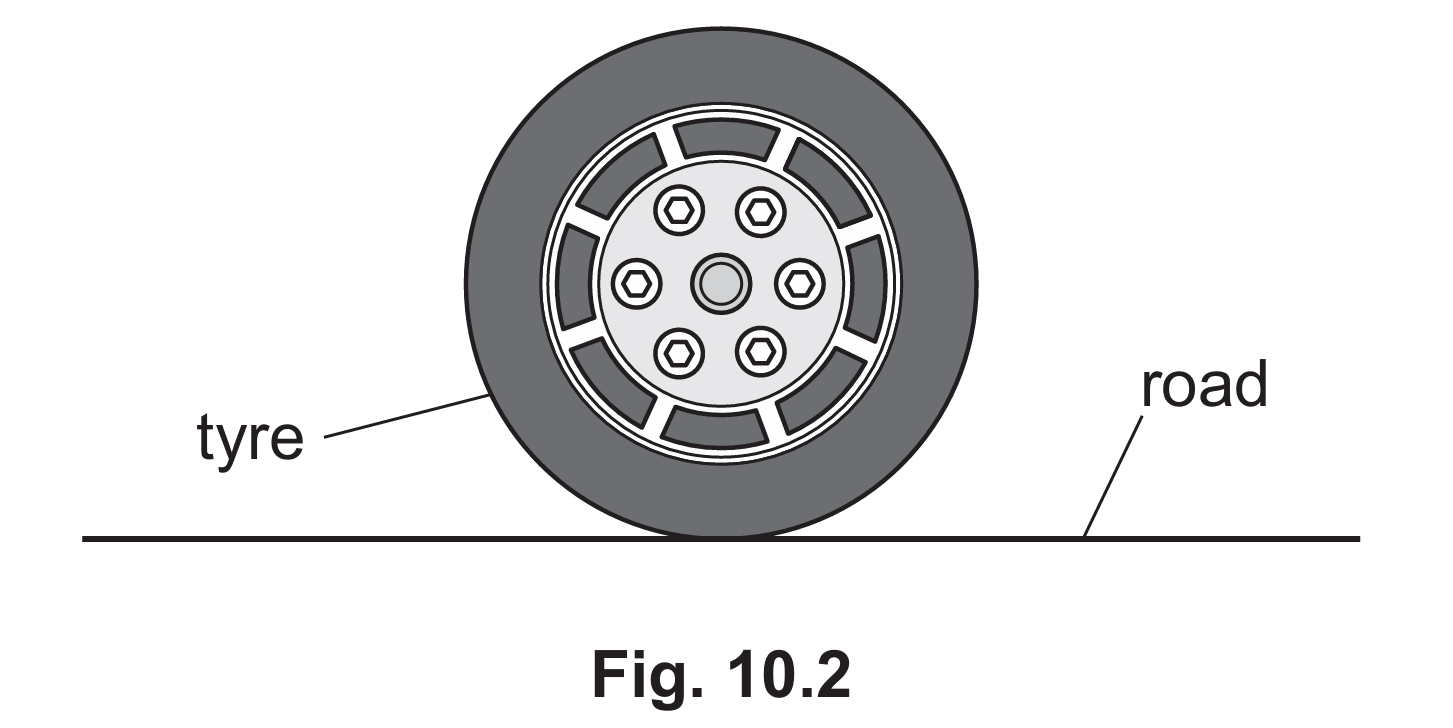
The tyre exerts a pressure of 20 N/cm² on the road.
Calculate the force exerted by the tyre on the road.
Most-appropriate topic codes (Cambridge IGCSE Co-ordinated Sciences 0654):
• Topic P6.1 — The Solar System (Part (a))
• Topic P4.2.5 — Electrical energy and electrical power (Part (b)(i))
• Topic P4.2.2 — Electric current (Part (b)(ii))
• Topic P1.5.2 — Turning effect of forces (Part (c)(i))
• Topic P1.7 — Pressure (Part (c)(ii))
▶️ Answer/Explanation
(a)(i) Gravitational attraction
The Sun’s gravitational field provides the centripetal force that keeps the Earth in its nearly circular orbit around the Sun.
(a)(ii) Milky Way
The Sun is one of approximately 100–400 billion stars in the Milky Way galaxy, which is a spiral galaxy about 100,000 light-years in diameter.
(b)(i) Energy = \(I \times V \times t = 96 \times 120 \times 900 = 10,368,000 \text{ J} \approx 10,000,000 \text{ J}\)
The electrical energy transferred is calculated using the formula \(E = IVt\), where current is in amperes, voltage in volts, and time in seconds. The unit of energy is the joule (J).
(b)(ii) Direct current (d.c.) flows in one direction only, whereas alternating current (a.c.) periodically changes direction.
In a direct current circuit, electrons flow continuously in the same direction. In an alternating current circuit, the direction of electron flow reverses periodically (e.g., 50 times per second in mains electricity).
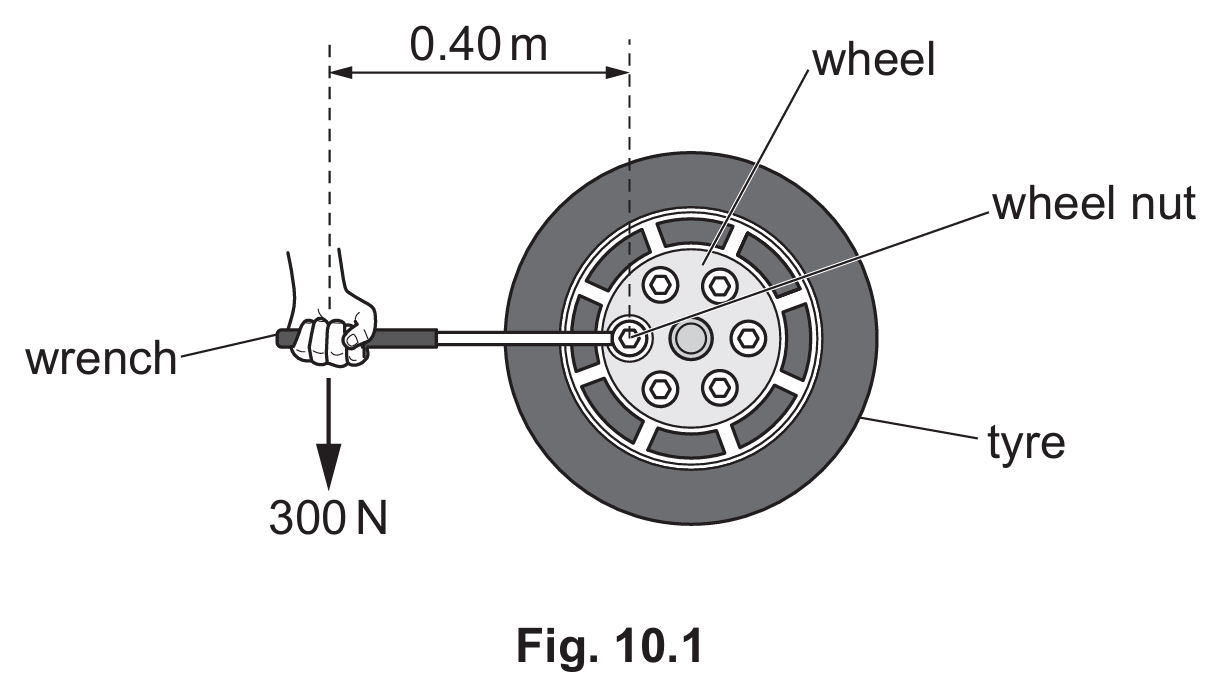
(c)(i) moment = \(300 \times 0.40 = 120 \text{ N m}\)
The moment of a force is calculated using the equation \(\text{moment} = \text{force} \times \text{perpendicular distance from the pivot}\). The unit is newton-metre (N m).
(c)(ii) force = \(20 \times 180 = 3600 \text{ N}\)
Pressure is defined as force per unit area. The force can be calculated by multiplying pressure by area: \(\text{force} = \text{pressure} \times \text{area}\).
Question
Most-appropriate topic codes (Cambridge IGCSE Co-ordinated Sciences 0654):
• Topic P1.6.2 — Work (Part (a)(i))
• Topic P1.7 — Pressure (Part (a)(ii))
• Topic P3.4 — Sound (Part (b))
▶️ Answer/Explanation
(a)(i) 30,000 J
Work done = force × distance moved in the direction of the force.
Work done = \(1500 \, \text{N} \times 20 \, \text{m} = 30,000 \, \text{J}\) (or \(3.0 \times 10^4 \, \text{J}\)).
The unit of work is the joule (J).
(a)(ii) 130,000 N/m²
Pressure = force ÷ area.
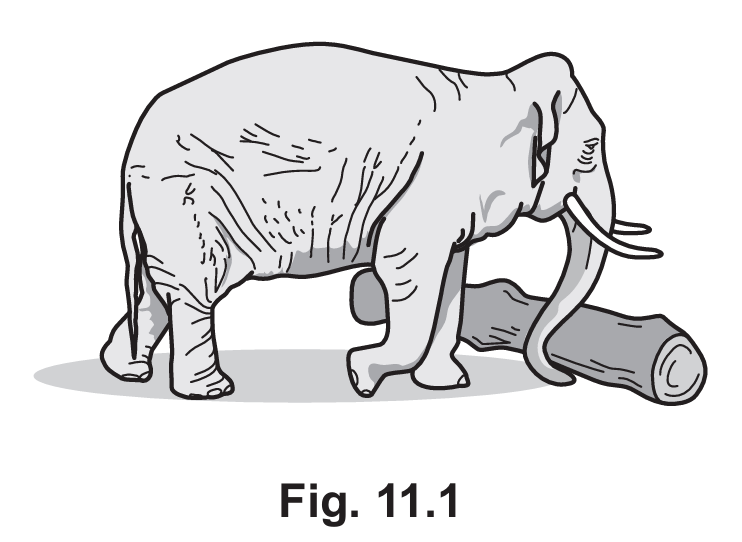
Total area in contact with the ground = \(4 \times 0.070 = 0.28 \, \text{m}^2\).
Pressure = \(\frac{36,000}{0.28} = 128,571 \, \text{N/m}^2 \approx 130,000 \, \text{N/m}^2\) (or 130,000 Pa).
(b)(i) elephant
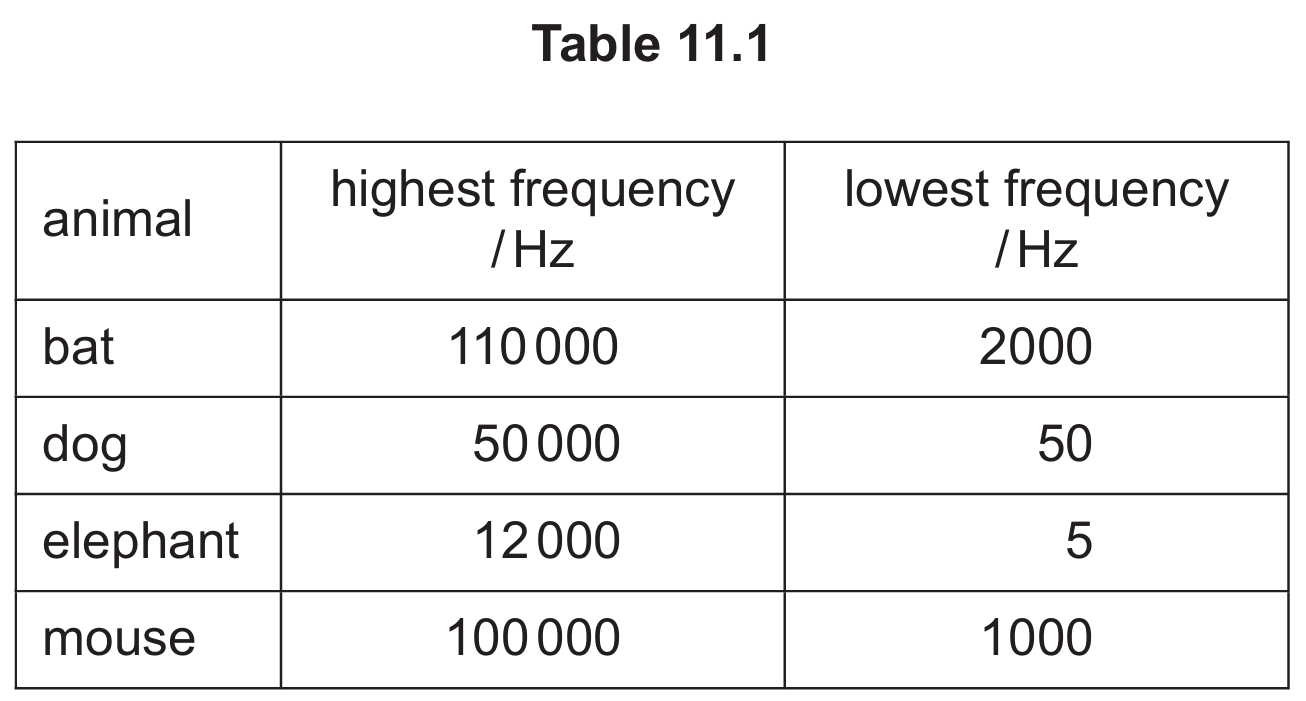
Frequency range = highest frequency − lowest frequency:
- Bat: 110,000 − 2,000 = 108,000 Hz
- Dog: 50,000 − 50 = 49,950 Hz
- Elephant: 12,000 − 5 = 11,995 Hz (smallest range)
- Mouse: 100,000 − 1,000 = 99,000 Hz
(b)(ii) 20 Hz to 20,000 Hz
The typical human audible frequency range is approximately 20 Hz (lowest frequency heard) to 20,000 Hz (highest frequency heard). This range varies with age and individual hearing ability.