
CIE iGCSE Co-Ordinated Science P1.7 Pressure Exam Style Questions Paper 4
Question
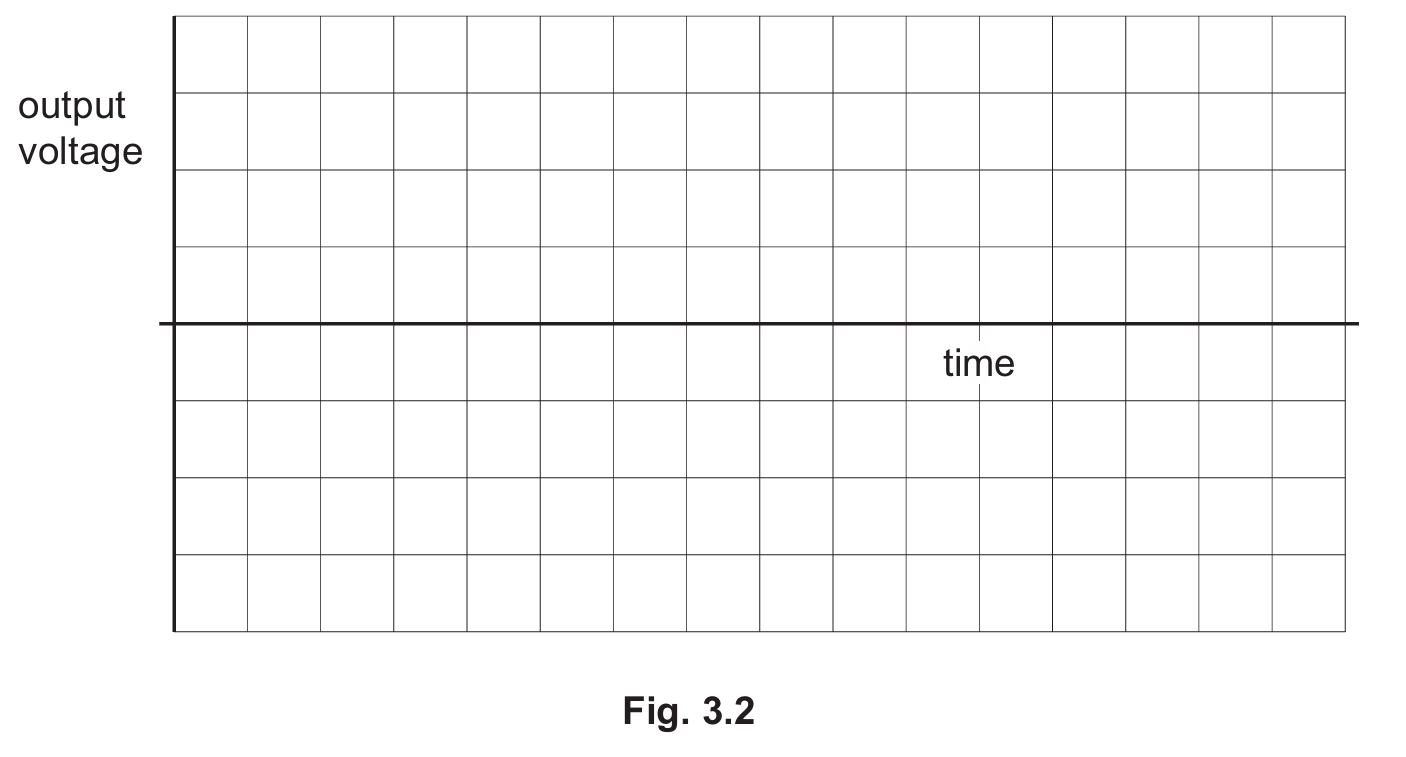
On Fig. 3.2, sketch a graph of output voltage against time for the a.c. generator when the wind turbine is turning at a constant speed.
Describe the construction of a basic step-up transformer.
You may include a labelled diagram to aid your description.
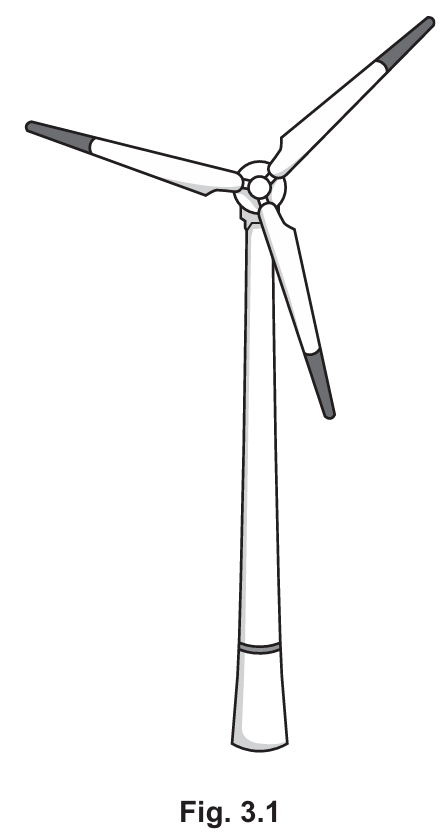
Each blade has a surface area of \(90\,\text{m}^2\).
Calculate the force exerted by the wind on each turbine blade.
Describe, in terms of oscillations and energy transfer, what is meant by a longitudinal wave.
Most-appropriate topic codes (Cambridge IGCSE Co-ordinated Sciences 0654, 2025–2027 syllabus):
• Topic P1.6.3 — Energy resources (Part (a))
• Topic P4.5.2 — The a.c. generator (Part (b))
• Topic P4.5.6 — The transformer (Part (c))
• Topic P1.7 — Pressure (Part (d))
• Topic P3.4 — Sound / Topic P3.1 — General properties of waves (Part (e))
▶️ Answer/Explanation
(a) Does not release \(CO_2\) / renewable / no fuel costs
Wind turbines generate electricity without burning fossil fuels.
This means no greenhouse gases are released and the energy source (wind) is renewable.
(b) Sinusoidal waveform
The trace should be a smooth sine wave, alternating above and below the time axis.
Both the amplitude and the time period of the wave must stay constant, since the turbine turns at constant speed.
(c) Soft-iron core with two coils
A basic transformer has a soft iron core linking two separate coils of wire.
The primary and secondary coils are both wound around the same core.
For a step-up transformer, the number of turns on the secondary coil is greater than the number of turns on the primary coil.
(d) \(648\,000\,\text{N}\) (≈ \(6.5\times10^{5}\,\text{N}\))
Force is calculated using \(F = P \times A\).
\(F = 7200 \times 90 = 648\,000\,\text{N}\), which rounds to \(650\,000\,\text{N}\) (2 s.f.).
(e)(i) \(20\,\text{Hz}\)
The typical range of human hearing is approximately \(20\,\text{Hz}\) to \(20\,000\,\text{Hz}\).
\(20\,\text{Hz}\) is therefore the accepted minimum audible frequency for a healthy human ear.
(e)(ii) Oscillations parallel to energy transfer
In a longitudinal wave, the particles oscillate back and forth in the same direction that the energy is being transferred.
This produces alternating regions of compression and rarefaction along the direction of travel.
Question
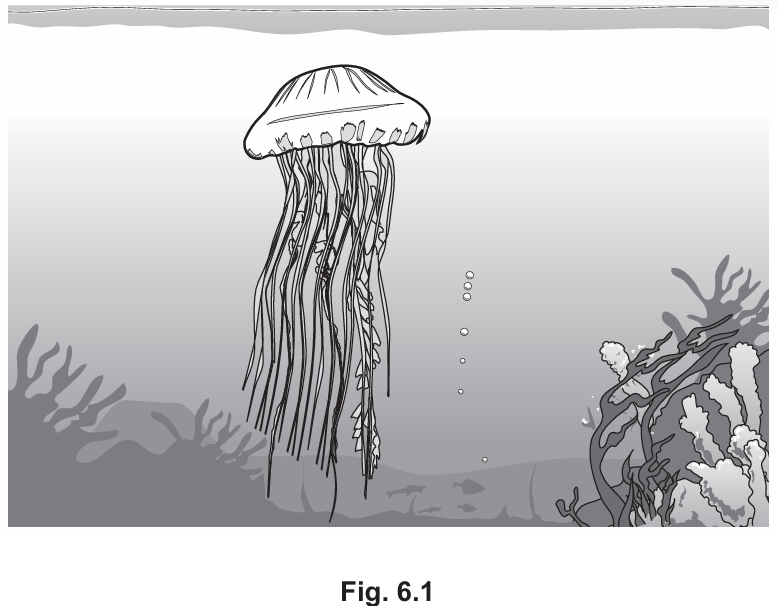
The mass of the jellyfish is 0.15 kg.
There are no horizontal forces acting on the jellyfish.
Describe and explain the motion of the jellyfish.
The gravitational field strength \(g = 10\,\text{N/kg}\).
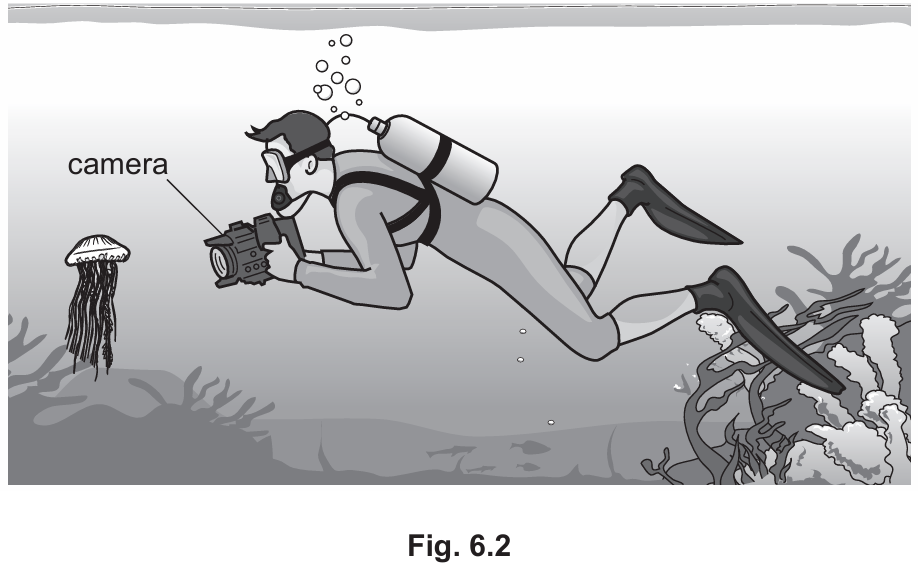
The circular lens has a radius of 0.035 m.
Calculate the force exerted by the water on the lens of the camera.
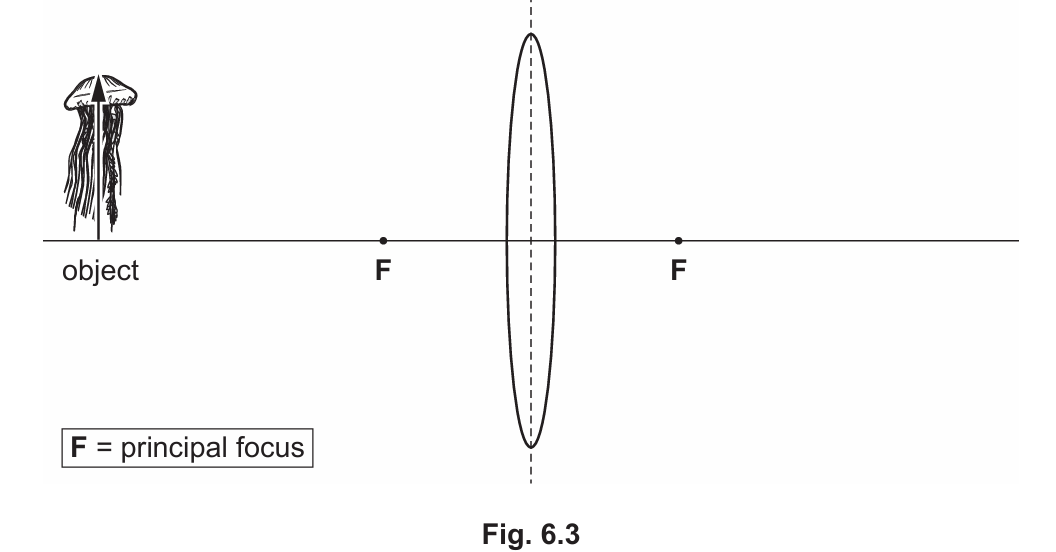
Complete Fig. 6.3 to show how a thin converging lens forms an image.
Draw two rays to locate the image and draw an arrow to represent the image.
Most-appropriate topic codes (Cambridge IGCSE Co-ordinated Sciences 0654):
• Topic P1.5.1 — Effects of forces Exam (Part (a))
• Topic P1.7 — Pressure (Part (b)(i))
• Topic P3.2.3 — Thin converging lens (Part (b)(ii))
▶️ Answer/Explanation
(a) accelerates upwards
Weight \(= mg = 0.15 \times 10 = 1.5\,\text{N}\).
Resultant force \(= 2.1 – 1.5 = 0.6\,\text{N}\) upwards, so by Newton’s second law the jellyfish accelerates upwards.
(b)(i) 690 N
Area of the lens \(= \pi r^2 = \pi \times 0.035^2 = 3.85 \times 10^{-3}\,\text{m}^2\).
Force \(= P \times A = 180\,000 \times 3.85 \times 10^{-3} \approx 690\,\text{N}\).
(b)(ii) two rays drawn to locate the image, with the image arrow correctly drawn
One ray is drawn parallel to the axis from the object, refracting through the far principal focus.
A second ray is drawn through the centre of the lens undeviated; where the two rays cross marks the position of the image, which is drawn as an inverted arrow.