
CIE iGCSE Co-Ordinated Science P2.1.2 Particle model Exam Style Questions Paper 3
Question
Most-appropriate topic codes (Cambridge IGCSE Co-ordinated Sciences 0654):
• Topic P1.4 — Density (Part (a)(i) & (a)(ii))
• Topic P2.1.1 — States of matter (Part (b)(i))
• Topic P2.1.2 — Particle model (Part (b)(ii) & (b)(iii))
• Topic P5.1 — The nucleus (Part (c))
• Topic P4.4 — Electrical safety (Part (d))
▶️ Answer/Explanation
(a)(i)
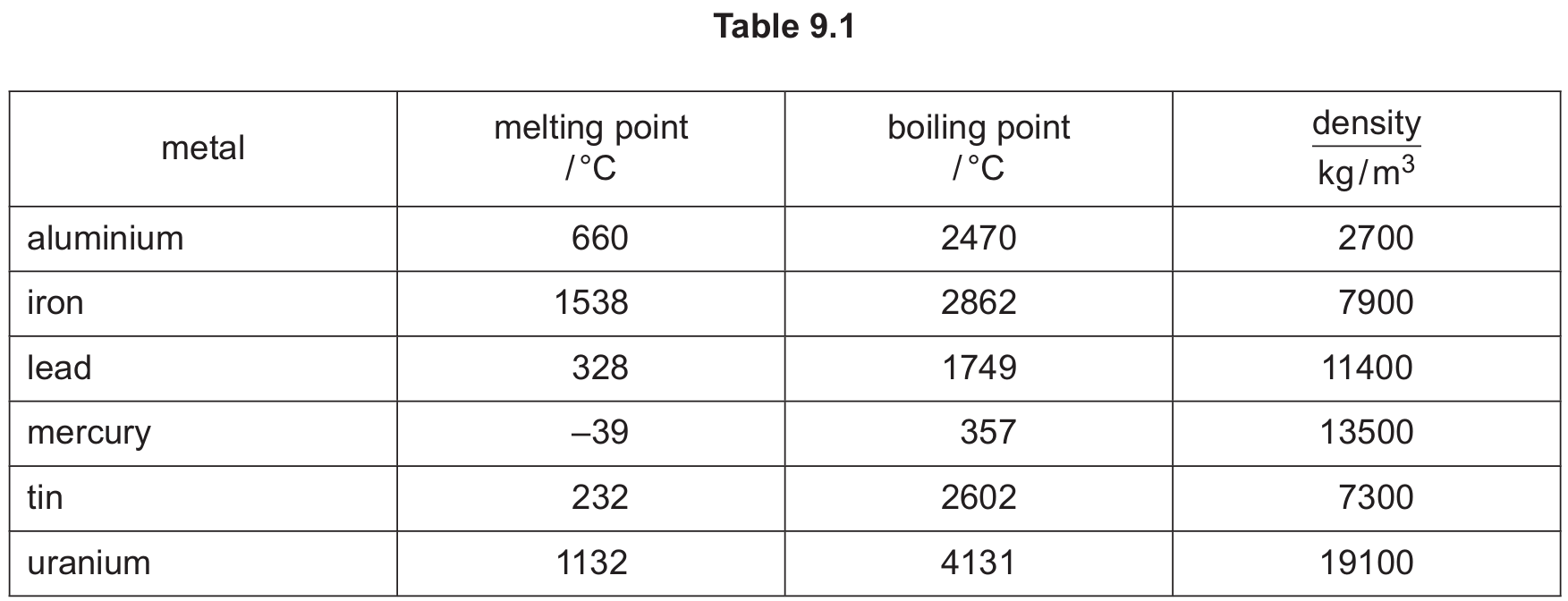
uranium (density = $19\,100\,\text{kg/m}^3$)
Density is defined as mass per unit volume. Comparing all six metals in Table 9.1, uranium has the highest density value, making it the densest metal listed.
(a)(ii)
All the metals have a density greater than that of water ($1000\,\text{kg/m}^3$).
An object sinks in a fluid when its density is greater than the density of the fluid. The least dense metal in the table is aluminium at $2700\,\text{kg/m}^3$, which is still nearly three times the density of water. Since every metal listed exceeds $1000\,\text{kg/m}^3$, all will sink.
(b)(i)
Mercury’s melting point (−39 °C) is below 20 °C, and its boiling point (357 °C) is above 20 °C.
Room temperature (20 °C) lies between the melting point and the boiling point of mercury. This means mercury is above its melting point (not a solid) and below its boiling point (not a gas), so it must be a liquid at room temperature.
(b)(ii)
Arrangement: random / irregular — particles are not held in fixed positions.
Separation: close together, most touching.
Liquid particles have enough energy to overcome the rigid lattice of a solid, allowing them to move past one another, but they remain close together and are not widely spaced like gas particles. This gives liquids a fixed volume but no fixed shape.
(b)(iii)
The particles move more slowly as temperature decreases.
Temperature is a measure of the average kinetic energy of the particles. As thermal energy is removed, particles lose kinetic energy, their speed decreases, and collisions become less frequent and less energetic. If cooled sufficiently below its melting point of −39 °C, mercury would solidify.
(c)
92 protons and 146 neutrons
In the nuclide notation $^{238}_{92}\text{U}$, the lower number (92) is the proton number giving the number of protons, and the upper number (238) is the nucleon number (total protons + neutrons). The number of neutrons is therefore $238 – 92 = 146$.
(d)
1. If too large a current flows, the fuse wire heats up due to the heating effect of the current.
2. The temperature rises above 200 °C and the fuse wire melts.
3. This breaks the circuit, stopping all current flow and protecting the device.
The fuse is connected in series so that all current must pass through it. Its low-melting-point alloy ensures it melts before the current reaches a level that would overheat the wiring or damage the appliance, acting as a deliberate weak point that sacrifices itself to protect the rest of the circuit.
Question
Topic codes:
• Topic P1.2 — Motion (Part (a)(i) & (a)(ii))
• Topic P2.1.2 — Particle model (Part (b))
• Topic P1.5.2 — Turning effect of forces (Part (c))
• Topic P4.2.1 — Electrical charge (Part (d)(i), (d)(ii) & (d)(iii))
▶️ Answer/Explanation
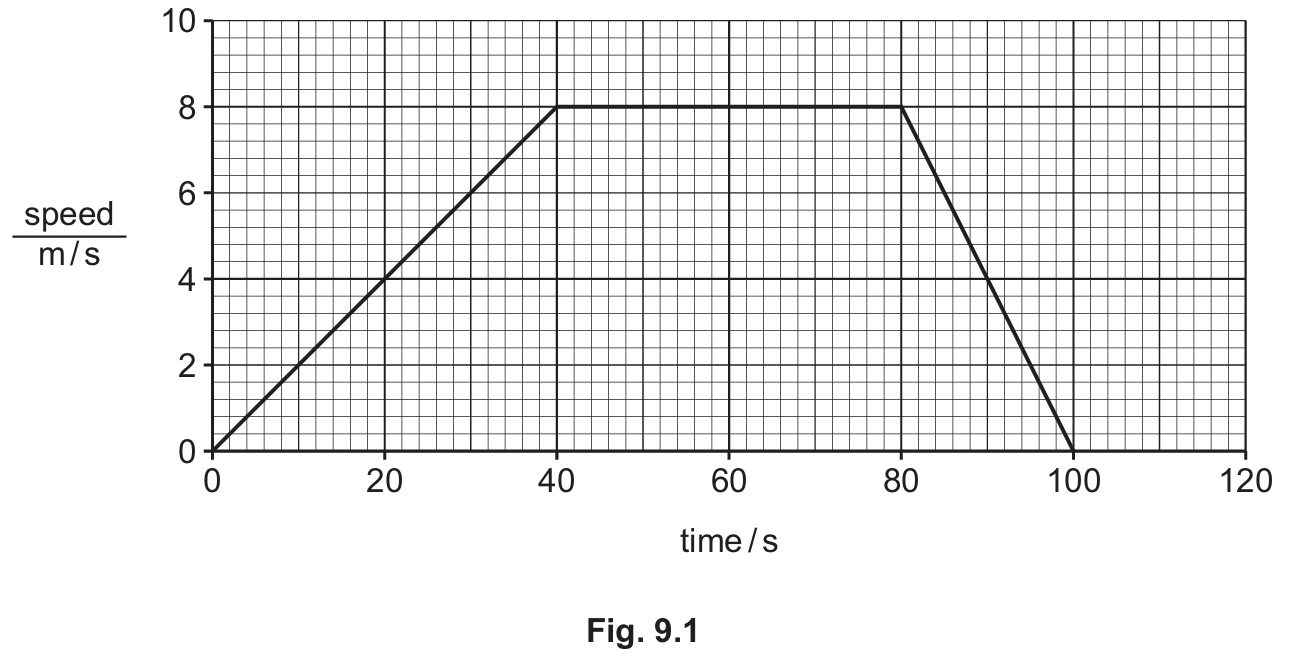
(a)(i) Any time between t = 0 to t = 40 s
The car is accelerating when the speed is increasing. From the graph, the speed increases from 0 to 8 m/s during the first 40 seconds (the line slopes upwards). Any time within this interval shows acceleration.
(a)(ii) 560 m
Total distance travelled = area under the speed-time graph.
The graph forms a trapezium split into three sections:
- Triangle 1 (0 to 40 s): \(\frac{1}{2} \times 40 \times 8 = 160\) m
- Rectangle (40 to 80 s): \(40 \times 8 = 320\) m
- Triangle 2 (80 to 100 s): \(\frac{1}{2} \times 20 \times 8 = 80\) m
Total distance = 160 + 320 + 80 = 560 m
(b) Particles move faster / have greater kinetic energy / \(E_k\)
As temperature increases, the air particles gain kinetic energy. They move more rapidly, colliding with each other and the tyre walls more frequently and with greater force. This increased motion causes the pressure in the tyre to rise.
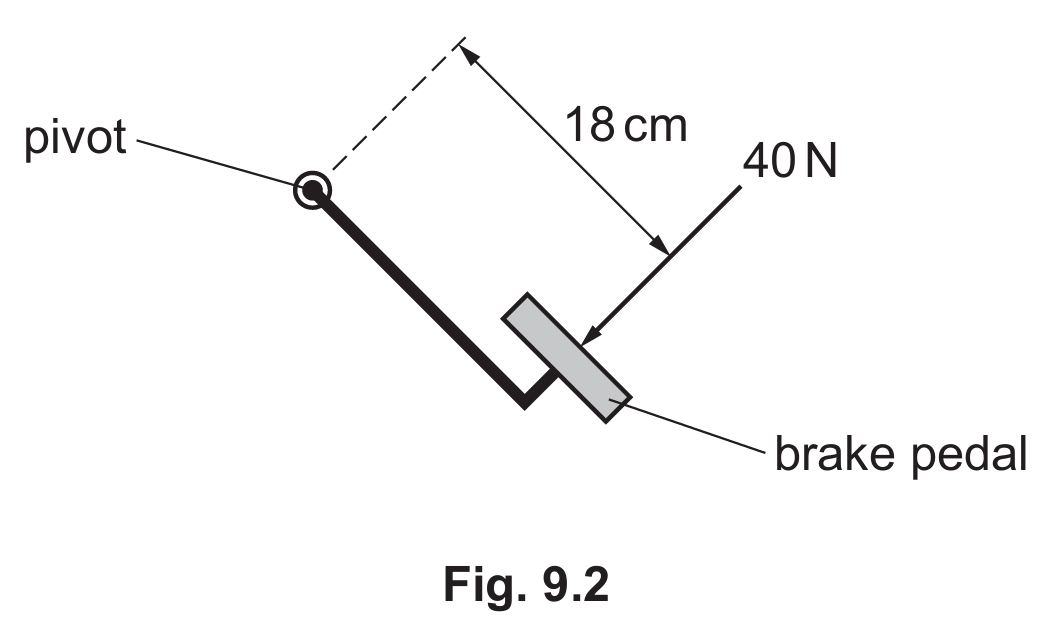
(c) Moment = 720 Ncm
Moment = force × perpendicular distance from the pivot.
Moment = 40 N × 18 cm = 720 Ncm
(Note: The perpendicular distance is measured from the pivot to the line of action of the force. Here it is given as 18 cm.)
(d)(i) Friction
As the car moves, friction between the car and the air, and between the tyres and the road, causes the transfer of electrostatic charges. This is similar to charging by friction where electrons are transferred from one surface to another.
(d)(ii) Electrons
The charged particles that move during the transfer of electrostatic charge are electrons. They are negatively charged and are transferred from one material to another during friction.
(d)(iii) \(-1\)
Electrons have a relative charge of \(-1\). This means they have a negative charge equal in magnitude to the positive charge of a proton (\(+1\)).