
CIE iGCSE Co-Ordinated Science P2.1.3 Pressure changes Exam Style Questions Paper 3
Question


Most-appropriate topic codes (Cambridge IGCSE Co-ordinated Sciences 0654):
• Topic P1.2 — Motion (Part (a))
• Topic P2.3.3 — Radiation (Part (b)(i))
• Topic P3.3 — Electromagnetic spectrum (Part (b)(ii))
• Topic P2.1.3 — Pressure changes (Part (b)(iii))
• Topic P1.5.2 — Turning effect of forces (Part (c))
• Topic P3.2.1 — Reflection of light (Part (d))
▶️ Answer/Explanation
(a)(i) speed-time graph with three sections
A straight line rises from (0, 0) to (20, 5) representing constant acceleration.
A horizontal line runs from (20, 5) to (110, 5) representing constant speed.
A straight line falls from (110, 5) to (115, 0) representing constant deceleration.
(a)(ii) 450 m
Distance = speed × time.
Distance \(= 5 \, \text{m/s} \times 90 \, \text{s} = 450 \, \text{m}\).
(b)(i) radiation
Thermal energy from the Sun reaches the Earth as radiation.
Radiation is the only method of thermal transfer that does not need a medium, which is why it can cross the vacuum of space.
(b)(ii) infrared
Infrared radiation from the Sun is responsible for heating dark surfaces such as the saddle.
Black surfaces are good absorbers of infrared radiation.
(b)(iii) molecules move faster and collide more often with the tyre walls
As temperature increases, the air molecules gain kinetic energy and move faster.
This causes them to collide with the walls of the tyre more frequently.
More frequent (and more forceful) collisions increase the pressure of the air in the tyre.
(c) spanner B has a longer handle, giving a greater moment for the same force
Moment = force × perpendicular distance from the pivot.
Spanner B is longer, so it gives a greater distance from the pivot (the nut).
A greater distance means a smaller force is needed to produce the same turning effect, making it easier to loosen the nut.
(d) upright; laterally inverted
The image formed in a plane mirror is upright, the same way up as the object.
It is laterally inverted, meaning left and right appear reversed.
The image is also the same size as the object and appears the same distance behind the mirror as the object is in front.
Question
Describe the pitch and amplitude of the sound waves produced.
Explain why the pressure of the air in the tyres increases.
Most-appropriate topic codes (Cambridge IGCSE Co-ordinated Sciences 0654):
• Topic P1.5.1 — Forces and resultant force (Part (a))
• Topic P1.2 — Speed-time graphs (Part (b))
• Topic P3.4 — Sound: pitch and amplitude (Part (c))
• Topic P2.1.3 — Kinetic theory/gas pressure (Part (d))
▶️ Answer/Explanation
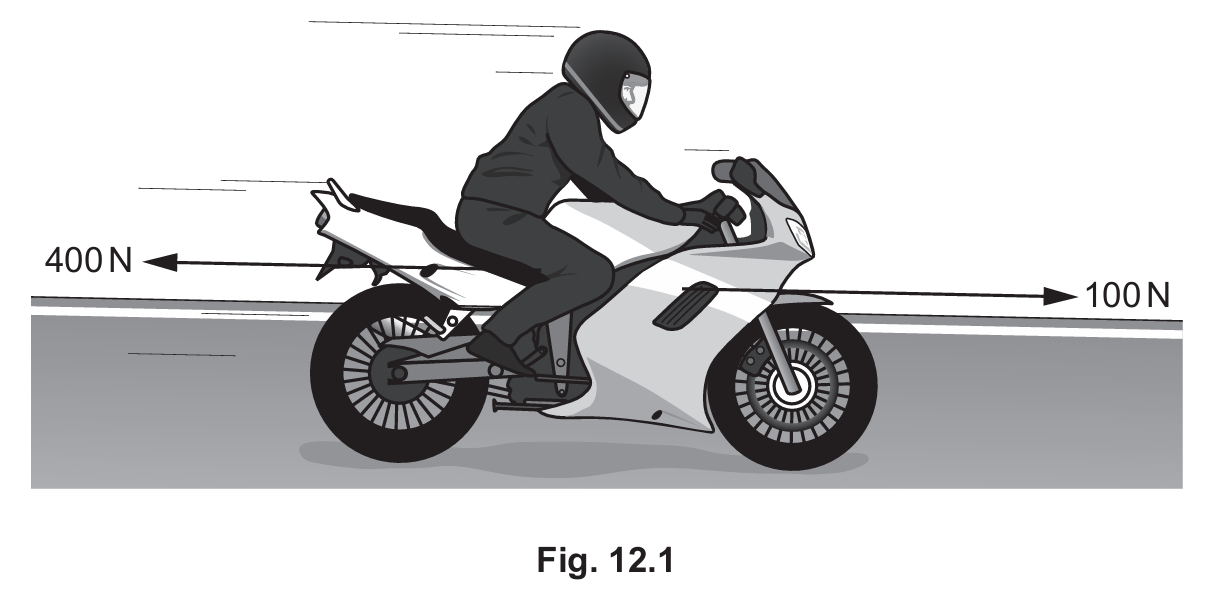
(a)(i) 300 N
Resultant force = forward force − backward force.
\( 400\,\text{N} – 100\,\text{N} = 300\,\text{N} \)
(a)(ii) Slows the motorcycle down
The 100 N backward force is greater relative to direction of travel context in this case the net force opposes motion, decelerating the motorcycle.
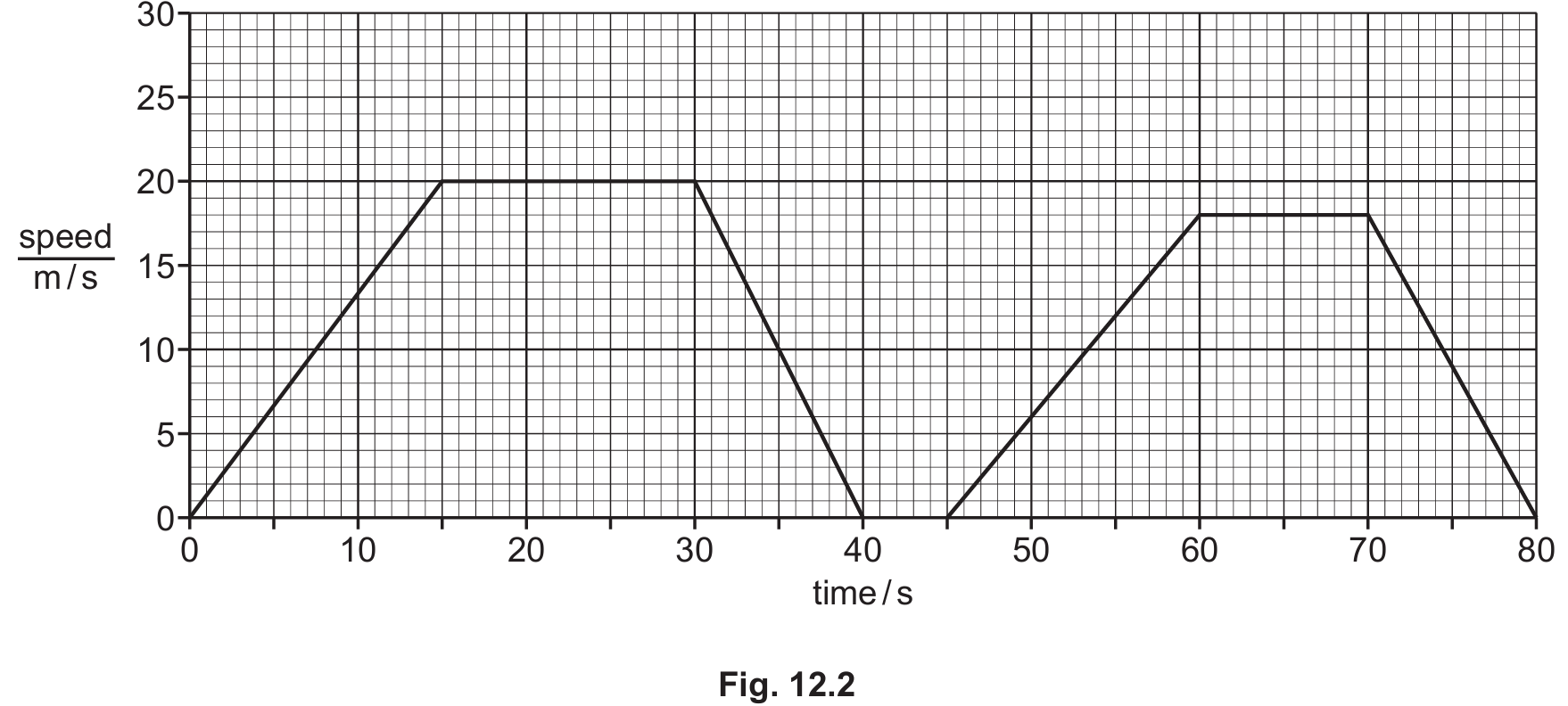
(b)(i) 0 s, 40–45 s, or 80 s
These are the intervals where the speed-time graph reads zero, meaning the motorcycle is stationary.
(b)(ii) Point between 15–30 s or 60–70 s labelled C
A horizontal (flat) section of the graph represents constant speed.
(b)(iii) Point between 0–15 s or 45–60 s labelled S
An upward-sloping section of the graph represents increasing speed (acceleration).
(c) High pitch; large amplitude
Pitch corresponds to frequency — high frequency gives high pitch.
Amplitude corresponds to loudness — a loud sound has a large amplitude.
(d) Increased kinetic energy of molecules; more frequent collisions with tyre wall
As temperature rises, air molecules gain kinetic energy and move faster.
This causes more frequent, more forceful collisions with the tyre’s inner walls, increasing pressure.