
CIE iGCSE Co-Ordinated Science P2.1.3 Pressure changes Exam Style Questions Paper 4
Question
Most-appropriate topic codes (Cambridge IGCSE Co-ordinated Sciences 0654):
• Topic P2.1.2 — Particle model / Gas pressure (Part (a)(i))
• Topic P2.1.2 — Particle model / Temperature and particle motion (Part (a)(ii))
• Topic P2.1.3 — Pressure changes / Gas laws (Part (a)(iii))
• Topic P3.4 — Sound / Speed of sound in different media (Part (b)(i))
• Topic P3.4 — Sound / Ultrasound definition (Part (b)(ii))
• Topic P3.4 — Sound / Ultrasound calculations (Part (b)(iii))
▶️ Answer/Explanation
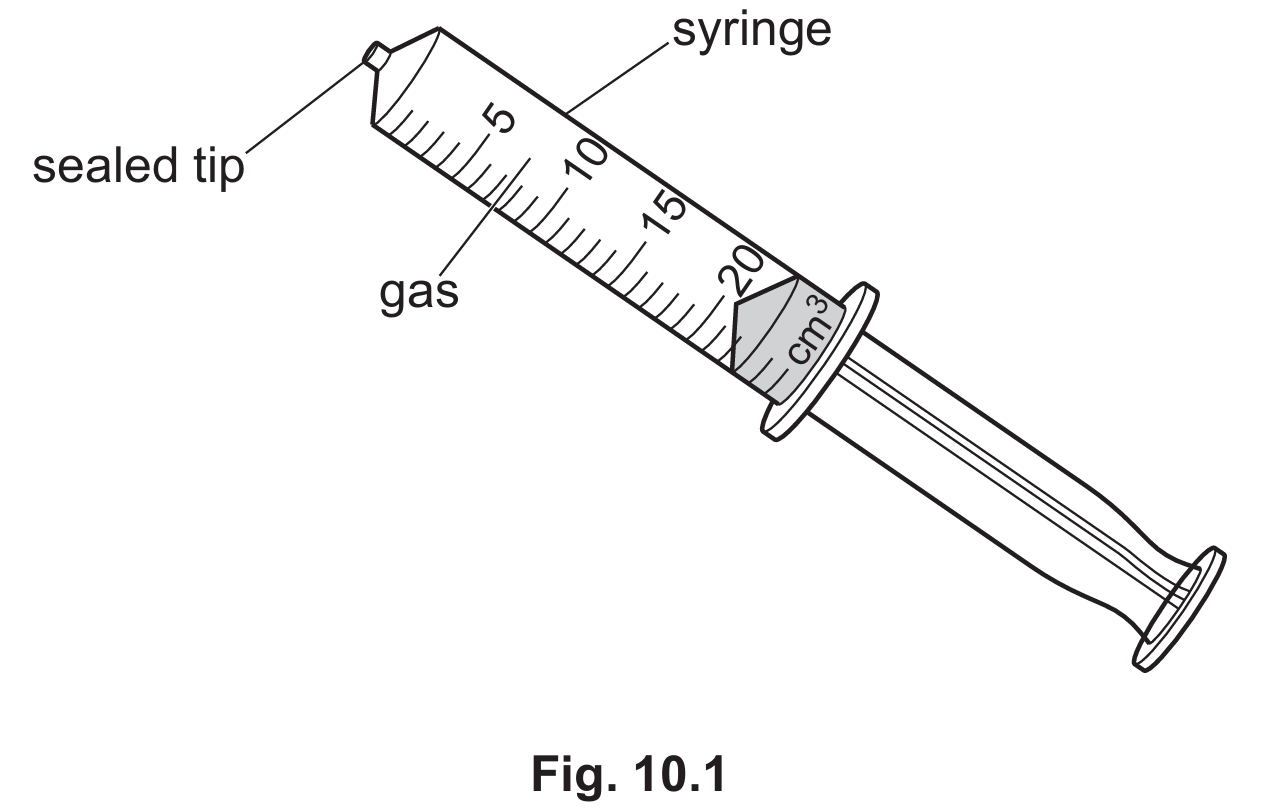
(a)(i) Gas pressure is caused by the collisions of particles with the walls of the container.
Gas particles move randomly in all directions, constantly colliding with the walls of the syringe. Each collision exerts a small force, and the total force per unit area is the gas pressure.
(a)(ii) The average speed of the particles increases.
Heating the gas transfers thermal energy to the particles, increasing their kinetic energy and causing them to move faster on average.
(a)(iii) The particles move faster, so collisions with the walls occur more frequently and with greater force, increasing the pressure.
At constant volume, the particles have less space to move, so the increased speed leads to a higher rate of collisions and a greater force per collision, resulting in higher pressure.
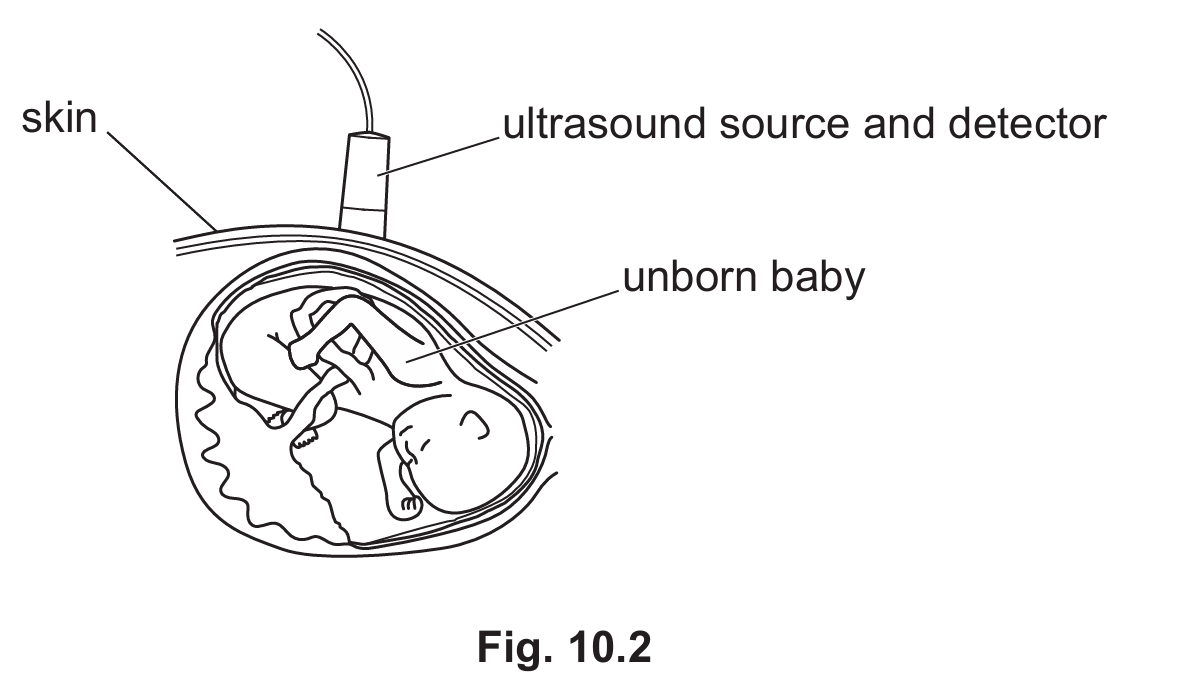
(b)(i) Solid
Sound travels fastest in solids because particles are closely packed together, allowing vibrations to be transferred quickly from particle to particle.
(b)(ii) 20,000 Hz (20 kHz)
Ultrasound is defined as sound waves with frequencies higher than the upper limit of human hearing, which is 20,000 Hz.
(b)(iii)
Step 1: Total distance travelled = speed × time = 1500 × \( 8.0 \times 10^{-5} \) = 0.12 m
Step 2: Depth = total distance ÷ 2 = 0.12 ÷ 2 = 0.060 m
Question
The Sun is the source of energy for all our energy resources except nuclear, ………… and tidal.
State what happens to the pressure of the steam if the temperature of the steam is increased.
The efficiency of the generator is 75%.
Calculate the kinetic energy required to produce \(3600\,\text{J}\) of electrical energy.

Most-appropriate topic codes (Cambridge IGCSE Co-ordinated Sciences 0654, 2025–2027 syllabus):
• Topic P5.1 — The nucleus (Part (a)(i))
• Topic P1.6.3 — Energy resources (Part (a)(ii))
• Topic P2.1.3 — Pressure changes (Part (b))
• Topic P4.5.2 — The a.c. generator (Part (c)(i))
• Topic P1.6.1 — Energy (Part (c)(ii))
• Topic P5.2.3 — Radioactive decay (Part (d))
▶️ Answer/Explanation
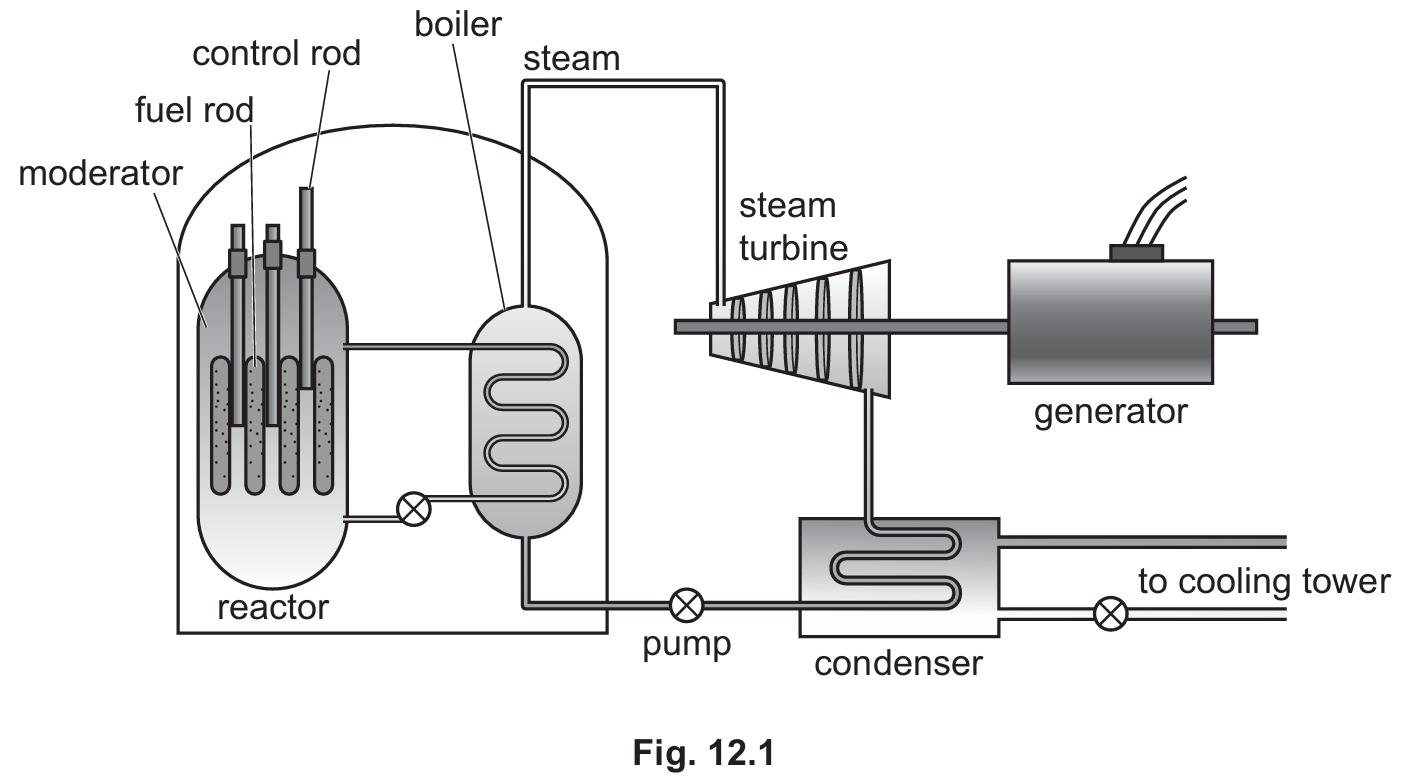
(a)(i) Nuclear fission
In the reactor, uranium nuclei split apart in a process called nuclear fission, releasing large amounts of energy.
(a)(ii) Geothermal
Geothermal energy comes from heat within the Earth, not from the Sun, just like nuclear and tidal energy.
(b)(i) Molecules collide with the walls, exerting a force
Steam molecules move rapidly and randomly within the boiler.
As these molecules collide with the container walls, each collision exerts a small force, and the combined effect of many collisions produces pressure.
(b)(ii) Pressure increases
At constant volume, increasing the temperature increases the average kinetic energy and speed of the molecules.
Faster, more frequent and more forceful collisions with the walls result in increased pressure.
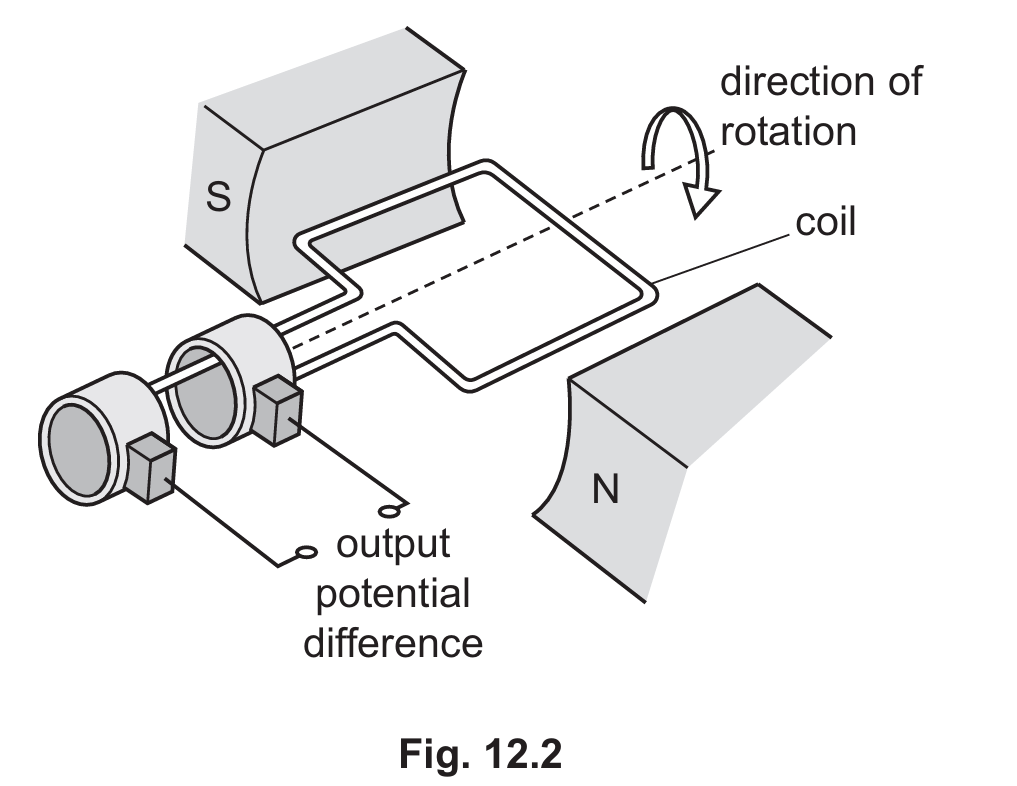
(c)(i) The coil experiences a changing magnetic flux, inducing a p.d.
As the coil rotates within the magnetic field, the magnetic flux passing through it continuously changes.
This changing flux induces an output potential difference across the coil, by electromagnetic induction.
(c)(ii) \(4800\,\text{J}\)
Efficiency \( = \dfrac{\text{output energy}}{\text{input energy}} \times 100\%\).
Rearranging: input (kinetic) energy \( = \dfrac{3600}{75} \times 100 = 4800\,\text{J}\).
(d) \(^{235}_{92}\text{U} \rightarrow\, ^{231}_{90}\text{Th} + \,^{4}_{2}\alpha\)
In alpha decay, the mass number decreases by 4 and the atomic number decreases by 2.
Mass number: \(235 – 4 = 231\); atomic number: \(92 – 2 = 90\), identifying the daughter nuclide as thorium-231.