
▶️ Answer/Explanation
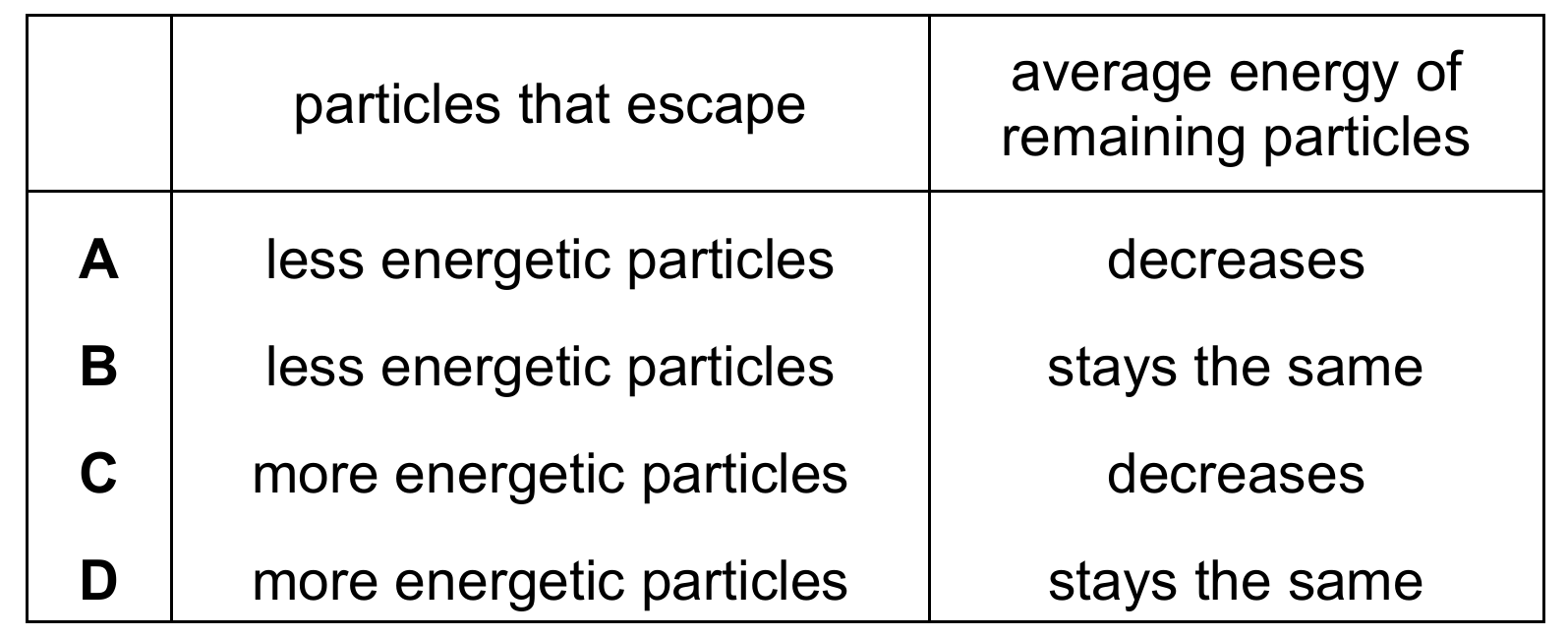
During evaporation, the more energetic (faster-moving) particles at the surface of the liquid have enough kinetic energy to overcome the intermolecular forces and escape into the air. Since these high-energy particles leave, the average kinetic energy of the remaining particles decreases, which results in a drop in temperature (cooling). Therefore, option C correctly shows that more energetic particles escape and the average energy of the remaining particles decreases.
✅ Answer: (C)
✅ Answer: (C)
▶️ Answer/Explanation
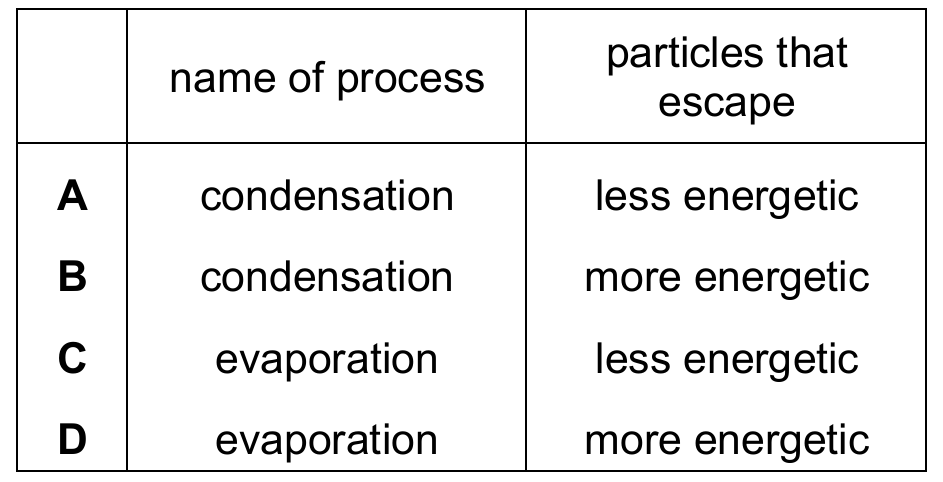
The process is evaporation, which occurs at the surface of a liquid. During evaporation, the most energetic particles (those with the highest kinetic energy) escape from the liquid surface. This removes the most energetic particles, causing the average kinetic energy of the remaining particles to decrease, which results in a decrease in temperature. Condensation is the opposite process where particles gain energy and return to the liquid.
✅ Answer: (D)
✅ Answer: (D)
▶️ Answer/Explanation
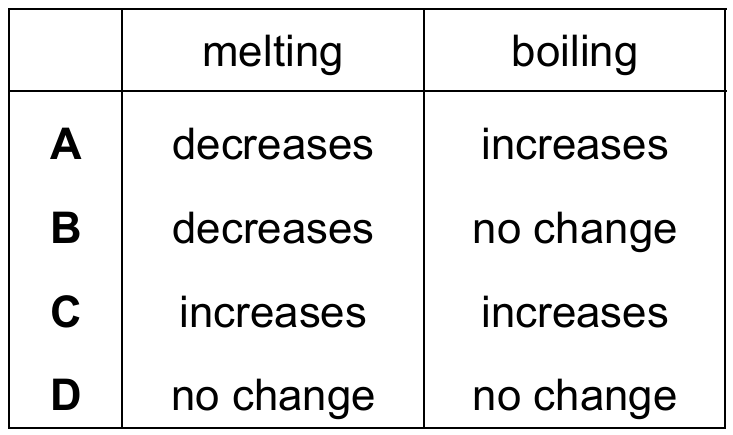
During melting, energy supplied is used entirely to overcome the forces holding particles in a fixed arrangement, not to increase kinetic energy.
The same applies during boiling, where energy breaks intermolecular forces to separate particles into a gas.
Since none of the added energy increases particle kinetic energy during either process, temperature stays constant throughout both melting and boiling.
✅ Answer: (D)
The same applies during boiling, where energy breaks intermolecular forces to separate particles into a gas.
Since none of the added energy increases particle kinetic energy during either process, temperature stays constant throughout both melting and boiling.
✅ Answer: (D)
▶️ Answer/Explanation
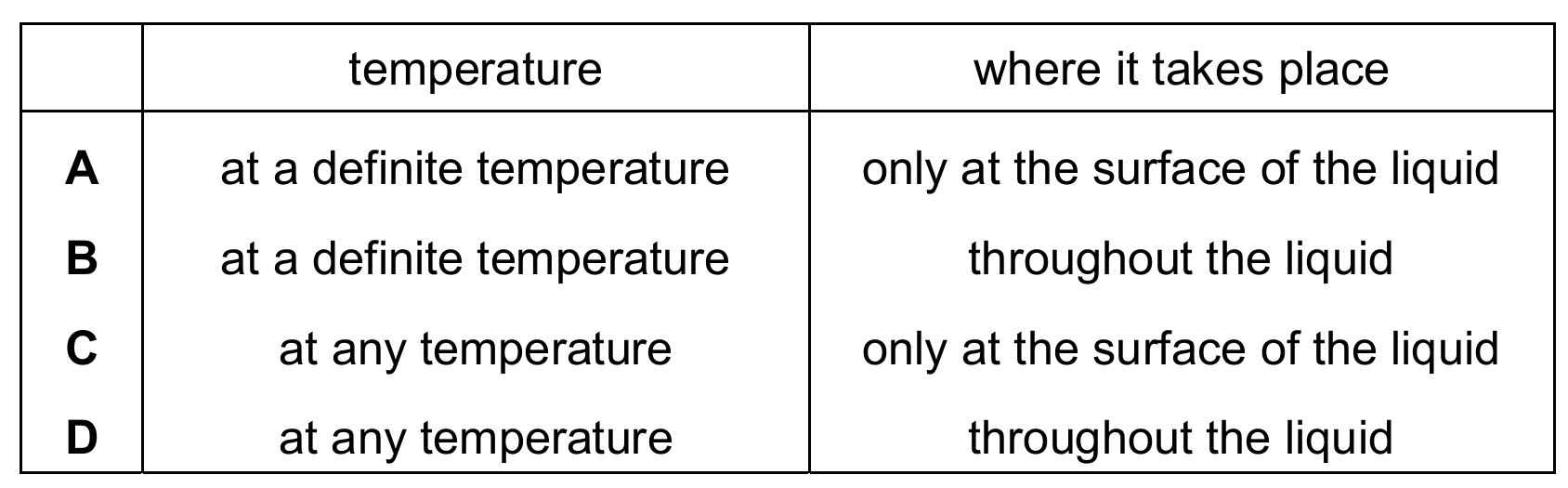
Boiling occurs at a fixed, definite temperature (the boiling point) and takes place throughout the liquid, with bubbles forming inside. Evaporation occurs at any temperature only at the surface.
✅ Answer: (B)
✅ Answer: (B)