
▶️ Answer/Explanation
Thermal conductors are materials that allow thermal energy to pass through them easily. Good thermal conductors are typically metals, as they have delocalised (free) electrons that can transfer energy quickly. Poor thermal conductors (thermal insulators) are materials that do not transfer thermal energy easily, such as gases and non-metals.
Comparing the options:
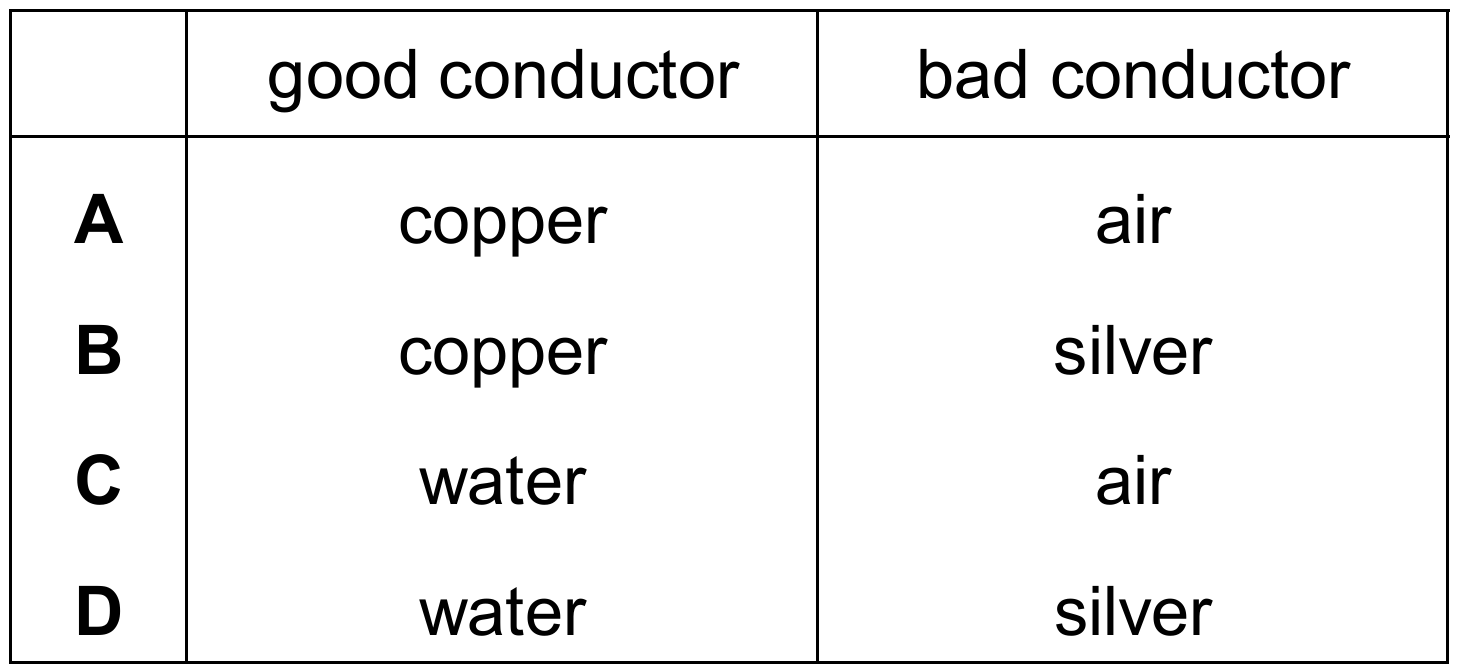
- Copper is a metal and is a very good thermal conductor.
- Air is a gas and is a poor thermal conductor (good thermal insulator).
- Silver is also a good thermal conductor (in fact, it is one of the best), so pairing copper with silver would not show a good and bad conductor.
- Water is a poor conductor compared to metals, but it is a better conductor than air.
Therefore, the row that shows a good thermal conductor (copper) and a bad thermal conductor (air) is row A.
✅ Answer: (A)

▶️ Answer/Explanation
A vacuum prevents both conduction and convection because these methods require particles (atoms, molecules, or fluids) to transfer energy. Since a vacuum contains no particles, there is no medium for conduction or convection to occur. However, radiation does not require a medium and can travel through a vacuum, so it is not prevented. Therefore, the correct option is A.
✅ Answer: (A)
✅ Answer: (A)


▶️ Answer/Explanation
Thermal energy travels through the air to the food in grilling by radiation, since there are no closely-packed particles to transfer energy by conduction or convection currents in this setup.
Thermal energy travels through the metal pan by conduction, as vibrating particles in the solid transfer energy to neighbouring particles.
✅ Answer: (C)
Thermal energy travels through the metal pan by conduction, as vibrating particles in the solid transfer energy to neighbouring particles.
✅ Answer: (C)
▶️ Answer/Explanation
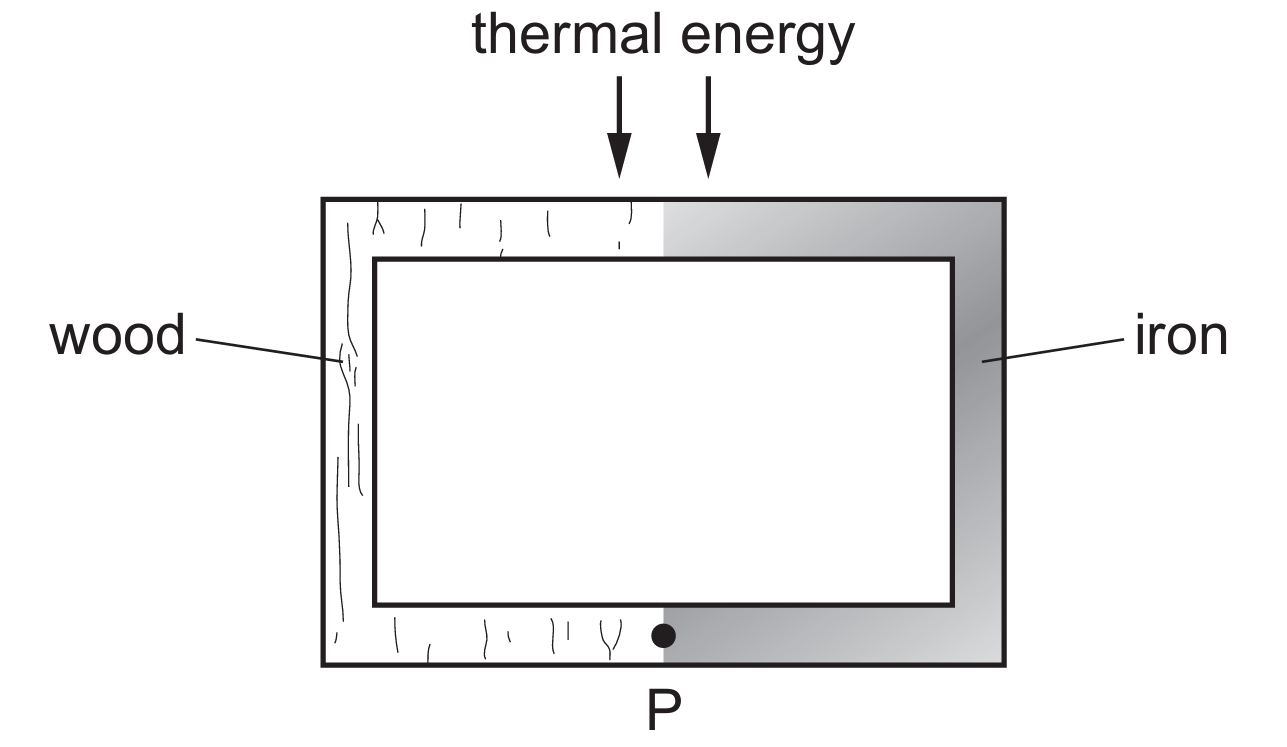
Thermal energy travels through solids by conduction, since convection requires a fluid (liquid or gas) that can circulate, which is not possible in a solid object.
Iron, as a metal, is a good thermal conductor due to its free (delocalised) electrons that transfer energy quickly, whereas wood is a poor conductor (a good insulator).
Most thermal energy therefore reaches point P by conduction through the iron rather than through the wood.
✅ Answer: (A)
Iron, as a metal, is a good thermal conductor due to its free (delocalised) electrons that transfer energy quickly, whereas wood is a poor conductor (a good insulator).
Most thermal energy therefore reaches point P by conduction through the iron rather than through the wood.
✅ Answer: (A)