Home / iGCSE / Coordinated Sciences / P2.3.1 Conduction Paper 2

CIE iGCSE Co-Ordinated Science P2.3.1 Conduction Exam Style Questions Paper 2

Question

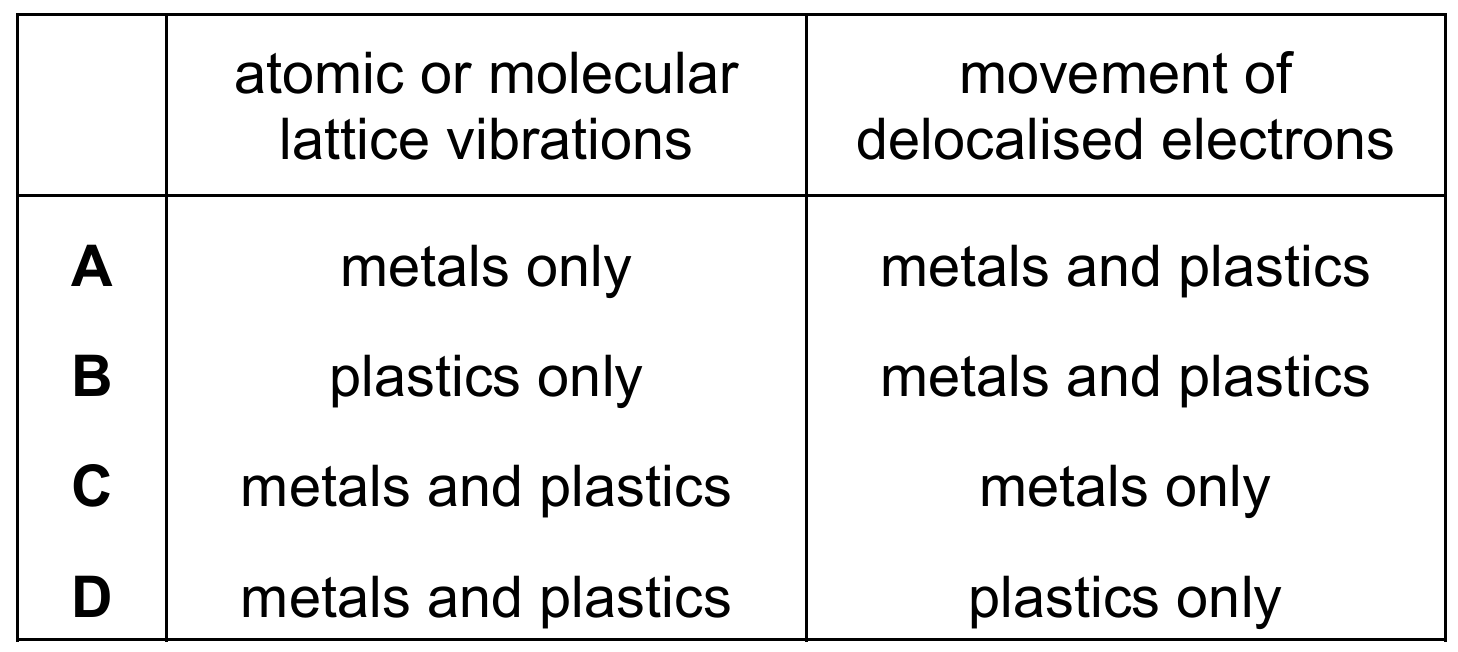
Some materials use atomic or molecular lattice vibrations and some materials use the movement of delocalised electrons for thermal conduction.

Which row shows the correct materials?

▶️ Answer/Explanation
Thermal conduction in solids occurs via lattice vibrations (phonons) in all solids, but metals also have delocalised electrons that transfer energy rapidly. Therefore, lattice vibrations occur in both metals and plastics, while electron movement is mainly in metals. Thus row C is correct.
Answer: (C)

Question

Which statement explains why metals are better thermal conductors than non-metals?

A. Atoms in metals are fixed in a lattice by bonds.
B. Atoms in metals vibrate about fixed positions.
C. Metals contain free electrons.
D. Metals contain free protons.

▶️ Answer/Explanation
Metals contain free (delocalised) electrons that can move freely through the metal lattice.
These electrons gain kinetic energy at the hot end and transfer it quickly through the metal by colliding with other electrons and ions.
Non-metals lack these free electrons, so they can only transfer energy by slower atomic vibrations.
Answer: (C)

Question

Two methods of cooking are grilling under a red-hot heater and frying in a shallow metal pan.

How does thermal energy pass through the air to reach the food in method 1 and how does thermal energy pass through the bottom of the metal pan in method 2?

▶️ Answer/Explanation
In grilling, thermal energy travels through the air from the red-hot heater to the food by infrared radiation, since air is a poor conductor.
In frying, thermal energy passes through the solid metal pan by conduction, as vibrating particles pass energy to neighbouring particles.
Answer: (C)

Question

Solid metals transfer thermal energy by conduction.

Which conduction process occurs only in metals?

A. Atoms move freely through the solid and carry energy.
B. Atoms vibrate about fixed positions and pass energy to neighbouring atoms.
C. Electrons move freely through the solid and carry energy.
D. Electrons vibrate about fixed positions and pass energy to neighbouring electrons.

▶️ Answer/Explanation
In all solids, particles vibrate about fixed positions and pass energy to neighbouring particles by collisions, so option B occurs in all solids, not just metals.
Metals additionally contain free (delocalised) electrons that can move through the structure, carrying thermal energy much more quickly than vibrations alone.
This free movement of electrons, described in option C, is the process unique to metals and explains why metals are much better thermal conductors than non-metals.
Answer: (C)

Question

Four rods have the same dimensions. They are made of four different metals and are all at room temperature.

All the rods are heated equally at one end for the same time.

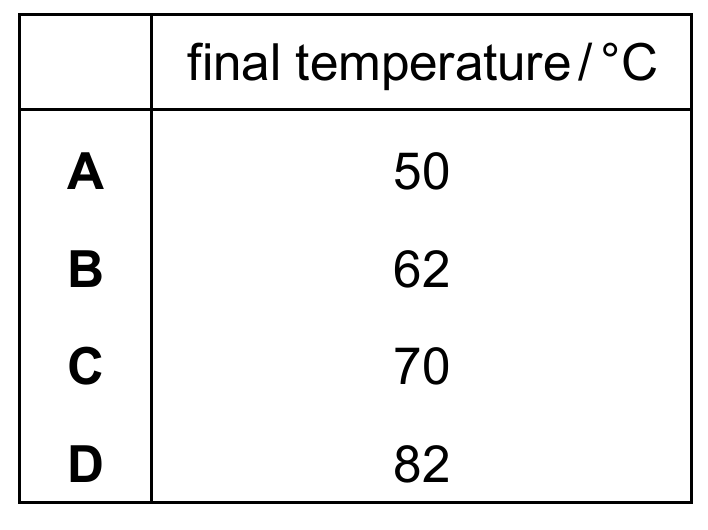
The final temperature of the other end of each rod is shown in the table.

Which rod is the worst conductor of heat?

▶️ Answer/Explanation
The worst conductor of heat will have the lowest final temperature at the other end, as heat is conducted poorly through it. Rod A has the lowest final temperature (50°C), meaning it is the worst conductor. Good conductors would reach higher temperatures at the far end.
Answer: (A)
Scroll to Top