Home / iGCSE / Coordinated Sciences / P2.3.2 Convection Paper 1 |IITIAN ACADEMY

CIE iGCSE Co-Ordinated Science P2.3.2 Convection Exam Style Questions Paper 1

Question

In which situation is convection the main method of thermal energy transfer?

A. heat from a heater on the floor of a room spreading around the room
B. heat from a hot furnace reaching a factory worker standing beside it
C. heat from the hot end of a metal spoon reaching a cook’s hand holding the other end
D. heat from the Sun reaching a worker in a field

▶️ Answer/Explanation

Convection is the transfer of thermal energy by the movement of fluids (liquids or gases) due to density changes caused by heating. Warm fluid becomes less dense and rises, while cooler, denser fluid sinks, creating a circulation current.

Looking at each situation:

  • A. A heater on the floor warms the air around it. The warm air rises, and cooler air moves in to take its place, creating a convection current that spreads heat around the room. This is convection.
  • B. Heat from a furnace reaching a worker is mainly by radiation (infrared waves), as it travels through the air without heating the air itself significantly.
  • C. Heat through a metal spoon is transferred by conduction (through the solid metal).
  • D. Heat from the Sun reaches the Earth by radiation through the vacuum of space.

Therefore, convection is the main method of thermal energy transfer in situation A.

Answer: (A)

Question

The diagram shows a type of double glazing in a window. The double glazing consists of two sheets of glass separated by a vacuum.

Which methods of energy transfer are prevented by the vacuum?

A. conduction and convection only
B. conduction and radiation only
C. convection and radiation only
D. conduction, convection and radiation

▶️ Answer/Explanation
A vacuum prevents both conduction and convection because these methods require particles (atoms, molecules, or fluids) to transfer energy. Since a vacuum contains no particles, there is no medium for conduction or convection to occur. However, radiation does not require a medium and can travel through a vacuum, so it is not prevented. Therefore, the correct option is A.
Answer: (A)

Question

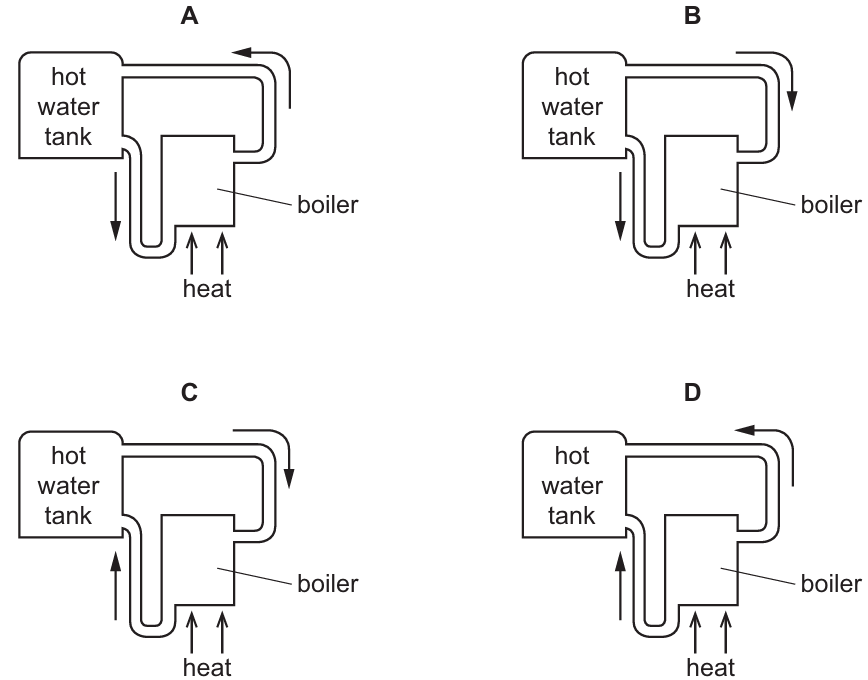
The diagrams show part of a water-heating system which is working by convection.

Which diagram shows the flow of water in the system?

▶️ Answer/Explanation
Water heated near the bottom of the system expands and becomes less dense than the surrounding cooler water.
This warmer, less dense water rises, while cooler, denser water sinks to take its place, setting up a convection current.
The correct diagram shows water rising above the heat source and sinking back down elsewhere to form a continuous loop.
Answer: (A)

Question

A beaker contains water that is all at 20 °C.
A convection current is started in the water, as shown in the diagram.
Four points are labelled W, X, Y and Z.

Which two actions can each, on their own, cause this convection current?

A. cooling the water at W or heating the water at Y
B. cooling the water at W or heating the water at Z
C. cooling the water at X or heating the water at Y
D. cooling the water at X or heating the water at Z

▶️ Answer/Explanation
In the diagram, water rises on the right side and sinks on the left; this can be driven by heating at point Z (bottom right, making water less dense so it rises) or by cooling at point X (top left, making water denser so it sinks).
Both actions independently set up the same clockwise circulation pattern shown, confirming option D is correct.
Answer: (D)

Question

In which of the three states of matter is convection the main method of thermal energy transfer?

A. liquids and gases
B. liquids only
C. solids and liquids
D. solids only

▶️ Answer/Explanation
Convection relies on particles being free to move and carry thermal energy with them as they circulate.
This free movement of particles happens in liquids and gases (fluids), where particles can flow.
In solids, particles are fixed in place and cannot circulate, so convection does not occur there.
Answer: (A)
Scroll to Top