
CIE iGCSE Co-Ordinated Science P2.3.2 Convection Exam Style Questions Paper 3
Question
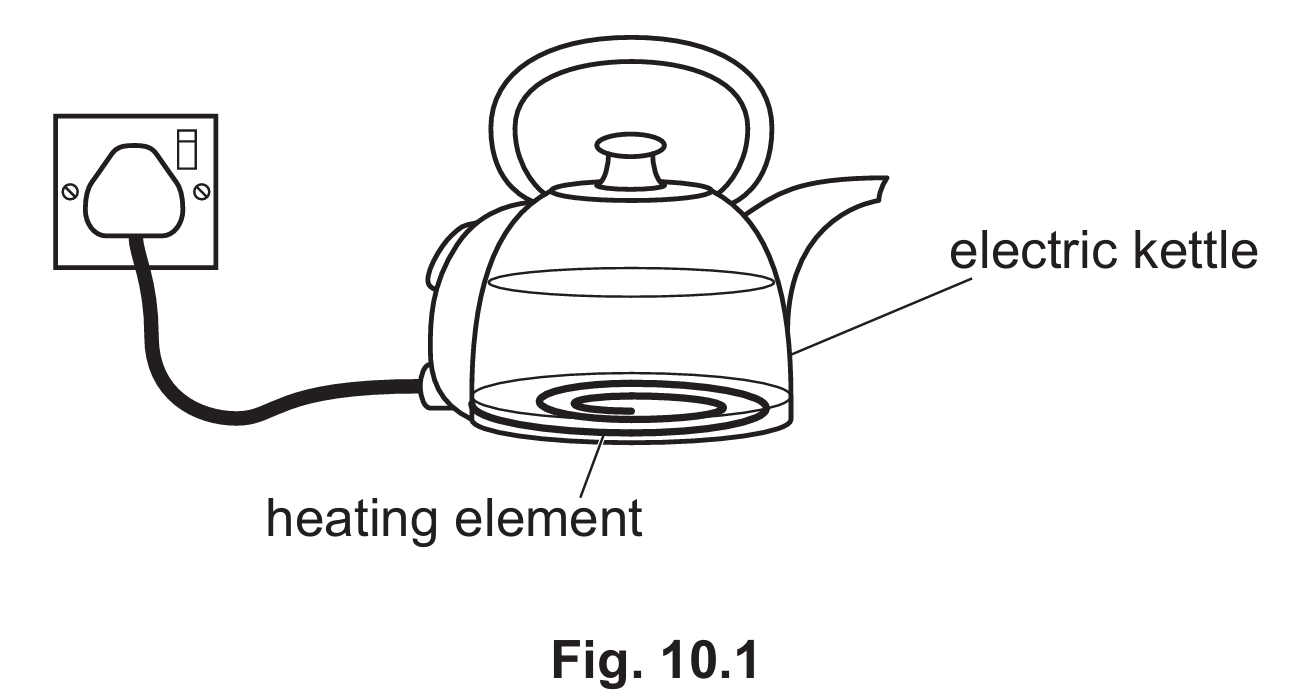
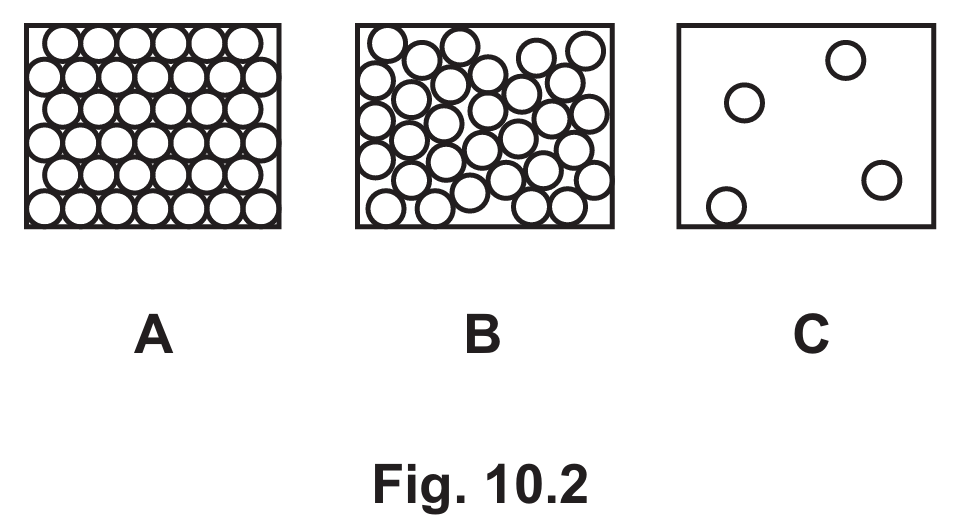
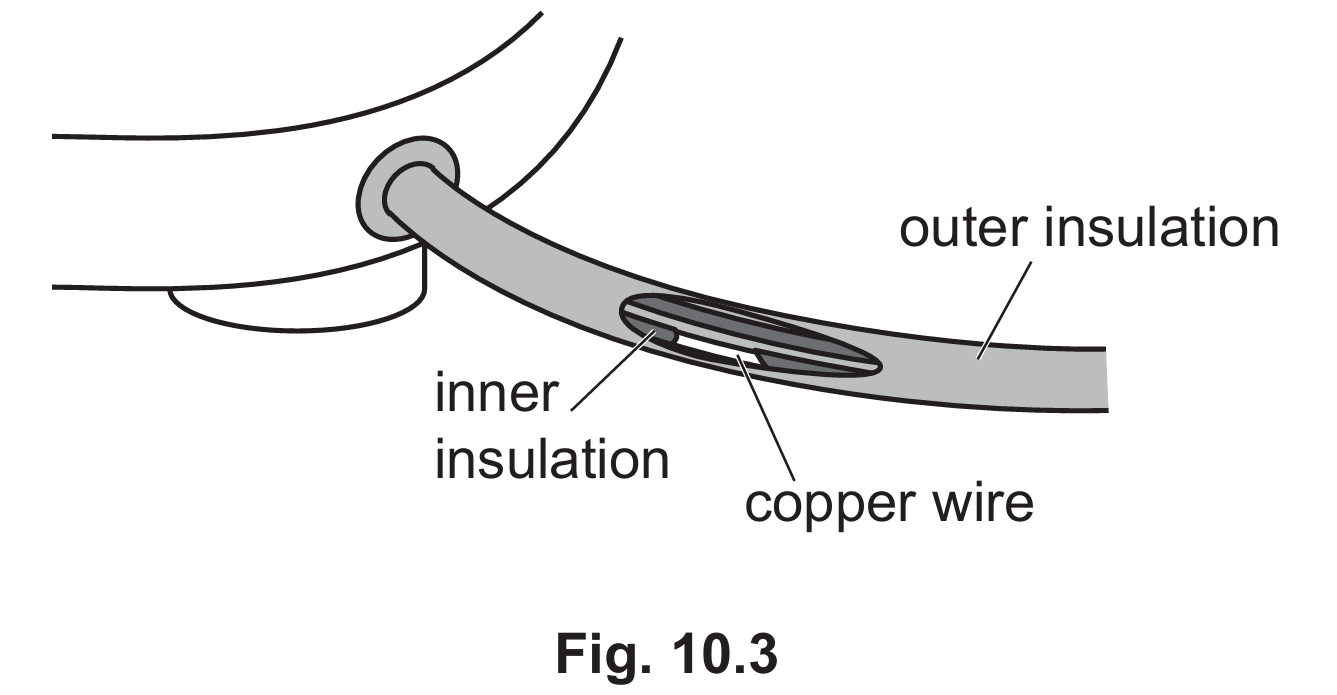
Most-appropriate topic codes (Cambridge IGCSE Coordinated Sciences 0654):
• Topic P2.3.2 — Convection (Part (a))
• Topic P2.1.1 — States of matter (Part (b))
• Topic P4.2.5 — Electrical energy and electrical power (Part (c)(i), (c)(ii), (c)(iii))
• Topic P4.4 — Electrical safety (Part (d))
▶️ Answer/Explanation
(a) convection
Convection is the transfer of thermal energy in fluids (liquids and gases) by the movement of the fluid itself. Heated water rises and cooler water sinks, creating convection currents.
(b) (gas is diagram) C and (liquid is diagram) B
In a gas (C), particles are far apart and move randomly. In a liquid (B), particles are close together but can slide past each other.
(c)(i) P = IV (in any form) OR (current =) 3000/240; 12.5 (A)
Using P = IV, I = P/V = 3000/240 = 12.5 A.
(c)(ii) energy = power × time (in any form); conversion of minutes to hours; conversion of W to kW; (= 0.5 kWh)
Energy = 3000 W × (10/60) h = 3.0 kW × 0.167 h = 0.5 kWh.
(c)(iii) ($) 0.25
Cost = 0.5 kWh × $0.50/kWh = $0.25.
(d) insulation damaged / exposed (live) wire; electric shock
Damaged insulation exposes live wires. If a person touches the exposed wire, they may receive an electric shock, which can be fatal as current passes through the body.
Question
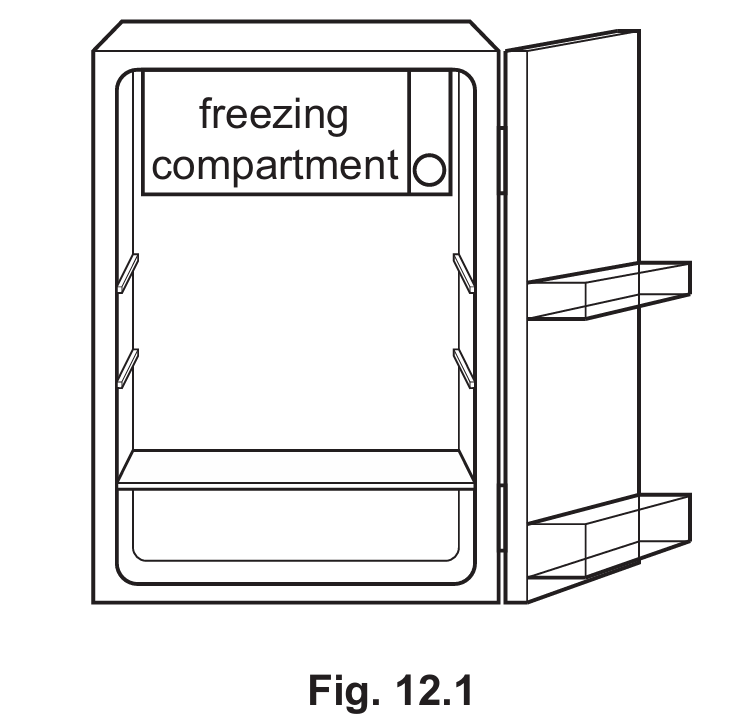
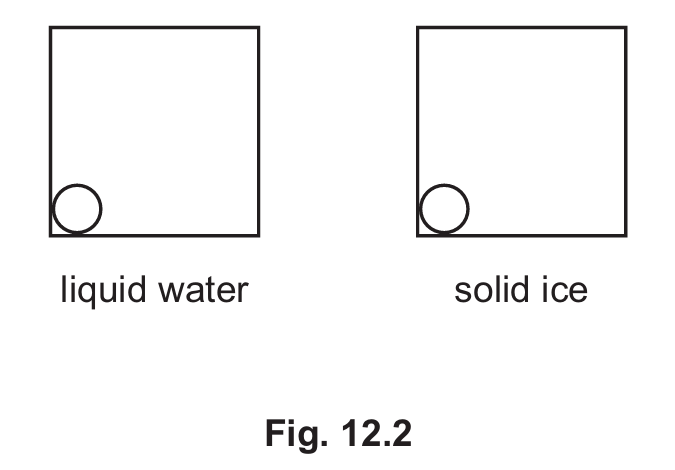
One molecule has been drawn for you in each box.
Each box must contain at least 9 molecules.
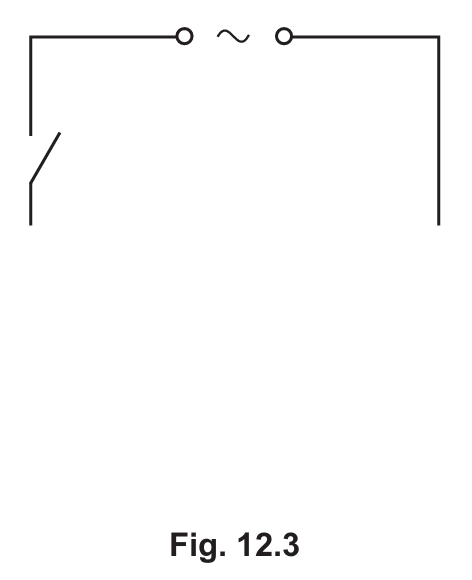
- power two lamps connected in series inside the refrigerator
- power an electric motor connected in parallel with the two lamps.
Most-appropriate topic codes (Cambridge IGCSE Co-ordinated Sciences 0654):
• Topic P2.3.2 — Convection (Part (a))
• Topic P2.2.2 — Melting, boiling and evaporation (Part (b)(i))
• Topic P2.1.2 — Particle model (Part (b)(ii))
• Topic P4.3.2 — Series and parallel circuits (Part (c)(i))
• Topic P4.2.4 — Resistance (Part (c)(ii))
▶️ Answer/Explanation
(a) arrow drawn downwards from the freezing compartment
The air in contact with the freezing compartment is cooled, becomes denser, and sinks downwards. Warmer air at the bottom rises to replace it, creating a convection current. The arrow should show the cooled air moving downwards within the refrigerator.
(b)(i) 0°C
The freezing point of pure water at standard atmospheric pressure is 0°C. At this temperature, liquid water changes state to solid ice.
(b)(ii) Liquid water: at least 9 particles touching, randomly arranged; Solid ice: at least 9 particles touching, regularly arranged in a lattice structure
In liquid water, the molecules are close together (touching) but have a random arrangement as they can move past each other. In solid ice, the molecules are held in fixed positions in a regular, ordered lattice structure, with a specific arrangement (often drawn as a hexagonal pattern).
(c)(i) Circuit diagram should show:
- Correct circuit symbols for the two lamps and the motor
- The two lamps connected in series with each other (one after the other in the same branch)
- The motor connected in parallel with the lamps (in a separate branch)
(c)(ii) 9000 Ω
For resistors connected in series: total resistance = R₁ + R₂ + …
Combined resistance = 6000 Ω + 3000 Ω = 9000 Ω.