
CIE iGCSE Co-Ordinated Science P2.3.2 Convection Exam Style Questions Paper 4
Question
Most-appropriate topic codes (Cambridge IGCSE Co-ordinated Sciences 0654):
• Topic P6.2.2 — Life cycle of stars (Part (a))
• Topic P6.2.1 — The Sun as a star (Part (b)(i))
• Topic P2.3.2 — Convection (Part (b)(ii))
• Topic P2.3.3 — Radiation (Part (b)(iii))
• Topic P6.2.3 — Galaxies and the Universe (Part (c))
▶️ Answer/Explanation
(a) New stars, planets, or protostars may form from a nebula.
The material from a supernova explosion forms a nebula (cloud of gas and dust), which can collapse under gravity to form new stars and planetary systems.
(b)(i) Energy release in a star:
• Energy is released by nuclear fusion.
• Hydrogen nuclei fuse together to form helium nuclei.
• This process releases vast amounts of energy in the form of electromagnetic radiation (including light and heat).
(b)(ii) Convection in the Sun’s outer layers:
• Hot gas near the core becomes less dense and rises.
• As it rises, it cools and becomes more dense.
• The cooled gas sinks back down, creating convection currents that transfer energy outward.
(b)(iii) Surface design to limit temperature:
• Colour: White or silver (to reflect most incident radiation)
• Texture: Shiny or smooth (to reduce absorption of radiation)
Light colours reflect more radiation (poor absorbers), while shiny surfaces are poor emitters of thermal radiation.
(c) Completed sentences:
The Universe initially expanded from a place of high density (or temperature).
The Universe is still expanding.
The Universe is approximately 13.8 billion years old.
Question
Topic codes:
• Topic P2.2.2 — Melting, boiling and evaporation (Part (a))
• Topic P2.3.2 — Convection (Part (b))
▶️ Answer/Explanation
(a)(i) Similarity: Both boiling and evaporation are changes of state from liquid to gas.
Difference 1: Boiling occurs at the boiling point, while evaporation occurs below the boiling point.
Difference 2: Boiling occurs throughout the liquid (forms bubbles), while evaporation occurs only at the surface of the liquid.
(a)(ii) Three factors which increase the rate of evaporation:
1. Increased temperature (particles have more kinetic energy, more can escape)
2. Increased surface area (more particles at the surface can escape)
3. Increased air movement over the liquid surface (removes vapour, maintaining a steep concentration gradient)
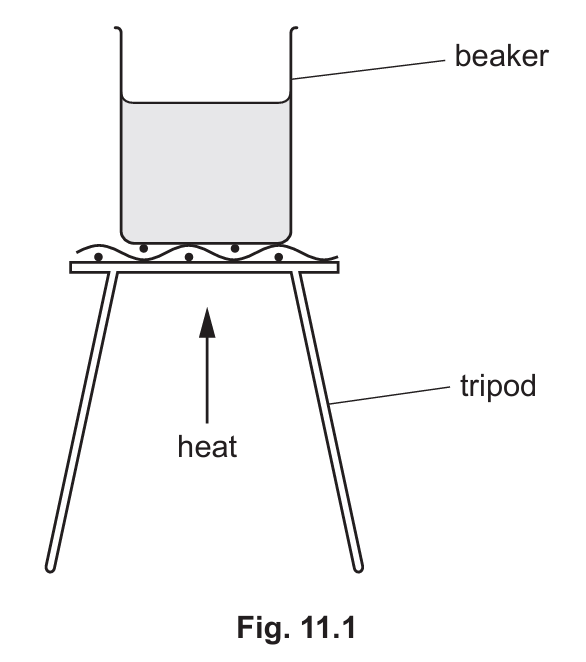
(b) Convection in the beaker of water:
The heated water at the bottom becomes less dense (as it expands).
This less dense water rises to the top.
The cooler, more dense water sinks to the bottom, where it is heated and the cycle repeats, creating a convection current.
This circulation transfers thermal energy throughout the water, causing all the water in the beaker to increase in temperature.