
CIE iGCSE Co-Ordinated Science P2.3.4 Consequences of thermal energy transfer Exam Style Questions Paper 4
Question
Calculate the frequency of this infrared radiation.
Describe the process of conduction in a metal.
Most-appropriate topic codes (Cambridge IGCSE Co-ordinated Sciences 0654, 2025–2027 syllabus):
• Topic P2.3.4 — Consequences of thermal energy transfer (Parts (a)(i), (a)(ii), (a)(iv))
• Topic P3.1 — General properties of waves (Part (a)(iii))
• Topic P4.2.3 — Voltage (electromotive force and potential difference) (Part (b))
▶️ Answer/Explanation
(a)(i)
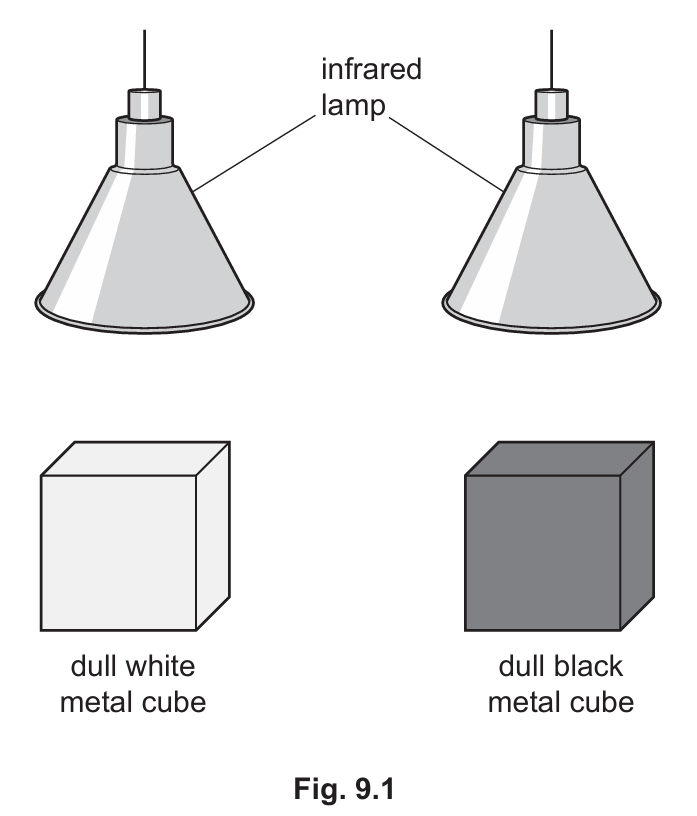
The dull black cube absorbs infrared (thermal) radiation better than the dull white cube.
Black, dull surfaces are better absorbers of radiation than white or shiny surfaces.
Since more radiation is absorbed, the dull black cube gains more thermal energy and its temperature rises more.
(a)(ii)
The shiny black cube reflects more radiation than the dull black cube, rather than absorbing it.
Shiny surfaces are poor absorbers (good reflectors) of infrared radiation, regardless of colour.
Therefore less energy is absorbed by the shiny black cube, so its temperature rises less than the dull black cube.
(a)(iii)
Convert wavelength: \( \lambda = 0.75 \text{ mm} = 0.75 \times 10^{-3} \text{ m} \).
Use \( v = f\lambda \), so \( f = \frac{v}{\lambda} = \frac{3.0 \times 10^8}{0.75 \times 10^{-3}} \).
\( f = \mathbf{4.0 \times 10^{11}} \textbf{ Hz} \).
(a)(iv)
Thermal energy is conducted in metals by the vibration of ions/atoms — when heated, ions vibrate more vigorously and pass these vibrations on to neighbouring ions.
In addition, free (delocalised) electrons in the metal gain kinetic energy and move through the metal, transferring energy from hotter regions to cooler regions.
The electrons moving through the metal make conduction much faster in metals than in non-metals.
(b)(i)
A thermocouple consists of two different metal wires joined at two junctions.
When the two junctions are at different temperatures, a voltage (e.m.f.) is produced that varies with the temperature difference.
This e.m.f. is measured and used to determine the temperature.
(b)(ii)
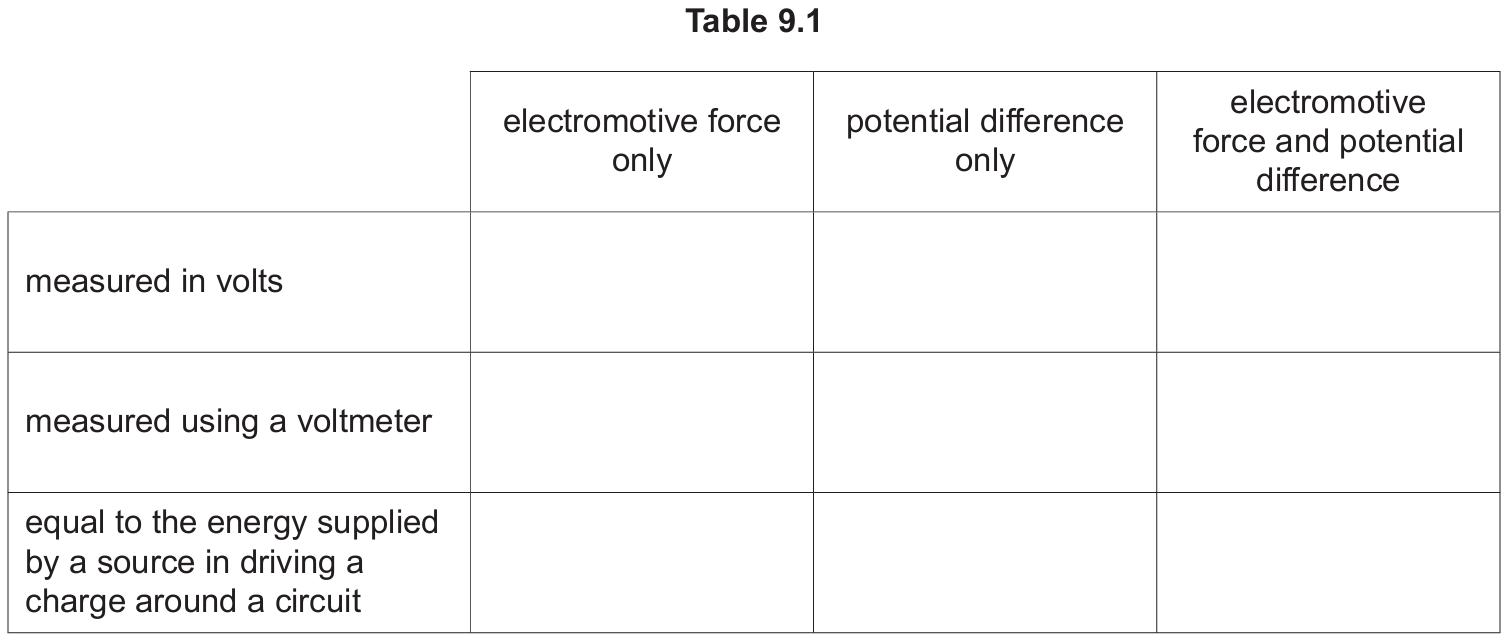
Measured in volts: in electromotive force and potential difference column — both e.m.f. and p.d. are measured in volts (V).
Measured using a voltmeter: in electromotive force and potential difference column — both can be measured with a voltmeter.
Equal to the energy supplied by a source in driving a charge around a circuit: in electromotive force only column — this is the definition of e.m.f. specifically; p.d. refers to energy transferred per unit charge between two points in a circuit.