Home / iGCSE / Coordinated Sciences / P3.1 General properties of waves Paper 2

CIE iGCSE Co-Ordinated Science P3.1 General properties of waves Exam Style Questions Paper 2

Question

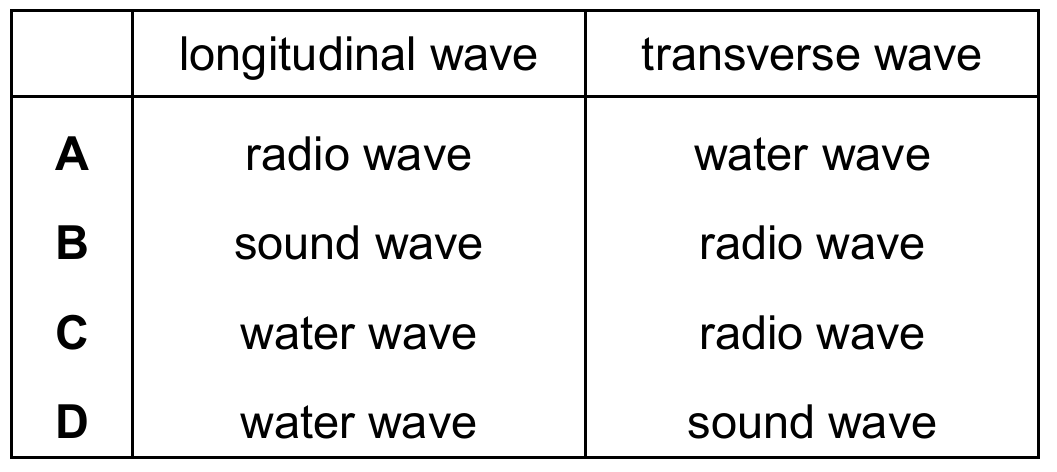
Which row contains an example of a longitudinal wave and an example of a transverse wave?

▶️ Answer/Explanation
Sound waves are longitudinal waves because the particles vibrate parallel to the direction of energy transfer. Radio waves are transverse waves because the oscillations are perpendicular to the direction of propagation. Option B correctly pairs sound wave (longitudinal) with radio wave (transverse).
Answer: (B)

Question

A wave has a frequency of \(3.0\text{ MHz}\) and a speed of \(1500\text{ m/s}\).

What is the wavelength of the wave?

A. \(5.0 \times 10^{-4}\text{ m}\)  
B. \(0.50\text{ m}\)  
C. \(500\text{ m}\)  
D. \(4500\text{ m}\)

▶️ Answer/Explanation
Rearranging \(v = f\lambda\) gives \(\lambda = \frac{v}{f}\).
Converting frequency: \(f = 3.0 \times 10^6\text{ Hz}\), so \(\lambda = \frac{1500}{3.0 \times 10^6} = 5.0 \times 10^{-4}\text{ m}\).
Answer: (A)

Question

A water wave passes point Y.

A student counts how many wave crests pass point Y in 30 seconds.

Using only this information, what can the student calculate?

A. the amplitude of the wave
B. the frequency of the wave
C. the speed of the wave
D. the wavelength of the wave

▶️ Answer/Explanation
Frequency is defined as the number of complete waves (crests) passing a point per second.
Counting the number of crests passing in 30 seconds and dividing by 30 gives exactly this value.
Amplitude, wavelength and speed all require additional measurements (such as distance) that were not given here.
Answer: (B)

Question

A loudspeaker produces a sound wave that has a frequency of 3300 Hz. The speed of sound in air is 330 m/s.

What is the wavelength of the sound wave?

A. 0.10 m
B. 1.0 m
C. 11 m
D. \(1.1 \times 10^6\) m

▶️ Answer/Explanation
The wave speed equation is \( v = f\lambda \), which rearranges to \( \lambda = \frac{v}{f} \).
Substituting the values gives \( \lambda = \frac{330}{3300} \).
This works out to \( \lambda = 0.10 \) m.
Answer: (A)

Question

A wave passes a rock in the sea. Five complete wavelengths pass the rock in \(20\text{ s}\).

What is the frequency of this wave?

A. \(0.25\text{ Hz}\)
B. \(4.0\text{ Hz}\)
C. \(15\text{ Hz}\)
D. \(100\text{ Hz}\)

▶️ Answer/Explanation
Frequency is the number of complete waves passing a point per second. \(f = 5/20 = 0.25\text{ Hz}\).
Answer: (A)
Scroll to Top