Home / iGCSE / Coordinated Sciences / P3.2.2 Refraction of light Paper 2

CIE iGCSE Co-Ordinated Science P3.2.2 Refraction of light Exam Style Questions Paper 2

Question

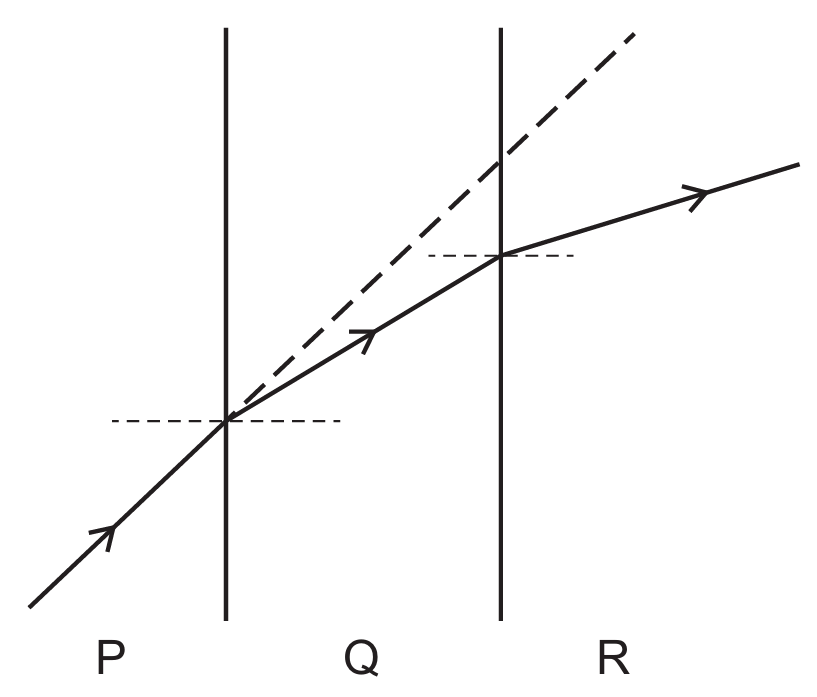
The diagram shows a ray of light passing from medium P to medium Q and then to medium R. The speeds of light in each of the mediums P, Q and R are \(c_{\mathrm{P}}\), \(c_{\mathrm{Q}}\) and \(c_{\mathrm{R}}\) respectively.

Which list compares the speeds of light in the three mediums in order from lowest to highest?

A. \(c_{\mathrm{P}} \rightarrow c_{\mathrm{Q}} \rightarrow c_{\mathrm{R}}\)
B. \(c_{\mathrm{P}} \rightarrow c_{\mathrm{R}} \rightarrow c_{\mathrm{Q}}\)
C. \(c_{\mathrm{Q}} \rightarrow c_{\mathrm{P}} \rightarrow c_{\mathrm{R}}\)
D. \(c_{\mathrm{R}} \rightarrow c_{\mathrm{Q}} \rightarrow c_{\mathrm{P}}\)

▶️ Answer/Explanation
The ray bends towards the normal at both interfaces, indicating that the light slows down each time it enters a new medium. Thus speed is greatest in P, less in Q, and least in R. Therefore the order from lowest to highest speed is c_R, c_Q, c_P. Option D.
Answer: (D)

Question

Which statement describes the term critical angle?

A. the largest angle of incidence in a denser medium for which refraction into a less dense medium occurs
B. the largest angle of incidence in a less dense medium for which refraction into a denser medium occurs
C. the smallest angle of incidence in a denser medium for which refraction into a less dense medium occurs
D. the smallest angle of incidence in a less dense medium for which refraction into a denser medium occurs

▶️ Answer/Explanation
The critical angle is the largest angle of incidence in a denser medium for which refraction into a less dense medium still occurs. At this angle, the refracted ray travels along the boundary (angle of refraction = 90°). Any angle of incidence greater than the critical angle results in total internal reflection. This definition applies only when light travels from a denser to a less dense medium, so option A is correct. The other options describe angles in the less dense medium or use the wrong definition.
Answer: (A)

Question

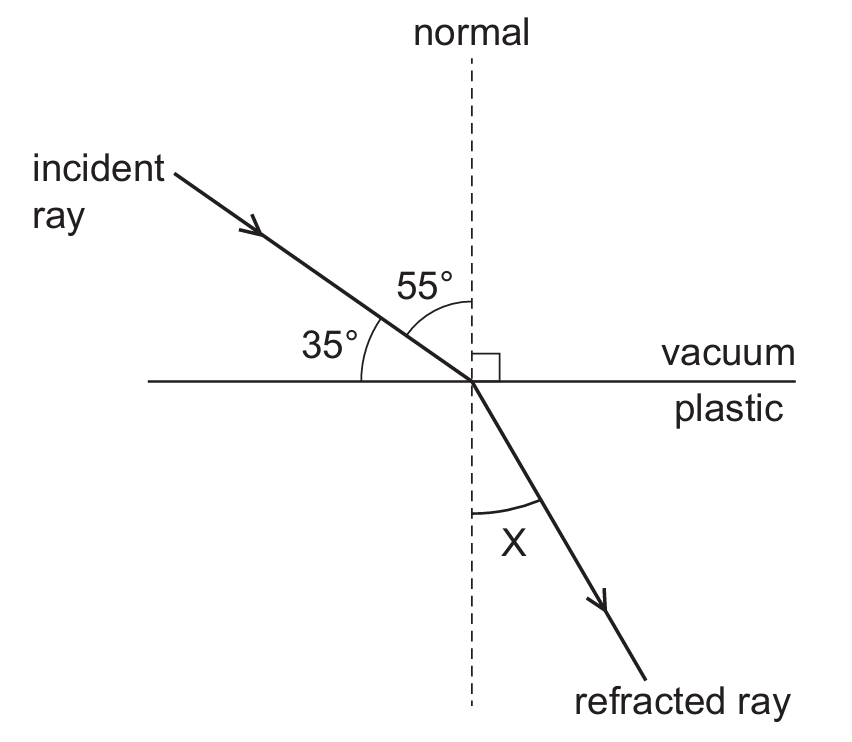
The diagram shows a ray of light that passes from a vacuum into plastic.

The plastic has a refractive index of 1.5.

An angle X is labelled on the diagram.

What is angle X?

A. 22°
B. 23°
C. 33°
D. 37°

▶️ Answer/Explanation
Using Snell’s law: \(n = \frac{\sin i}{\sin r}\). Here, \(n = 1.5\) and the angle of incidence \(i = 55^\circ\) (measured from the normal). Substituting: \(1.5 = \frac{\sin 55^\circ}{\sin X}\). Rearranging: \(\sin X = \frac{\sin 55^\circ}{1.5} = \frac{0.819}{1.5} \approx 0.546\). Taking the inverse sine: \(X = \sin^{-1}(0.546) \approx 33^\circ\).
Answer: (C)

Question

When light passes from air into glass its speed decreases but its frequency remains constant.

Light travelling in air enters a glass block at an angle of incidence that is greater than 0°.

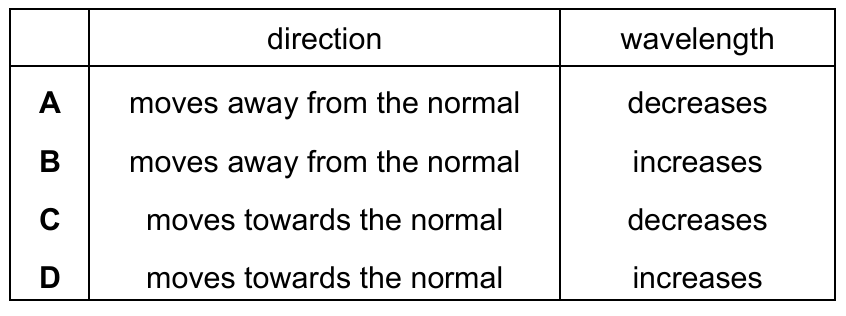
Which row describes what happens to the direction and what happens to the wavelength of the light?

▶️ Answer/Explanation
Glass is optically denser than air, so light entering it at a non-zero angle of incidence bends towards the normal.
Using (v = f\lambda), since frequency stays constant and speed decreases in glass, wavelength must also decrease.
So the light both bends towards the normal and has a decreased wavelength.
Answer: (C)

Question

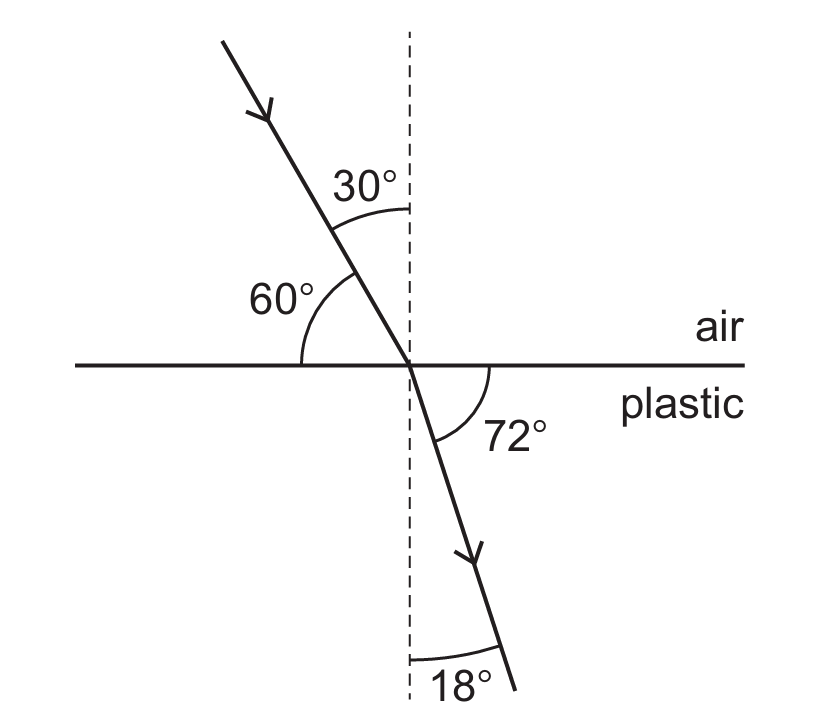
The diagram shows a ray of light passing from air into plastic. The sizes of four angles are given.

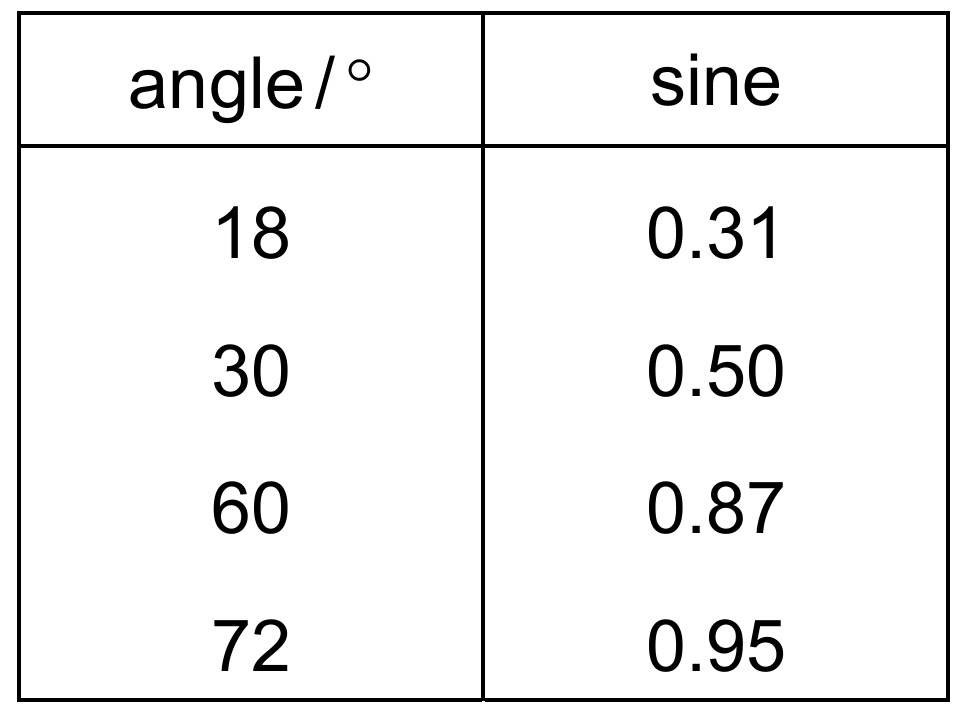
The table gives the value of the sine of each angle.

What is the refractive index of the plastic?

A. \(0.62\)  
B. \(0.92\)  
C. \(1.6\)  
D. \(1.7\)

▶️ Answer/Explanation
The angle in air (\(60^\circ\)) is the angle of incidence, and the angle in plastic (\(30^\circ\)) is the angle of refraction.
\(n = \frac{\sin 60^\circ}{\sin 30^\circ} = \frac{0.87}{0.50} = 1.6\).
Answer: (C)
Scroll to Top