
▶️ Answer/Explanation
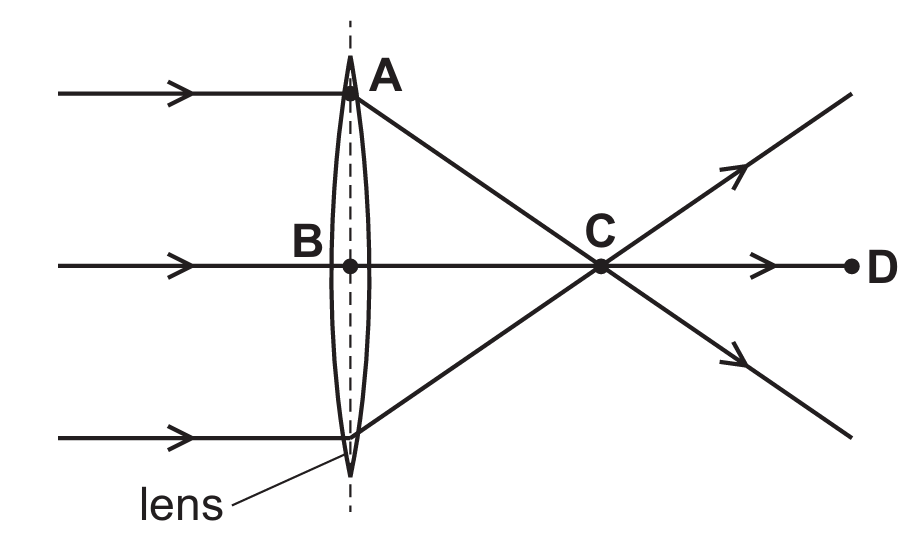
The principal focus (or focal point) of a converging lens is the point on the principal axis where rays of light that are parallel to the principal axis converge (meet) after passing through the lens.
In the diagram, parallel rays of light enter the lens from the left. After passing through the lens, they are refracted and converge at a single point on the right side of the lens. This point is labelled C in the diagram.
Point A is on the left side of the lens, point B is between the lens and the focal point, and point D is beyond the focal point. Only point C is where the rays actually converge, so it is the principal focus.
✅ Answer: (C)
▶️ Answer/Explanation
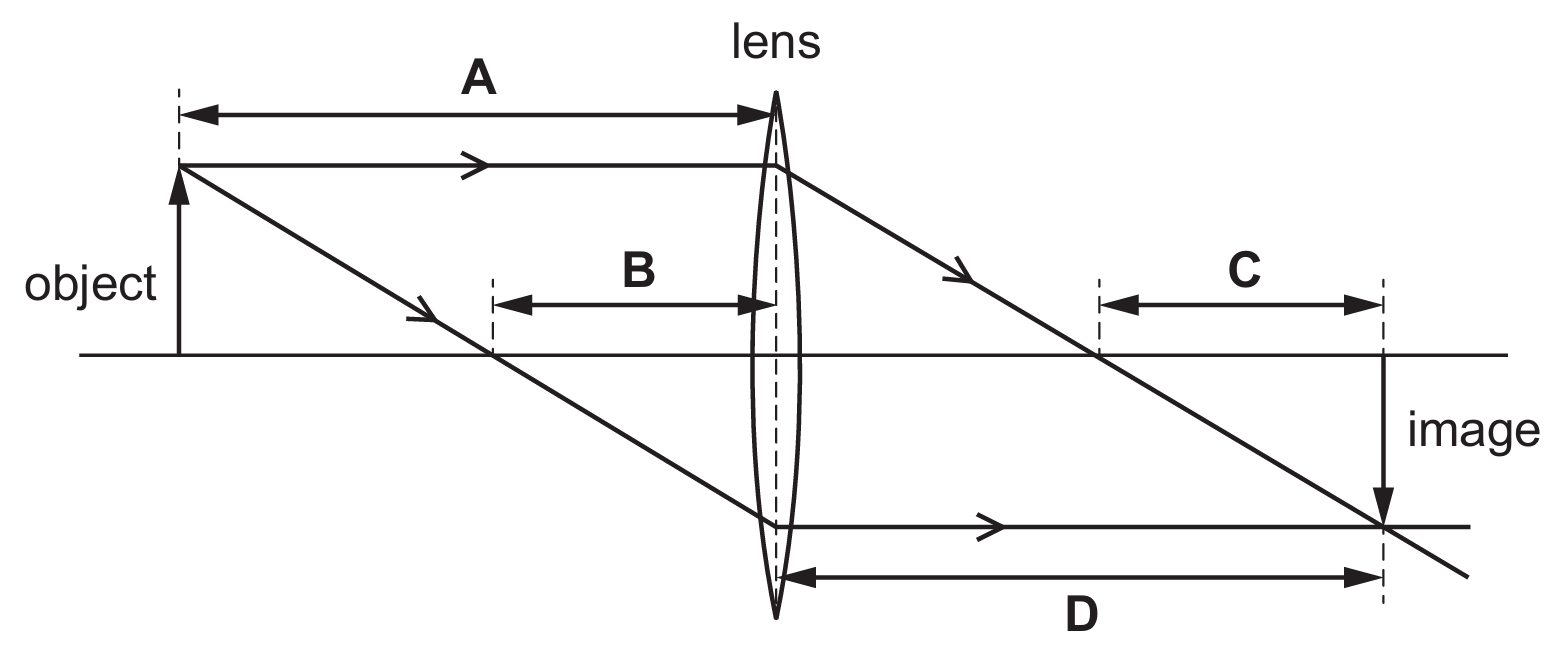
The focal length is the distance between the centre of the lens and the principal focus (focal point). In the diagram, this is the distance from the lens to where the rays converge after passing through the lens. The other labelled distances represent object distance and image distance.
✅ Answer: (B)
✅ Answer: (B)
▶️ Answer/Explanation
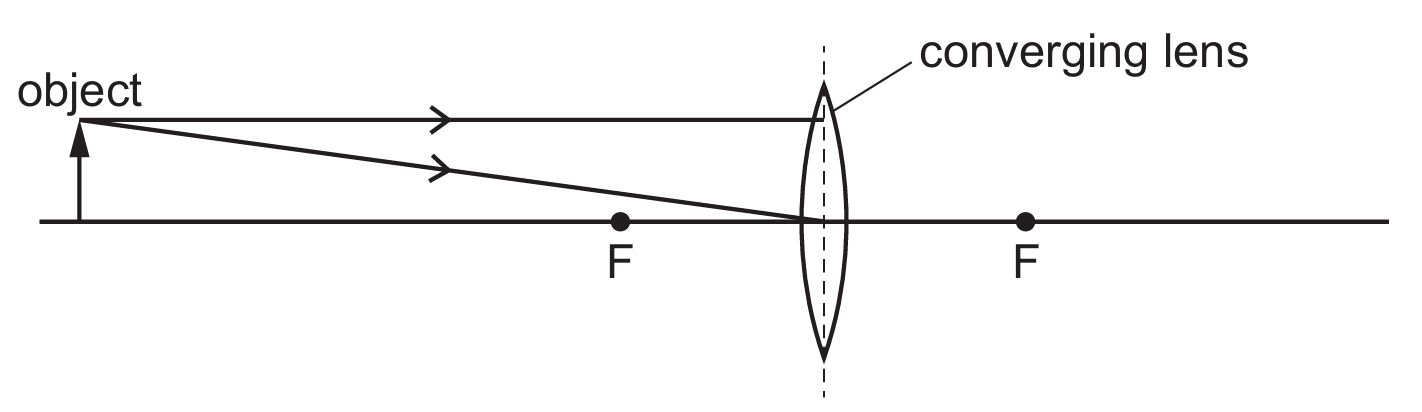
When an object is placed further than \(2F\) from a converging lens, the rays converge to form a real image between \(F\) and \(2F\) on the other side.
This image is always smaller than the object (diminished) and inverted (upside down) compared with the object.
✅ Answer: (A)
This image is always smaller than the object (diminished) and inverted (upside down) compared with the object.
✅ Answer: (A)

▶️ Answer/Explanation
The object in the diagram is placed well beyond twice the focal length of the converging lens.
When an object is placed beyond 2F, the resulting real image forms closer to the lens, between F and 2F on the other side.
Such an image is always smaller than the object (diminished) and inverted (upside down) relative to the object.
✅ Answer: (A)
When an object is placed beyond 2F, the resulting real image forms closer to the lens, between F and 2F on the other side.
Such an image is always smaller than the object (diminished) and inverted (upside down) relative to the object.
✅ Answer: (A)

▶️ Answer/Explanation
A converging lens forms a real, inverted, enlarged image only when the object is placed between one and two focal lengths from the lens.
If the object is beyond two focal lengths, the image is diminished; inside one focal length, the image becomes virtual and upright.
The labelled point that lies between the principal focus F and twice the focal length from the lens is therefore the correct position.
✅ Answer: (B)
If the object is beyond two focal lengths, the image is diminished; inside one focal length, the image becomes virtual and upright.
The labelled point that lies between the principal focus F and twice the focal length from the lens is therefore the correct position.
✅ Answer: (B)