
▶️ Answer/Explanation
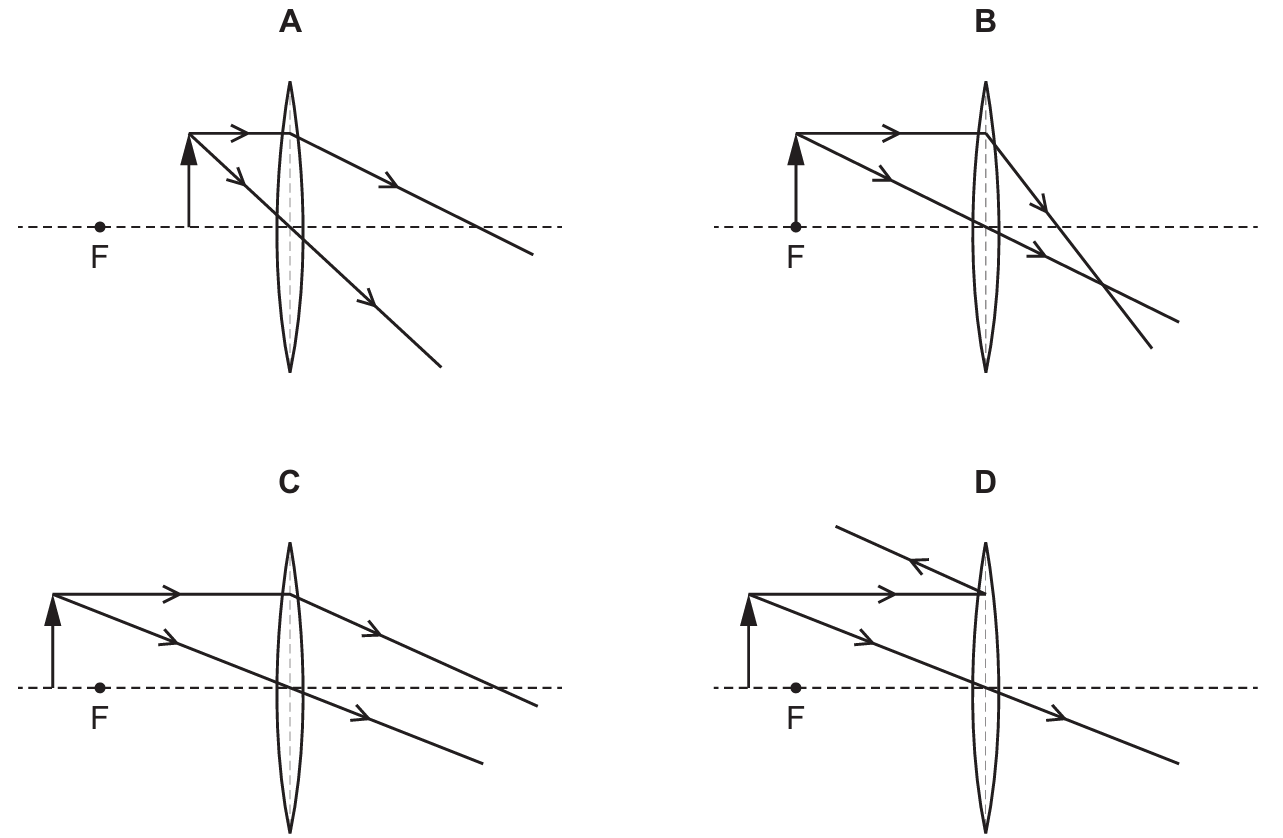
A magnifying glass is formed when the object is placed between the lens and its principal focus. The image formed is virtual, upright, and magnified.
✅ Answer: (A)
✅ Answer: (A)
▶️ Answer/Explanation
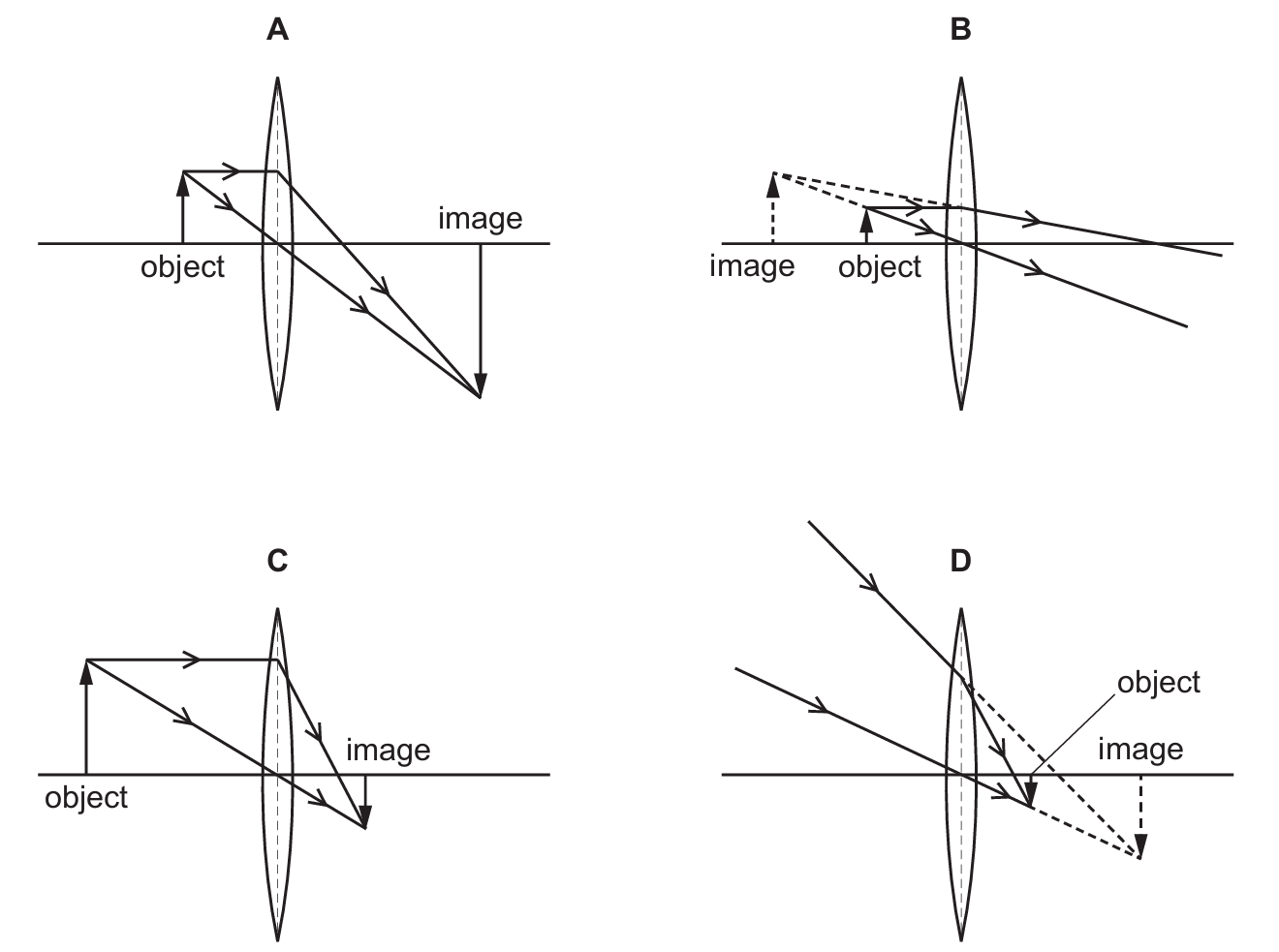
A virtual image is formed when the refracted rays diverge and appear to come from a point behind the lens. This is shown by dotted (dashed) lines extending backwards from the refracted rays to meet at the virtual image position. Option B correctly shows this with the image formed on the same side as the object using dotted lines. Options A, C, and D show real images (formed on the opposite side of the lens) where the rays actually converge.
✅ Answer: (B)
✅ Answer: (B)

▶️ Answer/Explanation
At position P, between \( f \) and \( 2f \), a converging lens forms a real, enlarged image.
When the object moves to position Q, inside the focal length \( f \), the lens can no longer converge the rays to a real point, so a virtual image forms instead.
A virtual image formed by a converging lens with the object inside the focal length is always magnified, so the image remains enlarged throughout.
✅ Answer: (D)
When the object moves to position Q, inside the focal length \( f \), the lens can no longer converge the rays to a real point, so a virtual image forms instead.
A virtual image formed by a converging lens with the object inside the focal length is always magnified, so the image remains enlarged throughout.
✅ Answer: (D)
▶️ Answer/Explanation
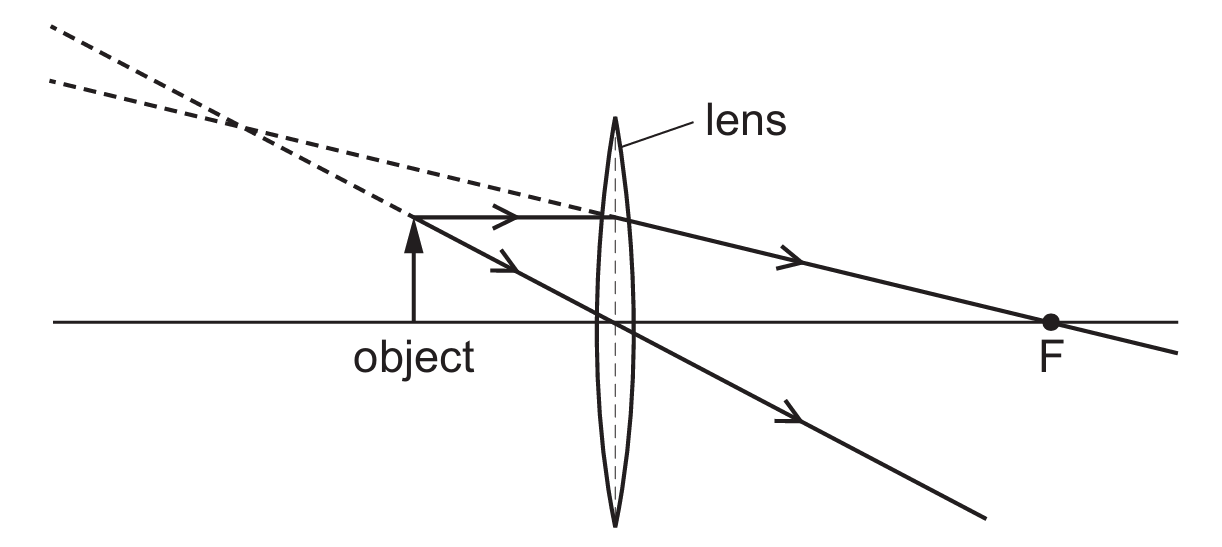
With the object placed close to the lens between the principal focus F and the lens itself, the rays diverge after passing through and don’t actually converge on the far side.
This means the image formed is virtual, since it can’t be projected onto a screen.
An object placed inside the focal length of a converging lens always produces an image that is enlarged and upright compared to the object.
✅ Answer: (B)
This means the image formed is virtual, since it can’t be projected onto a screen.
An object placed inside the focal length of a converging lens always produces an image that is enlarged and upright compared to the object.
✅ Answer: (B)